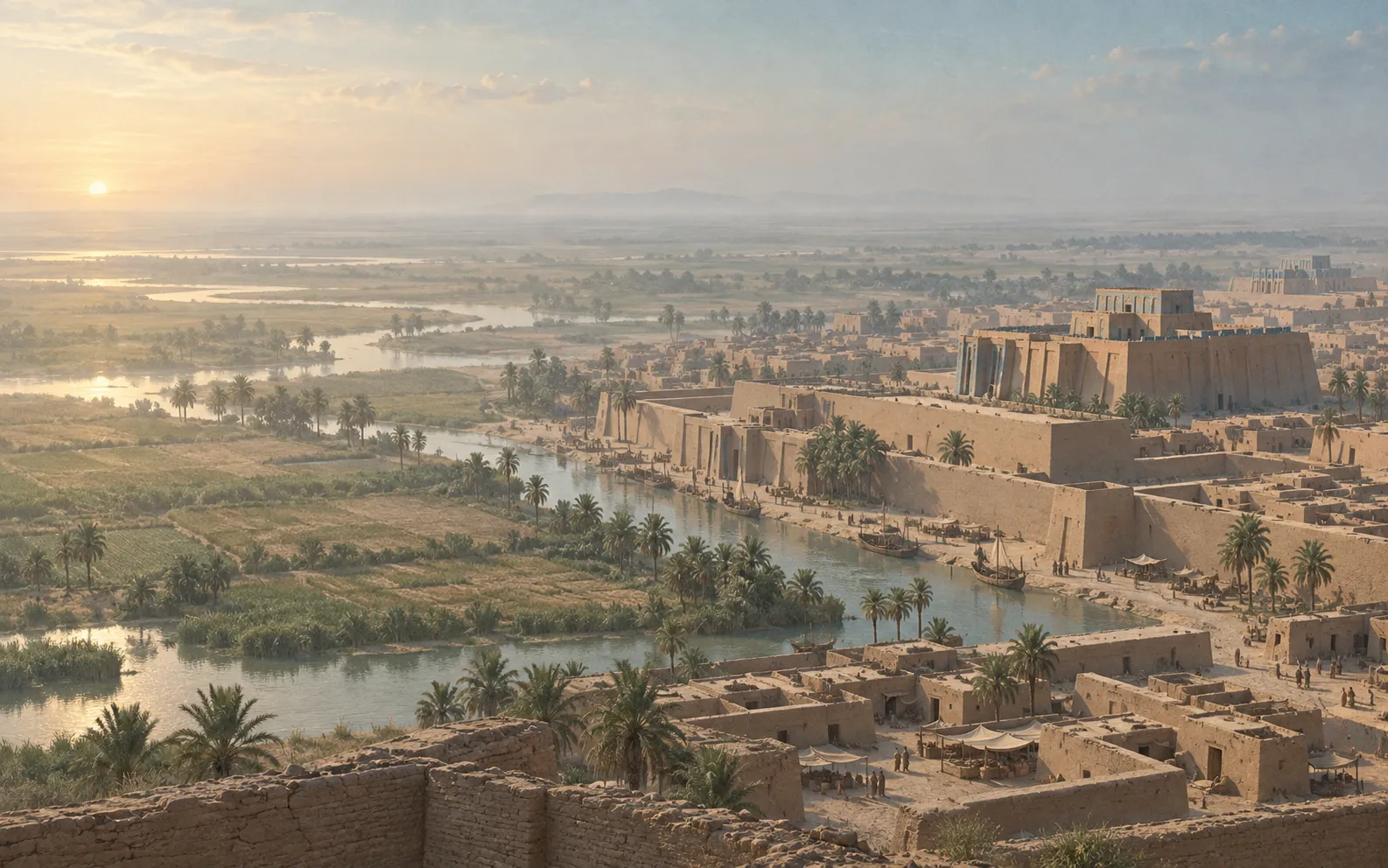
01 / A NEW SCALE OF LIFE
A city begins with a very ordinary problem.
Someone has to make sure everyone eats.
A building needs another day of work. The people building it need another day of food. Who makes sure both happen? Picture a group spending weeks on a building project. While they work, someone else must grow food, bring it in and decide how it reaches them. This is a thought experiment, but the problem is real: a city needs more than people living close together.
By around 3200 BCE, Uruk had become a major urban centre. Its monumental buildings show what people could achieve together. Less spectacular traces point to the work of organising supplies and labour.1
Think of a city as a set of promises. Someone will deliver. Someone will make. Someone will distribute. The more people rely on those promises, the more a missed delivery can affect people who never met the person responsible.
This is a way into the story, not a claim that we can recover every conversation in ancient Uruk. Buildings and objects survive. Most of the agreements that made everyday life possible do not.
The useful question is not simply “How big was it?” It is “How did so many different activities fit together?”
TERMS TO KEEP
Three words will keep appearing.
Mesopotamia
The land between the Tigris and Euphrates. Uruk stood in its southern part, in present-day Iraq.
Proto-cuneiform
Early picture-based writing used to record goods, quantities and administrative activity.
Temple institution
A large organisation that could manage land, labour, storage and distribution. It is an interpretation, not a label that explains everything.
02 / THE FOOD PROBLEM
More hands. More coordination.
Imagine you are responsible for feeding the building group. You could ask everyone to bring their own supplies. You could arrange a rota. Or you could gather food in one place and distribute it from there.
Now let the project run for a month. One household has less to spare. Another sends extra. A worker falls ill. Does the original arrangement still work? The interesting part is what happens when an agreement meets an awkward day.
Each approach changes who carries the burden. Each also raises a different question about trust. Try the three routes below before reading on.
Make a choice
Who will feed the workers?
A group is building a large communal building. The work will take several weeks, and everyone needs food each day. How would you organize the supply?
A thought experiment, not a reconstruction of a specific decision in Uruk.
Explore three approaches. There is no single right answer.
Bring food from home
- Benefit
- Households keep control of their supplies, and the group has no shared store to manage.
- Trade-off
- A household with few supplies may struggle to support a worker. Illness or a poor harvest could interrupt that person's participation.
- Who decides
- Households decide what they can provide. Their resources affect who can join the work; the group must agree how to help anyone who runs short.
Choose another approach to compare.
What do we know about Uruk?
Early clay tablets in Uruk recorded goods and workers' rations. They provide evidence of administration around food and labor. Our scenario explores the practical questions such arrangements can raise.
Whichever path you chose, notice what happened: solving the food problem created another task. Someone had to coordinate people, remember a contribution or account for a shared reserve.
That does not make central storage the inevitable winner. It helps us see why a practical arrangement can become a lasting responsibility—and why that responsibility deserves scrutiny.
PLACE & TIME
Uruk in its wider world
Explore Uruk’s location, then zoom out to put the city in a wider geographical context.
Uruk
Southern Mesopotamia · Present-day Iraq
c. 3500–3000 BCE
Period covered in this article
JavaScript is required for the interactive atlas.
Beyond the city
Think back to the food problem: what might the workers need from beyond Uruk?
03 / WHEN MEMORY NEEDS HELP
Before the great stories, there were records.
Writing makes us think of books, poems and letters. Some of the earliest written records from southern Mesopotamia have a more practical concern: keeping track of economic activity.2
A record lets information outlast a conversation. Someone can return to it later. Someone else can check it. That sounds ordinary to us, which is precisely why it is worth stopping to notice.
Imagine trying to resolve a disagreement a week after a delivery. One person remembers a full share; another remembers a shortage. A record gives them something outside their own memories to consult. It does not automatically tell us whether the arrangement was fair.
Look again at the object from the opening. This time, move from its overall appearance to individual traces. What is visible, and what needs an interpretation?
EXPLORE THE ARTIFACT
A piece of clay. Three traces.
Choose a detail to explore how numbers, signs and a seal impression share the same piece of clay.
04 / WHERE POWER ENTERS
Organisation creates possibilities. And dependencies.
In our thought experiment, the person managing a storehouse learns who contributes, what remains and where shortages are likely. That knowledge could help the group. It could also give the organiser influence.
There are two different questions here. How does a system help people cooperate? And what happens when they cannot easily challenge the people managing it? A system can be useful and still create unequal relationships.
To investigate the second question historically, we would need more than the existence of record-keeping. We would want evidence about decisions, obligations and the people affected by them. A neat explanation should not hide the gaps in what survives.
But a possibility is not proof. We cannot look at one tablet and assume that a single institution controlled every part of life. Try separating what the object shows from what we might be tempted to conclude.
TEST THE EVIDENCE
Does the evidence support the claim?
Look at the claim beside the tablet. Separate what the source shows, what it suggests and what it cannot prove.
CLAIM TO TEST
This tablet proves that one temple controlled all food distribution in Uruk.
Written for this exercise.
- SHOWS
- Round impressions, other marks and a seal impression on clay.
- SUGGESTS
- The Met interprets the tablet as probably recording grain distributed by a large temple.
- CANNOT PROVE
- This record alone cannot establish that one temple controlled food distribution throughout Uruk. That would require evidence from other records and places across the city.
A better-supported statement
This tablet points to temple involvement in grain distribution.
Object & interpretation: The Met · 1988.433.1 · Image: The Met / Public Domain
05 / WHAT STAYS WITH US
The distance is ancient. The questions feel familiar.
Who does the work? Who keeps the records? Who gets to decide? These questions connect our thought experiment to the evidence without turning Uruk into a modern city in ancient clothes.
It also changes the way we look at an ordinary record. A mark on clay may seem less impressive than a monumental building. Yet a record can make a commitment last, allow someone to check a quantity and give another person a reason to ask a question.
The people behind those marks remain harder to reach. A record of a distribution cannot tell us, by itself, whether its recipients felt secure, frustrated or fairly treated. Leaving room for that uncertainty is part of taking their lives seriously.
Uruk was not a finished blueprint for every city that followed. It offers something more interesting: a chance to examine how people organised shared life, and how difficult it can be to recover their choices from what survives.
TAKE THIS WITH YOU
A city is a web of dependencies.
The buildings are the visible part. Feeding people, coordinating work and keeping records connect the city behind them. Following those arrangements helps us ask how everyday cooperation could become a source of influence.
Daily Life needs coordination.
Food and labour have to come together before a large building project can keep going.
Organisation creates influence.
Arrangements for collecting, storing and distributing supplies raise questions about who makes decisions.
Records reveal relationships.
A tablet can help us trace those arrangements, even when the people involved remain out of view.
KEEP EXPLORING
One tablet opens a much bigger world.
If Uruk left you with more questions, these are three useful next steps.
The Ancient Near East: A Very Short Introduction
A compact entry point for the landscapes, cities and societies behind this story.
Explore the book ↗The Ancient Mesopotamian City
A focused next step if you want to stay with the question of how cities worked.
Explore the book ↗A History of the Ancient Near East
A fuller historical overview for readers ready to follow the region across millennia.
Explore the book ↗Some links may be affiliate links. They support Before Now at no extra cost.
FOLLOW THE EVIDENCE
Sources & image credits
- The Met · Uruk: The First City
Background on Uruk, monumental buildings and early administration.
- The Met · Administrative tablet, 1988.433.1
Object date, probable origin, interpretation and public-domain images.
The supply scenario is a thought experiment. The tablet’s precise reading and its probable origin require caution; dates are approximate.
FOLLOW THE TRAIL