
A ceramic fragment can connect an East African town to a workshop thousands of kilometres away. Glaze, fabric and shape may identify a family of wares made in China or elsewhere in Asia. The findspot establishes that an object reached the Swahili coast. Between those two observations lies a history of manufacture, movement, ownership and use that is often harder to recover than the distance itself.
That gap is where the object becomes interesting. An imported bowl was not merely evidence that trade happened. It was something selected, handled and given a place in a coastal society. Its users could value its appearance, durability, associations or practical qualities. To understand Chinese ceramics on the Swahili coast, follow three different questions: where was an object made, how did it travel, and what did it become after arrival? 1
PLACE & TIME
Place the evidence
Swahili coast
East Africa · links to Asia
c. 1100–1500 CE
Orientation
Begin with the fragment, not the map
Archaeologists usually encounter broken ceramics rather than complete vessels arranged as their owners left them. A rim, base or decorated sherd preserves some features and loses others. A fragment might be sufficient to identify a broad ware, while leaving the vessel’s full form uncertain. Classification can be strong without being exact. “Chinese ceramic” is a starting category whose confidence and precision need to be stated.
Glaze colour alone is rarely enough. Similar appearances can result from different workshops, techniques or production regions. Shape, clay fabric, decoration and comparison with well-dated examples contribute to identification. Specialists can refine attributions as reference collections and knowledge of kiln production improve. A changing classification does not necessarily mean the original excavation was worthless; it can reflect a more discriminating question about the same surviving material. 1
TERMS
Words that change the question
Sherd
A ceramic fragment, whose count does not automatically equal a count of vessels.
Ware
A category based on material and technical or stylistic characteristics.
Context
The recorded archaeological setting and associations of a find.
The phrase “Chinese-style” introduces another distinction. Some wares resembling Chinese products were made elsewhere in Asia. Treating the entire group as literally manufactured in China would turn visual influence into geographical certainty. Bing Zhao’s study of material from Sanje ya Kati and Songo Mnara explicitly considers Chinese-style ceramics within a wider field of production and exchange. The category needs interpretation, not automatic conversion into a single origin. 1
This matters for the story we tell about the ocean. If objects from several production regions circulated together, the network was more complicated than one exporter supplying passive customers. Demand, imitation and access could link several workshops and markets. Similarity among objects then becomes evidence for relationships between producers and consumers, rather than proof that every vessel followed the same journey.
- Check material and form alongside visual resemblance.
- Distinguish a production attribution from stylistic influence.
- State how precise the classification can be.
A date of manufacture is not a date of arrival
A ceramic type may have a known production range. That range helps establish when an object could have been made, but it does not necessarily date its first use on the coast. Objects could remain in circulation, be kept, transferred or reused. A vessel made in one century might enter a later archaeological deposit. Its biography need not fit neatly inside the date assigned to its manufacture.
Excavation context therefore matters as much as typology. A fragment recovered from a securely dated occupation layer has a different evidential role from one collected on the surface. A fill deposit could include material moved from an earlier setting. A disturbed area may combine several phases. Dating is strongest when several observations converge instead of allowing one attractive imported sherd to determine the entire history of a structure.
- Manufacturing dates constrain when a vessel could have begun its life.
- Context dates constrain the archaeological setting in which a fragment was deposited.
- Neither automatically identifies the day, year or route of its arrival.
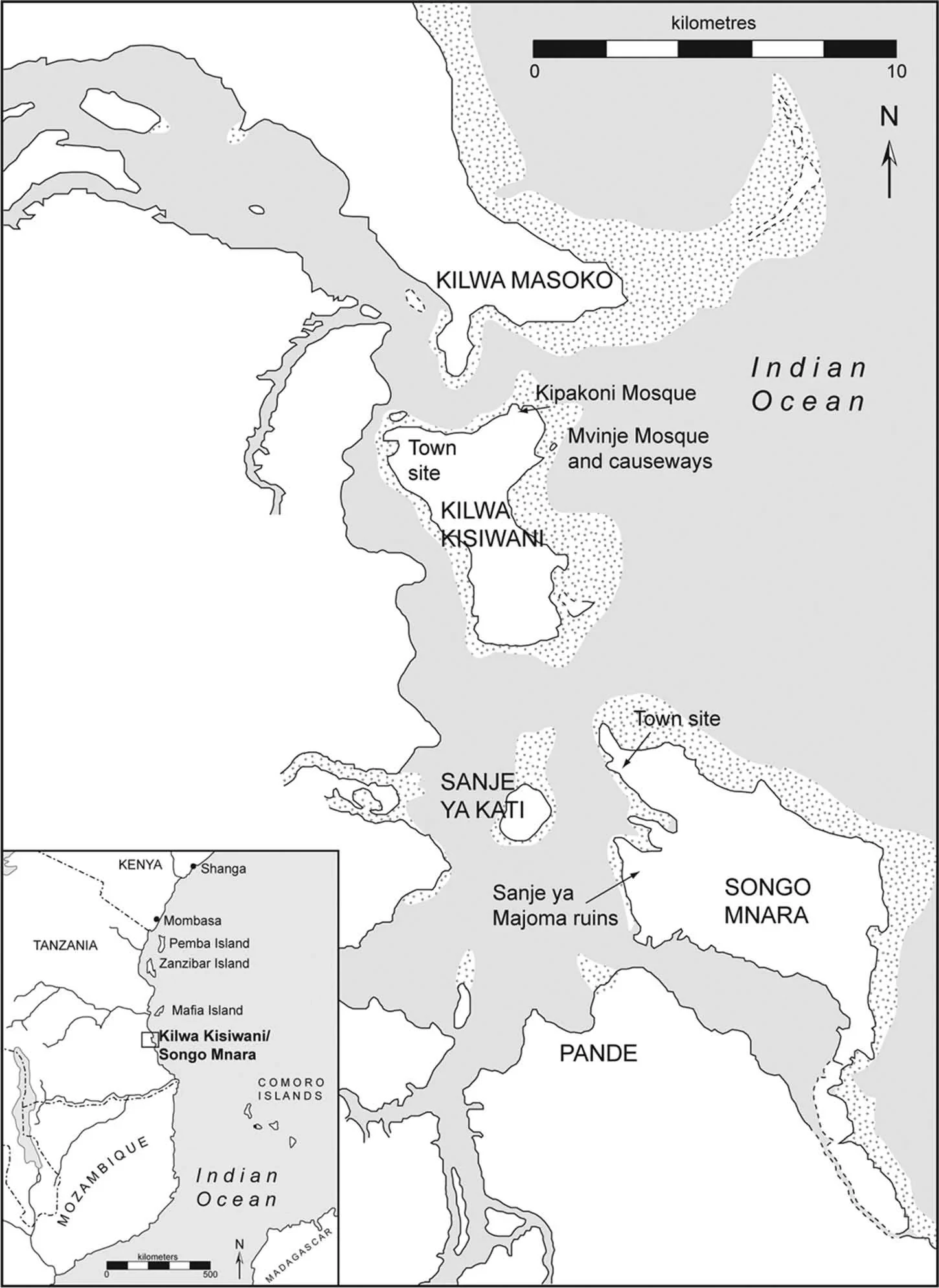
The distinction becomes especially important when comparing sites. Sanje ya Kati and Songo Mnara belong to different chronological contexts. Combining their imports into one timeless inventory would erase changes in supply and consumption. The coast’s participation in exchange persisted, but the objects available and the communities using them changed. A centuries-long trading history is not one continuous scene with the same goods on every table. 1
A long distance can contain several short journeys
A vessel made in China and found in East Africa establishes movement across a substantial geographical separation. It does not show that a Chinese ship carried it directly to the final port. Goods could move through South or Southeast Asian markets, change hands and continue in another vessel. Merchants specializing in different segments could collectively connect places they never visited personally.
This is one reason archaeological distribution can exceed the reach of an individual traveller. An object could go farther than any one owner. A route drawn between manufacture and discovery is therefore a hypothesis about connection, not an eyewitness account. We need written records, cargo evidence or additional archaeological patterns before specifying every intermediate port or participant.
FOLLOW THE CONNECTION
An object’s possible chain
Workshop
Production evidence constrains origin and manufacturing period.
Exchange
Successive transactions may connect several markets.
Coastal use
Context helps reveal consumption or adaptation at the destination.
Deposition
Breakage, disposal or reuse creates the archaeological setting.
That limitation does not weaken the basic historical finding. It changes its scale. Instead of proving one direct voyage, the object can support the existence of linked exchanges capable of carrying goods across the ocean. The question becomes how those connections operated and which alternatives were available. Several plausible routes may fit the same endpoints without being equally demonstrable from the fragment alone.
Nor does a ceramic prove the ethnicity of a trader or owner. Production location, transport personnel and consuming community are separate subjects. A Chinese-made bowl does not establish a Chinese resident in the house where it was used. The distinction is essential on the Swahili coast, where imported goods have too often been used to explain local urban life primarily through foreign presence.
Arrival began another history
Once at the destination, a vessel entered relationships that could differ from those surrounding its manufacture. It might be used in serving food, brought out for guests, displayed or eventually incorporated into another setting. These are possibilities that require evidence in each case. The general point is that an object’s local career can be as historically important as the journey that made it available.
Archaeologists investigate that career through associations and placement. Was imported material concentrated in certain buildings? Did it occur alongside local ceramics? Was it found in an area associated with eating, display, construction or disposal? Such questions allow consumption to become a topic in its own right. An imported object should not be treated only as a marker on a map of commercial reach. 12
KEY IDEA
Consumption was an act of selection
Local ceramics remained important. Their presence prevents an image of Swahili households supplied exclusively by prestigious overseas wares. Different vessels could serve different tasks, and imported material need not replace established practices to have social significance. The combination may tell us more than either category alone. It reveals how users assembled useful and meaningful sets of objects from what was available to them.
Prestige is also an interpretation, not a universal property sealed into a vessel at the kiln. An imported object could be desirable because it was rare, recognizable or associated with valued forms of hospitality. But a fragment’s foreign origin does not prove that every owner was wealthy. Access and meaning need to be investigated in their local distribution rather than assumed from distance travelled.
- Ask where imported and local vessels occur together.
- Test prestige through distribution rather than distance alone.
- Keep the owner’s identity separate from the object’s origin.
Architecture could give ceramics a public role
Imported ceramics are associated with architectural display at several Swahili sites, including the wider Kilwa landscape. Their use in buildings places them within a different field of visibility from a serving vessel in a household. A material originally made as a portable object could help distinguish a fixed structure. The relationship between trade and urban appearance could therefore be quite literal. 2
Interpreting such display requires attention to the specific building and phase. A ceramic set into a wall is evidence for an architectural use at that location. It does not identify the builder’s private motive or establish an unchanging custom across the whole coast. Later repair may also affect what we see. Public display can be demonstrated more readily than the complete social meaning its observers gave it.
COMPARE
Different settings, different claims
Action
Using, storing or discarding a vessel.
Incorporating ceramic material into a structure.
Question
Which activities and associations occur nearby?
What becomes visible, and in which building phase?
Limit
A fragment does not identify every user.
A display does not recover every observer’s interpretation.
Nevertheless, the change of setting is revealing. Incorporation into architecture could detach an object from its original practical function and place it within local claims about status, piety or connection. That is adaptation, not merely possession. It shows that coastal users could make foreign products participate in projects whose purposes were defined in East Africa.
The same principle helps avoid a misleading cultural balance sheet. An imported object does not subtract from the African character of a town. Material culture develops through selection and use, not through keeping every ingredient geographically pure. The stronger question concerns what users did with available things, and how that activity related to their institutions and communities.
- Identify the building and construction phase.
- Separate visible placement from an inferred motive.
- Treat reuse as part of the object’s local history.
Survival can distort the proportions
Ceramics survive unusually well compared with many other traded materials. Textiles, foodstuffs, timber and other organic goods may deteriorate or leave evidence that is harder to recognize. A ceramic-rich assemblage can therefore make pottery appear disproportionately central to exchange. The archaeological record is not a preserved invoice in which the quantity surviving corresponds directly to the original value traded.
Even within ceramics, fragmentation affects counting. Ten sherds need not represent ten vessels, and one large vessel can generate many fragments. Methods based on fragment numbers, weight or estimates of minimum vessel numbers answer different questions. Comparisons need consistent methods and awareness of excavation coverage. A dramatic total can conceal those basic differences if it is presented without explanation.
- Durable objects are more likely to remain visible than many organic goods.
- Fragment counts and vessel counts measure different things.
- The excavated area is a sample of a site, not necessarily the entire settlement.
The same caution applies to absence. Not finding a ware in one excavation does not prove that nobody at the site ever owned it. Yet absence need not be dismissed automatically: it can become meaningful when excavation is extensive, methods are appropriate and comparable contexts produce different patterns. Historical reasoning weighs how likely the evidence was to survive and be recovered before turning a missing object into a conclusion.

A museum bowl is a comparison, not a coastal find
A complete celadon bowl in the Metropolitan Museum of Art can help you see qualities that a sherd preserves only partly. The museum identifies the chosen example as a fourteenth-century Chinese stoneware vessel associated with Longquan production. Its glaze and form provide visual orientation. Its museum record does not identify it as excavated at Kilwa or another Swahili town, and it must not be labelled as such. 3
That distinction protects the article’s argument. A comparative object illustrates a material or type; an excavated object supports a claim about a particular archaeological context. Both are useful, but they do different work. A caption that merely says “Chinese bowl found on the Swahili coast” would manufacture a provenance and make the image appear to prove a statement it cannot support.
READ THE OBJECT
A comparison with a declared provenance
Observe the surface
Glaze and decoration help orient the eye, but specialist classification uses more than a photograph.
Read the record
The Met identifies a Chinese Longquan bowl of the fourteenth century.
Keep the comparison bounded
This specimen illustrates material qualities; it does not prove a find context in East Africa.
Longquan celadon bowl, China, fourteenth century, Met accession 18.57.8. Comparative specimen: the museum record does not identify it as a Swahili-coast excavation find.
You can apply the same test to any photograph accompanying an article about trade. Does it show the actual find under discussion, a comparable specimen or a modern reconstruction? Where does its information come from? An accurate caption need not be long. Naming the object’s role allows an engaging image to inform the argument without silently becoming false evidence.
The surface of the museum bowl also reminds us that images provide partial access. Light, angle and photography affect the appearance of glaze. A specialist attribution depends on examination and comparison beyond what an online picture supplies. Looking closely is worthwhile, but it should lead towards the museum record and the research rather than replace them.
- Read the collection record before assigning a provenance.
- Name whether an image shows a find or a comparison.
- Use close looking to generate questions for research.
What one object can securely connect
The strongest conclusions combine production knowledge with local context. A securely identified imported ware in an appropriate coastal deposit demonstrates a material connection. Repeated patterns across dated contexts can reveal changes in access and consumption. Architectural use or domestic association can support a more specific interpretation. Each additional step requires additional evidence; distance alone does not supply it.
These distinctions also keep human agency visible. Producers made vessels for markets, merchants carried and transferred them, and coastal users selected and repurposed them. No one participant controlled the whole biography. The fragment is evidence for a chain of actions whose participants may remain unnamed. Anonymity should encourage care, not tempt us to fill the gaps with an invented merchant or household.

Chinese ceramics on the Swahili coast reveal an oceanic connection that became meaningful through local use. Their journey matters, but so does their destination. A bowl could cross several markets and still acquire a distinct role in an East African town. The best reading follows both movements: the movement through space and the movement between functions and values. A small fragment then becomes more than proof of contact. It becomes a disciplined way to ask how connected societies made things their own.