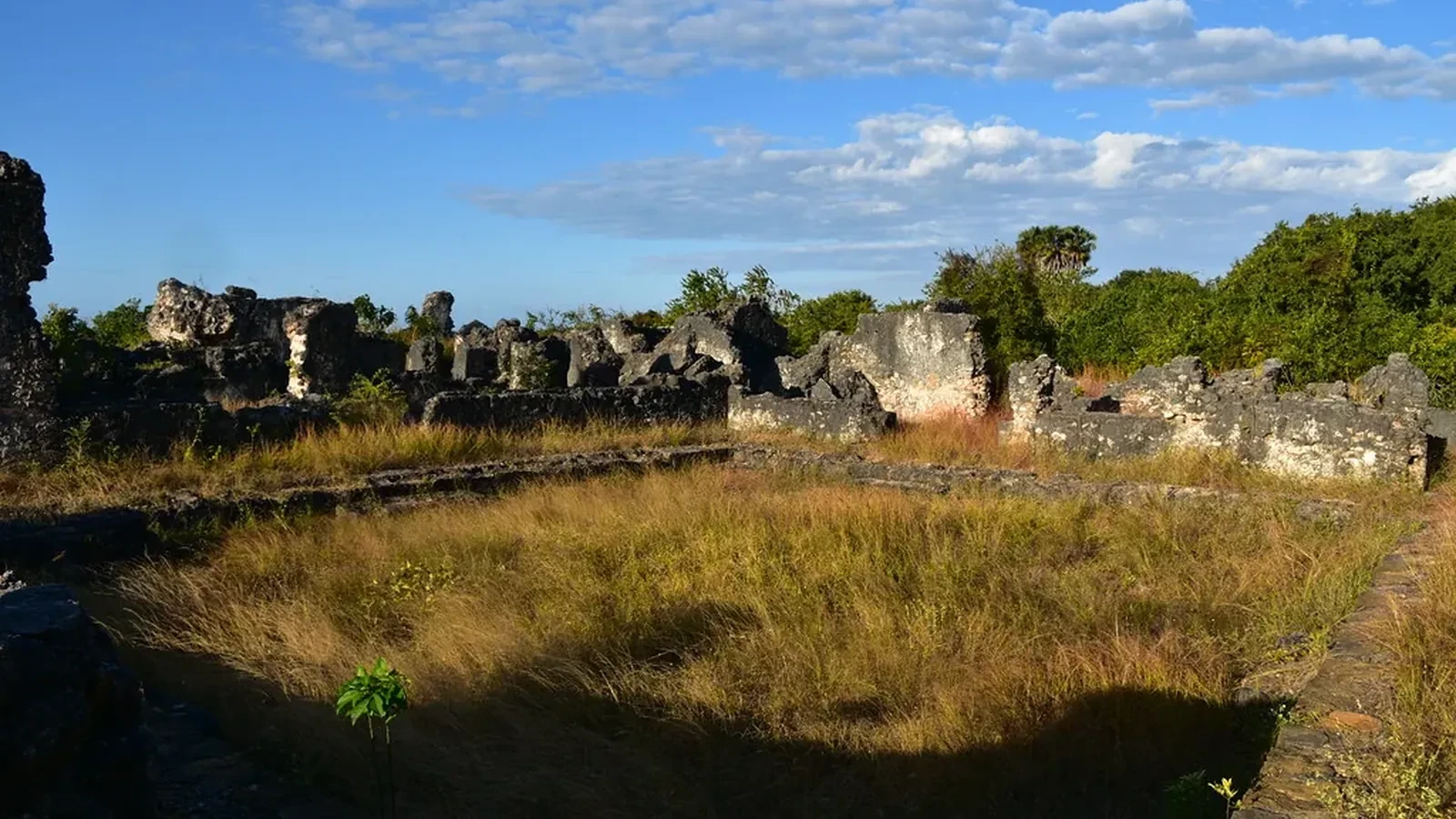
A ruined palace on an island off Tanzania can change the way you picture medieval trade. Kilwa Kisiwani was neither a remote endpoint waiting to be discovered nor a transplanted Asian city on African soil. Its inhabitants helped build a maritime society whose connections reached inland as well as overseas. The stone buildings make that history unusually visible, but their significance lies in the relationships that sustained them.
At Kilwa, Indian Ocean commerce met an African coast with its own languages, communities, resources and ambitions. Imported objects were valuable because people there wanted and used them. Rulers gained influence by negotiating access to exchange. Builders translated wealth into mosques, houses and monumental statements. To understand the city, begin with that local capacity to act, then follow the routes that made it consequential. 1
PLACE & TIME
Place the evidence
Kilwa Kisiwani
Tanzania · East Africa
c. 1000–1505 CE
Orientation
An island was an advantage, not an explanation
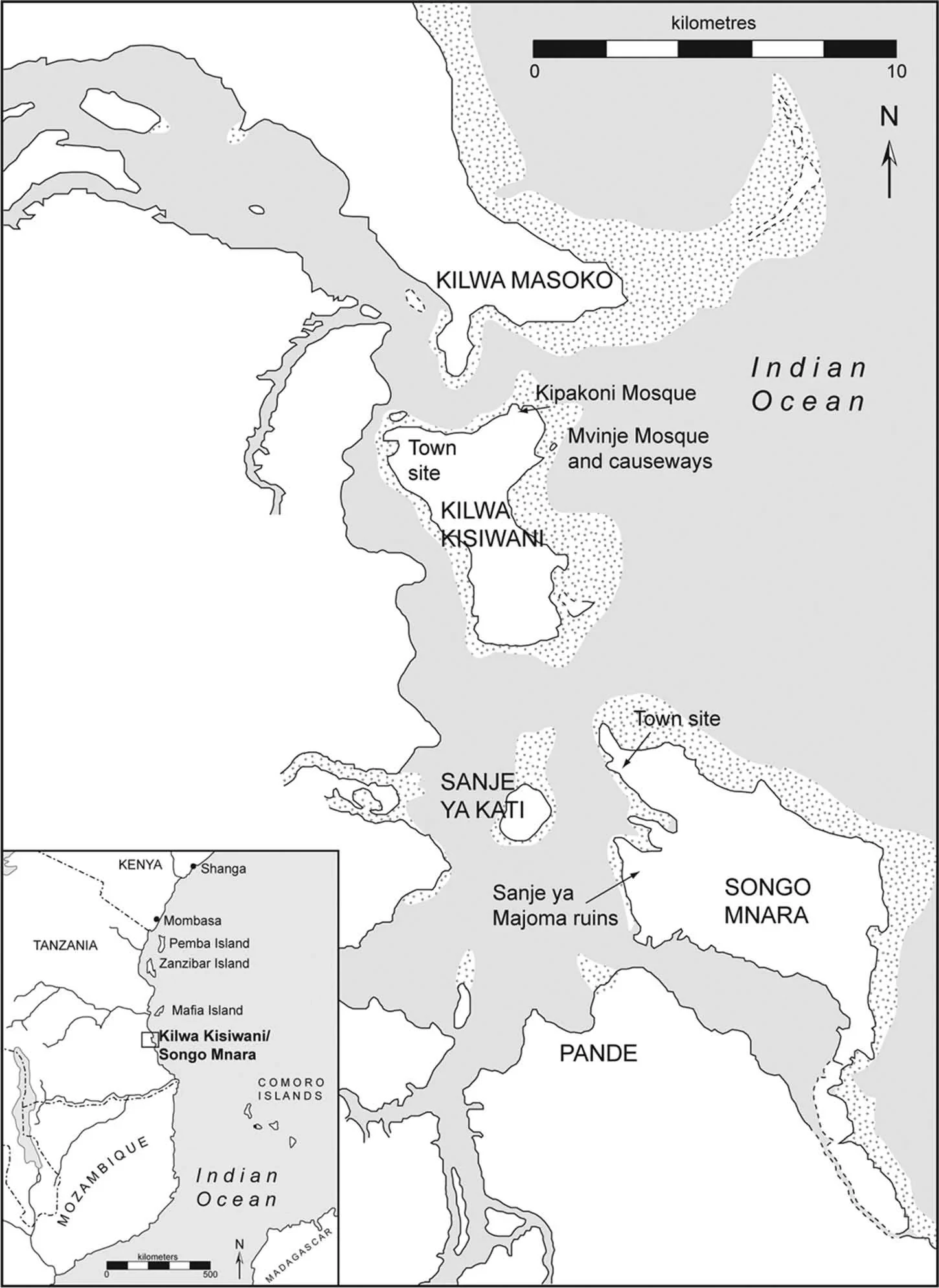
Kilwa Kisiwani stands near the coast of present-day southern Tanzania. An island position gave people access to marine resources and sheltered coastal movements while keeping connections to the mainland close. It did not automatically produce a successful trading city. Suitable landing places, supplies, political relationships and knowledge of surrounding waters still had to be maintained. Geography offered possibilities; inhabitants and their neighbours made those possibilities useful.
The wider coast was a changing collection of settlements rather than a single state. Kilwa’s history belongs within that world of Swahili communities, whose language is African in its structure and whose social life developed through centuries of interaction. Islam and overseas connections became important parts of coastal identities. Neither requires the conclusion that urban life arrived fully formed with outsiders. Local development and external participation can belong to the same explanation.
- An island could help organize maritime access, but ships still needed people who knew the approach.
- A coastal town needed food and materials from environments beyond its stone buildings.
- Long-distance exchange depended on connections that were shorter, more frequent and less spectacular.
Kilwa’s celebrated monuments chiefly draw attention to periods of considerable wealth, particularly the thirteenth and fourteenth centuries. They do not represent an unchanged town extending across every century of occupation. Walls were rebuilt, institutions changed and prosperity varied. Reading a ruin historically means asking which phase is visible and what happened before and after it. The island’s long occupation is a framework for change, not evidence of continuous dominance. 1
The hinterland belonged inside the maritime story
An account that begins with ships and ends with imported bowls misses half the network. Gold and ivory reaching the coast came through African relationships of production and movement. People who extracted, collected, transported and exchanged those materials were not merely supplying a stage on which foreign merchants performed. Their decisions, labour and political circumstances helped determine what a port could offer and on what terms.
Gold associated with the interior of southeastern Africa moved through routes involving places such as Sofala. Kilwa’s importance included connections with that coastal trade. It is misleading to collapse the whole chain into an image of the city directly controlling every mine or inland producer. Influence over exchange could be substantial without being a continuous territorial empire. Different participants controlled different stretches, and the resulting dependence ran in several directions. 1
FOLLOW THE CONNECTION
From an inland resource to an overseas cargo
Production
People obtained resources within African landscapes and political relationships.
Coastal movement
Transport and successive exchanges brought materials within a port’s reach.
Negotiation
Participants assessed goods and agreed conditions; the ruler was not the only actor.
Onward movement
Ships carried a cargo into another set of markets and uses.
The distinction matters because an oceanic network was also a chain of local negotiations. A merchant arriving by sea could not simply collect an abstract African commodity. Someone had to bring it within reach, establish its quality, agree a transaction and arrange its onward movement. Those steps create room for African expertise and authority even when the surviving written account concentrates on the visiting merchant or the ruler at the port.
They also reveal a limitation in the word “wealth.” The value of exported goods could support impressive buildings without giving everyone involved an equal share. People transporting materials, producing food or working in households could experience the commercial city very differently from people directing transactions. The palace is evidence of the ability to concentrate resources. It is not a census of how comfortably the surrounding population lived.
- Trace production and transport before measuring a port’s wealth.
- Separate commercial influence from direct control of every supplier.
- Ask who performed the work and who received its rewards.
Stone made relationships visible
Kilwa’s Great Mosque and the palace complex known as Husuni Kubwa make commercial success tangible. The mosque developed through several phases; its surviving fabric cannot be assigned to a single founding moment. Husuni Kubwa, associated with the early fourteenth century, used a scale and architectural ambition that exceeded an ordinary dwelling. Together they show how religious and political institutions could turn resources into durable claims on place. 1
Coral limestone was a coastal building material, not an imported city in miniature. Quarrying, preparing mortar, carrying stone and coordinating construction required local knowledge and labour. Architectural connections across the ocean can therefore coexist with a strongly local material practice. Similarity is a question about exchange and adaptation, not a shortcut to declaring that one society copied another without choices of its own.
KEY IDEA
Resources became claims on place
A mosque also needs to be understood as a setting for repeated activity. Prayer, gathering and recognition among worshippers helped produce a community that could include visitors while retaining local distinctions. Religious affiliation could make encounters easier by providing familiar practices and expectations. It did not remove differences in language, status, wealth or political allegiance. A shared religious framework supported connections without making the port socially uniform.
Nor should the palace and mosque be made to speak for every building. Earth-built dwellings leave a different archaeological record from monumental stone architecture. The tendency to celebrate what survives most prominently can produce a city populated only by rulers, merchants and religious leaders. A fuller history asks who maintained those places, who supplied their occupants and which activities occurred beyond the most photogenic remains.
An ocean arrived as particular objects
Chinese ceramics and other imported materials offer strong evidence that Kilwa participated in wide exchange. Yet the distance between a kiln and an African findspot does not reveal the exact journey of a vessel. A bowl could pass through several hands and ports. Its final owner might never have met a Chinese person, and the ship that delivered it to East Africa might have begun the voyage somewhere much nearer. 2
That is not a disappointing qualification. It explains what made a network a network. Long-distance connection could emerge from overlapping voyages rather than a single direct crossing. Goods acquired new values as they moved, and their meaning at Kilwa depended on local use. Serving food, displaying an object or placing material within architecture were different actions. An imported thing’s origin was only one part of its history.
- Production evidence asks where and approximately when an object was made.
- Distribution evidence asks how it could have moved between places.
- Consumption evidence asks what people at the destination did with it.
These questions require different kinds of support. A ceramic fragment may be classified by fabric, glaze and form, while its excavation context helps establish its local history. A celebrated collection without precise find information can show that a type reached the region but say much less about one household. The chapter on Chinese ceramics will return to that distinction rather than treating every sherd as a complete travel itinerary.
Coins connect authority with ordinary exchange
Coins attributed to Kilwa’s rulers add another kind of evidence. Naming authority on an object that could circulate created a relationship between a political claim and material transactions. That does not mean every exchange used coins, or that a coin’s value stayed identical in every setting. Objects can move between economic, social and ritual uses; their meaning depends partly on where they are found. 3
Archaeological work at nearby Songo Mnara shows why context matters. Coins were recovered in settings that invite questions beyond a simple model of buying and selling. Their distribution can illuminate relationships within houses and public spaces, but interpretation requires caution. A scattered coin and a deliberate deposit are not equivalent traces. The existence of a local currency should sharpen questions about the coastal economy, rather than settle them in advance.
COMPARE
Two material claims
Visibility
Fixed and prominent in a particular landscape.
Portable and able to move between settings.
Authority
Construction can concentrate labour and resources.
Naming a ruler can associate an object with political claims.
Limit
A monument does not describe every resident.
A coin’s meaning is not always confined to payment.
Political authority also depended on circumstances beyond coinage. A ruler could benefit from customs, diplomatic relationships or access to imported goods, yet still depend on residents, visitors and allies. Treating the city as one ruler’s possession erases those negotiations. Treating it as an unrestricted marketplace erases power. Kilwa is most intelligible when commerce and authority are examined together without assuming they were perfectly aligned.
Ibn Battuta saw a city through a particular lens
Ibn Battuta’s account of his visit in the early fourteenth century brings a person’s description into this material landscape. He praised aspects of Kilwa and presented its ruler through the religious and social concerns of a Muslim traveller. The account is valuable precisely because it records what interested a particular observer. It is not a complete report on all residents or a neutral inventory of urban life. 4
The travel narrative was assembled later, with the writer Ibn Juzayy, after journeys extending across many regions. Memory, literary convention and the purposes of the finished work affected its form. For Kilwa, the strongest reading places the account alongside archaeology and asks where their subjects overlap. A traveller’s admiration for a ruler and a palace’s substantial remains can inform the same discussion without proving every detail of each other.
EVIDENCE CHECK
Test the claim
Question
A visitor praised Kilwa; did that describe everyone?
The traveller’s evaluation records the concerns and access of a particular observer.
Evidence
A description of a ruler and religious life.
A Muslim visitor could find valued forms of hospitality.
Boundary
It cannot establish every resident’s wealth or wellbeing.
Read the source record: UC Berkeley ORIAS: Red Sea, East Africa and Arabian Sea
The traveller’s access also mattered. Hospitality could bring him into contact with people who had resources and connections. Those encounters might make the city appear especially generous or pious while leaving labour, conflict and less privileged households outside the narrative. Silence about an activity is therefore not evidence that it did not exist. The question is whether this author had reasons or opportunities to describe it.
That approach leaves room for confidence. Kilwa’s maritime connections are supported by more than one kind of evidence. The uncertainties concern particular routes, individual lives and changing degrees of influence. We do not need to choose between accepting every attractive story and knowing nothing. Historical explanation becomes stronger when it distinguishes a secure connection from a more speculative account of how that connection worked.
A city had neighbours and successors
Songo Mnara, close to Kilwa, provides an especially useful neighbouring case. Its relatively short period of occupation, mainly from the late fourteenth into the early sixteenth century, allows archaeologists to study a bounded urban landscape. It was part of the same coastal world, but its houses, open spaces and patterns of activity should not simply be substituted for evidence about Kilwa itself. Proximity supports comparison; it does not establish identical daily life. 3
The relationship also resists a common error in writing about trade. One famous port can become a symbol that absorbs every neighbouring settlement. Smaller places then appear only as satellites. Yet people could participate in several kinds of connection at once: a town’s religious life, an agricultural landscape, coastal exchange and overseas commerce. Those overlapping attachments are more revealing than assigning everyone one position beneath a dominant city.
- Ask what a neighbouring site can independently demonstrate.
- Compare its dates before combining its evidence with Kilwa’s monuments.
- Keep differences in scale, occupation and excavation coverage visible.
The early sixteenth century brought Portuguese intervention, including a fort constructed at Kilwa in 1505. That event belongs to a longer history of regional relationships, political change and shifting trade. It should not be narrated as the moment an isolated city first entered global history. Portuguese forces encountered a place already connected, and their capacity to intervene depended partly on understanding and exploiting existing divisions. 5
What remains asks something of us
Today’s ruins are also the outcome of abandonment, weathering, excavation and conservation. The coastline and built fabric face environmental pressures. A modern photograph shows maintained remains in a present landscape; it cannot restore the full appearance or sounds of a medieval neighbourhood. Recognizing that difference does not make the place less evocative. It directs attention to the work needed to preserve evidence for future questions. 1
Kilwa’s greatest contribution to this story path is a change of viewpoint. Instead of imagining an ocean that carried history towards Africa, follow how an African city helped organize movement across it. Inland materials, local building traditions, Islamic institutions and imported objects meet in a place whose inhabitants had their own projects. The connections were real, but they were made useful locally, through decisions that no map of sea lanes can replace.

A good final question is therefore not merely “How far did Kilwa’s trade reach?” It is “What had to happen here for those distant connections to matter?” That question brings suppliers, builders, households, religious communities and political negotiations back into view. Across the following chapters, winds will set possibilities, ports will offer different arrangements, and travellers will describe only part of what they encounter. Kilwa provides the starting point: a connected ocean made from active places.