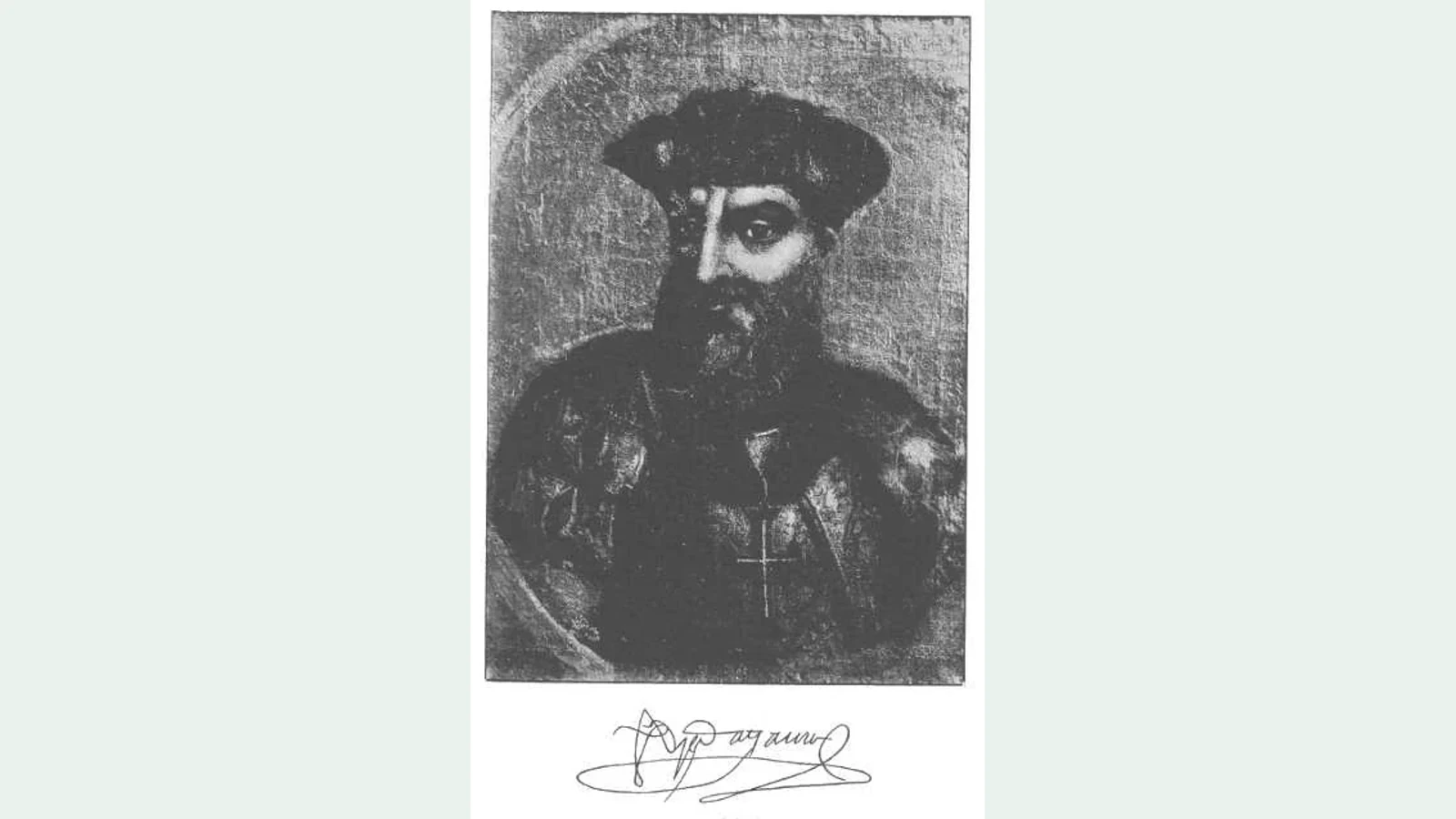
When Vasco da Gama reached Calicut in 1498, he entered a port with established trade, political authority and experienced intermediaries. His voyage opened a direct maritime connection from Portugal around Africa to India. It did not discover the Indian Ocean for the societies already moving through it. The difference is fundamental: a new route for one participant was an arrival within other people’s existing world.
Over the following years, Portuguese expeditions combined commerce with armed intervention, demands and alliances. Ships and forts helped project force at selected places. Violence caused profound harm, but ambition should not be confused with complete control. Between 1498 and 1510, the Portuguese encountered a network too extensive and politically varied to submit as one unit. Their expanding position depended on local knowledge and relationships as well as weapons. 1
PLACE & TIME
Place the evidence
Calicut · Kilwa · Goa
Western Indian Ocean
1498–1510 CE
Orientation
A route around Africa changed access
The voyage’s significance for Portugal lay partly in access to Asian goods without following the established routes through other commercial and political intermediaries. It was an attempt to alter who could participate, profit and exercise influence. Religious and royal ambitions accompanied commercial interests. Explaining one motive does not require excluding the others; expeditions could pursue several purposes whose practical consequences overlapped.
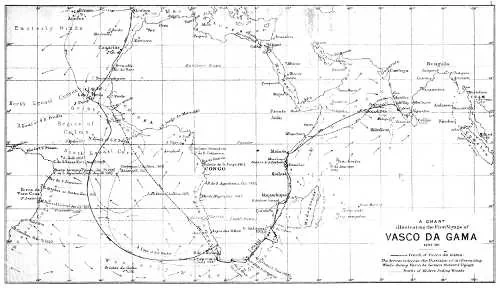
The first voyage also demonstrated dependence. At Malindi, the expedition obtained a pilot before crossing to India. Local assistance helped make a new European connection possible within waters already known to other mariners. The surviving journal records the pilot’s provision, while the often-repeated identification with Ahmad ibn Majid is not established by that evidence. Recognizing expertise matters more than attaching a famous but uncertain name. 2
TIME
A sequence with boundaries
- 1498
Calicut
Da Gama’s expedition enters an established port.
- 1500–1502
Escalation
Commercial demands become entangled with attacks and retaliation.
- 1505
Kilwa
Almeida’s forces construct a fort.
- 1509–1510
Diu and Goa
Naval victory and territorial conquest expand capacity, without universal control.
Selected interventions, not a complete conquest
This dependence does not make the Portuguese passive guests. It shows how entry into a network worked. Newcomers could acquire knowledge and use it for purposes that existing participants did not control. Cooperation in one encounter did not determine the political character of subsequent actions. Assistance and violence can belong to the same expanding project without becoming morally or historically equivalent.
The route also carried serious costs. Distance, illness, weather and loss of vessels affected expeditions before any commercial transaction succeeded. Those constraints are part of the explanation for Portuguese efforts to secure supply and strategic positions. They do not excuse coercion. They help identify the practical problems that an imperial project tried to solve, often by transferring costs and danger onto others.
- Separate obtaining expertise from exercising authority.
- Recognize the practical dependencies of a long expedition.
- Explain constraints without making them an excuse for violence.
Calicut had rules before the visitors arrived
The journal describes negotiations at Calicut through Portuguese expectations and misunderstandings. The gifts presented to the ruler were judged inadequate by officials, while intermediaries shaped communication. The account also misread Hindu practices through a Christian framework. A voyage could reach the right coastline while its participants remained deeply mistaken about the society they had encountered. 2
The episode is more informative than a simple story of rejection. Visitors were entering procedures concerning status, access and obligations. Their desire to buy spices did not entitle them to decide how the port should operate. Local authorities and merchants had interests of their own. Negotiation became difficult where Portuguese expectations did not fit those arrangements, and the surviving account gives only one side extended narrative authority.
- Arrival established contact, not automatic permission on the newcomers’ terms.
- A misunderstanding could concern rank or obligation as well as language.
- The expedition’s explanation of resistance does not fully recover local motives.
This is why “opening trade” needs care. Trade at Calicut was already open to a range of participants under existing conditions. The Portuguese wanted a place within it and, increasingly, a power to reshape it. A port that resisted their demands was not necessarily refusing all commerce. It could be defending particular arrangements against an intervention that threatened to change who controlled access.
Commercial demands became armed coercion
Subsequent expeditions brought a larger and more forceful effort to establish a position. Under Pedro Álvares Cabral in 1500, relations at Calicut deteriorated into lethal confrontation and Portuguese retaliation. Bombardment and attacks on shipping made force part of the commercial encounter. The precise sequence and allocation of blame need sources read in context, but the broader transition to coercive intervention is clear. 1
Da Gama’s return in 1502 intensified that pattern. Attacks included the burning of a vessel carrying Muslim pilgrims, with catastrophic loss of life. Exact casualty totals vary in retellings and are unnecessary to establish the event’s character. People whose voyage had a religious purpose became targets within a strategy to impose power. Maritime commerce and imperial ambition must be explained alongside such violence, not in place of it. 3
KEY IDEA
Commercial purpose does not make the means neutral
These events also prevent a neutral vocabulary from obscuring choices. “Securing trade” can describe an objective while concealing the means used to pursue it. Seizing a vessel or attacking passengers was an action, not an impersonal adjustment of a market. The consequences extended beyond lost cargo to families, communities and the possibility of travelling safely. An economic explanation should keep those human consequences visible.
At the same time, the ocean before Portuguese arrival should not be imagined as uniformly peaceful. Conflict, coercion and slavery already existed. Acknowledging that history does not make every later intervention equivalent or inevitable. The question concerns particular forms of force, their scale, their targets and the institutions attempting to make them systematic.
Control of passage was an ambition with limits
Portuguese power increasingly included efforts to regulate shipping through permits and demands backed by naval force. The system known as the cartaz developed as part of that claim to maritime authority. It should not be projected backwards as an immediately complete regime imposed in 1498. Its operation changed over time and depended on the capacity to inspect, threaten or attack vessels along particular routes. 3
The principle was a substantial intervention: movement through waters used by others was to become conditional on Portuguese permission or compliance. A document mattered because armed force could make refusing it dangerous. Yet claiming jurisdiction over an ocean and enforcing it everywhere are different things. Coastlines, alternative routes, seasonal conditions and limited manpower constrained what fleets could achieve.
COMPARE
A claim and its enforcement
Scope
Permission asserted over movements and participants.
Inspection and force available in selected places.
Dependence
A royal programme can define an ambition.
Ships, supplies, information and allies make action possible.
Limit
A claim is not proof of compliance.
A local success is not complete oceanic command.
For merchants, incomplete enforcement did not make the danger trivial. Uncertainty about where coercion would occur could itself affect planning. A successful passage might coexist with the destruction of another vessel nearby or in another season. We should therefore avoid two extremes: describing total Portuguese mastery, or treating their limits as evidence that intervention had little effect.
Control also required information. Forces needed to identify ships, cargoes, destinations and political affiliations. That demand created dependence on intermediaries and local knowledge. The imperial project could exploit existing connections while remaining unable to replace them wholesale. Its reach was built through the same complicated world it sought to dominate.
- Distinguish a claim to jurisdiction from actual enforcement.
- Keep uneven control and serious local danger in view together.
- Ask which information and intermediaries made intervention possible.
Forts concentrated power at selected points
A fortified position could provide a base for supplies, personnel and armed presence. It might support alliances or help enforce demands in a particular setting. A fort did not, by its mere existence, bring every surrounding town or voyage under control. Its effects depended on access, maintenance, manpower and relations with people beyond its walls.
At Kilwa, forces under Francisco de Almeida built a fort in 1505. Research on the construction places it within Portuguese royal strategy and the first viceroy’s expedition. The episode makes armed intervention concrete on the East African coast. It should also be distinguished from the later appearance and uses of the Gereza complex, where subsequent building and reuse can complicate a visitor’s interpretation of the remains. 4
FOLLOW THE CONNECTION
A fort required continuing support
Construction
A plan needed materials, labour and a workable local position.
Provision
An occupied base depended on food, water and maintenance.
Relations
Allies and surrounding communities affected what it could achieve.
Enforcement
Armed presence created capacity, but not universal control.
A fort’s construction required labour and materials in a local environment. Its occupation then required continuing provision. These mundane dependencies are easy to omit from a narrative of conquest, yet they affected whether a position could be maintained. Military architecture was an institution requiring repeated support, not a permanent quantity of power deposited on a map.
The distinction helps explain why some positions were difficult or short-lived. Portuguese plans did not always produce stable results. A local outcome could diverge from a royal directive issued far away. The history of a fort is therefore a test of imperial ambition against practical circumstances, rather than simple evidence that the ambition had already been fulfilled.
- Consider provision and maintenance after construction.
- Test royal strategy against the outcome at a particular place.
- Avoid reading a fort as a complete territorial map.
Local rulers pursued their own objectives
Along the Malabar coast, Portuguese relations differed between ports. Cooperation at Cochin and other settings formed part of a regional political landscape that included rivalry with Calicut. Local authorities could seek advantage through a partnership while trying to preserve their own position. Their decisions should not be narrated as if they had no purposes beyond helping or opposing a European project. 1
This also complicates the language of resistance. Different participants faced different pressures and opportunities. Armed opposition, negotiated accommodation, alliance and diversion of commerce could all be responses to intervention. They were not stages on a single scale from brave resistance to passive surrender. Explaining them requires attention to the interests and constraints of each actor.
PERSPECTIVES
The encounter changes with your position
A partnership could serve an existing rivalry while creating new obligations.
Attacks and permit demands could alter routes, costs and practical choices.
A strategy’s commercial language does not replace the experience of violence.
An alliance could benefit both parties in one respect while creating danger in another. A ruler gaining support against a rival might also become dependent on a partner with expanding demands. Neither outcome should be assumed in advance. The relevant question is how the relationship worked over time, including which commitments each side could enforce and which purposes remained incompatible.
Visitors’ accounts often make these politics appear as a series of reactions to Portuguese actions. A better reading restores the histories that preceded arrival. Regional rivalry did not begin when Europeans noticed it. Their intervention entered ongoing relationships and could change them, but it did not supply all their causes.
Diu and Goa changed the position without completing it
The Portuguese victory at Diu in 1509 marked a major confrontation with forces connected to regional and wider Indian Ocean interests. It demonstrated naval capacity and helped consolidate their position. It did not end all opposition or transform the whole ocean into a Portuguese-controlled space. A significant battle can alter a balance without determining every later outcome. 13
The capture of Goa in 1510 likewise became an important territorial development. Goa belonged to a particular political setting, and the conquest involved local assistance as well as Portuguese force. Its establishment as a major base belongs to the longer history that followed. Within this chapter’s endpoint, the event shows growing ambition and capacity, not an already finished imperial system.
- A battle can demonstrate the ability to win in a particular encounter.
- A base can support continuing intervention in a particular region.
- Neither automatically measures control over every route, cargo or community.
Keeping that scale visible makes the history more accurate without diminishing the violence. Portuguese power could be locally overwhelming and globally incomplete at the same time. People caught in an attack experienced its force directly, even if other merchants continued to trade elsewhere. An ocean-wide summary must not erase either the local devastation or the persistence of alternative connections.
A permit also differed from an ordinary commercial agreement. A buyer and seller might negotiate a cargo, but a claim to authorize passage asserted power over people who had not chosen that relationship. This distinction helps explain why paperwork belongs in a history of violence. Its practical effect depended on what could happen to a vessel without it, not merely on the wording written on the document. Enforcement turned an administrative object into a consequential demand.
- Distinguish a major victory from the end of opposition.
- Locate the dependencies of a newly acquired base.
- Keep local devastation visible within an ocean-wide summary.
The network did not disappear
Trade and travel continued through changing arrangements. Some participants adapted routes, sought protection, formed partnerships or accepted conditions. Others resisted or suffered losses. The continued movement of goods is not evidence that intervention was harmless; it shows that networks can persist while the distribution of risk and benefit changes. Continuity and disruption belong in the same account.
The first decade of Portuguese expansion is therefore best understood as entry into, and attempted reorganization of, an existing maritime world. The newcomers used a route unfamiliar to them, obtained knowledge from established participants, and increasingly tried to convert armed capacity into authority. The people they encountered were neither isolated nor interchangeable. Their different responses helped shape what intervention could achieve.

When a historical map colours a few forts and sea lanes as an empire, ask what that colour means. Does it mark a claim, an occupied position, an alliance or effective control? Whose movement became more dangerous, and whose commerce continued? Portuguese power changed the ocean profoundly, but it met an ocean already connected. That fact is the starting point for understanding both its possibilities and its limits.