
When trains began running near Tokyo in 1872, the authorities had instructions for people who might never buy a ticket. Do not wander along the tracks, leave goods on them or try to cross in front of a moving train. Wait for it to pass. The notice preserved by Tokyo Metropolitan Archives makes the arrival of the railway unusually concrete: it changed the rules of a familiar route before it changed everyone’s means of travel.
The first line connected Shimbashi in Tokyo with Yokohama, a treaty port through which goods, people and foreign expertise entered Japan. At approximately 29 kilometres, it was short. Its significance lay in what had to be assembled to make that distance work differently: a continuous track, locomotives, finance, trained people, schedules and authority over movement. A train was the visible part of a larger arrangement.
PLACE & TIME
A short line with connections far beyond its termini
The original Shimbashi and Yokohama stations
The Tokyo Bay region and later national routes
1872–1907 CE
Shimbashi is located at its original Shiodome site. The first Yokohama station stood at Sakuragichō.
The first train did not begin with one opening ceremony
A provisional service between Shinagawa and Yokohama began in June 1872. The formal inauguration of the complete Shimbashi–Yokohama line followed on 14 October, attended by the emperor. Japanese sources may call that date the twelfth day of the ninth month: they are using the old lunisolar calendar. It is not a different railway opening in September. The timetable history published by the East Japan Railway Culture Foundation gives the converted dates.
The distinction between the partial service and the full route also matters. A journey beginning at Shinagawa did not cover the same distance as a journey beginning at Shimbashi. Around the full opening, schedules offered a roughly 53-minute trip between the termini. This was an enormous change from walking the route, but it was a scheduled journey between specified stations, not a claim that every traveller’s entire door-to-door trip took 53 minutes.
TURNING POINTS
From an operating experiment to a wider system
- June 1872
Provisional service
Trains run between Shinagawa and Yokohama before the full Tokyo terminus connection is inaugurated.
- October 1872
The complete first line
Shimbashi and Yokohama are joined through the formal opening.
- 1880s–1889
Separate lines become a larger network
Public and private construction expands; the complete Shimbashi–Kobe connection opens in 1889.
- 1906–1907
Major private lines are nationalised
The state takes over important trunk railways within a system that retains other private operators.
The ceremonial beginning, expansion and later ownership changes answer different questions about the railway.
The new capital needed a link with an established port
Yokohama had opened to foreign trade in 1859, before the Meiji government existed. Connecting it with Tokyo joined an international commercial gateway to the new political centre. The idea of a railway therefore did not invent exchange between the two places. It offered a different way of moving along a corridor that already mattered.
Japan also possessed substantial transport networks before rail. Coastal shipping, river traffic, roads, porters and pack animals connected producers and markets. Bulky freight could travel considerable distances by water. The railway’s advocates had to make a case for its expense within that existing system. Faster overland travel was valuable, but it did not mean shipping became useless or that every commodity immediately moved by train.
KEEP THE DISTINCTION
What was new about a railway connection?
Speed between stations
A journey once made on foot could be scheduled within an hour.
People still needed access to the station, money for a ticket and transport beyond the terminus.
Repeated service
The same route could be operated to a published timetable.
Equipment, crews, fuel and maintenance had to be available repeatedly, not only at an opening ceremony.
A continuous corridor
The track could carry traffic through places previously crossed by roads or paths.
Rights of way, crossings and rules changed how neighbouring land could be used.
Foreign expertise entered a Japanese government project
British engineers and imported equipment were central to the first railway. Edmund Morel helped direct its early engineering before his death in 1871, so he did not live to see the formal opening. Japanese officials, workers and trainees were also indispensable. A line could not keep running through the purchase of a finished foreign machine if nobody could operate, repair or administer it locally.
Practical knowledge included surveying, earthworks, track construction and the maintenance of engines and carriages. Staff also had to sell tickets, handle passengers, communicate and enforce safe working arrangements. These tasks did not all require the same training. The transfer of technology was a process involving people and institutions, rather than a single transaction in which Japan bought modernity and unpacked it.
Finance was part of the technology’s political setting
The government used borrowing in London to help finance construction. The arrangement with intermediary Horatio Nelson Lay became a dispute over the terms on which money was being raised; the government terminated his contract and turned to the Oriental Bank. Eiichi Aoki’s account of the early project shows why money cannot be separated from engineering. Obtaining capital involved an international relationship that Japanese officials sought to control.
Public ownership gave the first railway a particular political meaning, but it did not make its resources free. Officials had to choose between costly projects, current expenditure and other demands on the treasury. A line serving a port and the capital could be defended as a national investment while its immediate benefits remained concentrated along one route. The term “national” did not by itself settle which district should receive the next section.
LOOK FROM HERE
One line could promise different returns
A functioning railway could demonstrate authority, improve movement and reduce dependence on outsiders for technical management.
Financing depended on confidence in future revenue and on the terms of the financial agreement.
The railway’s value depended on its price, timing and access in relation to the journey actually needed.
A departure time organised people as well as machinery
The schedule divided the journey into equal hours and minutes. That differed from the seasonal time system in which daylight and darkness were each divided into six parts. People had already used bells, calendars and clocks to coordinate work and urban life. The change was not the invention of time or proof that Japanese people previously lacked discipline; it gave a new institution a more exact set of demands.
One early notice discussed in the National Diet Library’s exhibition prohibited admission shortly before departure. A traveller needed to be ready in advance, not simply appear while the train remained visible. Railway workers in turn needed clocks that agreed with one another. As lines expanded and connections became important, coordination between stations became a practical condition of providing a service.
KEY IDEA
The printed departure time promises coordinated movement. It also requires people to adjust their arrival, work and onward journeys to the system.
The calendar change introduced in 1873 formed another part of this reorganisation of official time. It should not be confused with the later work of keeping railway clocks consistent across a widening network. A new calendar, a timetable and an operating rule were different instruments. Together they could make a state-backed system present in decisions that once concerned a familiar local journey.
Rules reached people who did not share the journey’s benefits
The 1872 notice at the beginning of this chapter required neighbours to keep clear of the line and wait at crossings. It reveals a redistribution of priority. A path that someone needed to cross was now part of a system in which the train had a protected movement. Waiting was not reserved for the people who chose to travel by rail.
Fares and classes also mattered. The train could bring people into one vehicle system without placing them on equal terms. Contemporary railway images drew attention to differentiated carriages as well as engines and ships. Neither a picture of eager passengers nor the existence of a cheap class tells us that every household could afford routine travel. The relevant question is what a particular journey cost relative to that traveller’s resources.
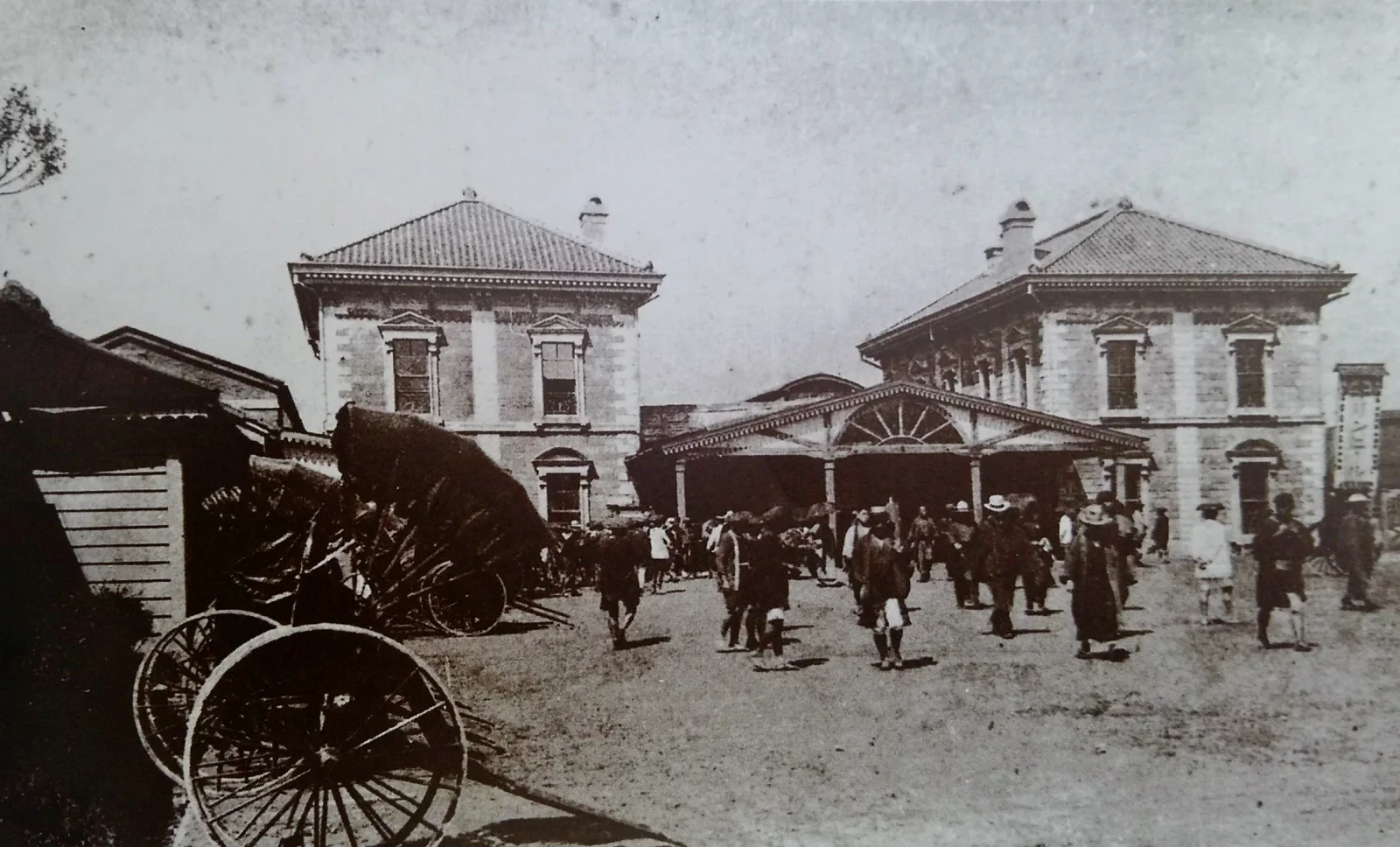
A later photograph of the original Yokohama station shows another part of the journey: the forecourt, people and other vehicles outside the building. The station did not replace the street. It created a point where different forms of movement met. Its site, now associated with Sakuragichō, is distinct from the present Yokohama Station; projecting today’s rail geography backwards changes the trip we are trying to understand.
A mixed network grew through competing initiatives
Fiscal limits slowed government expansion, while private companies became increasingly important. Nippon Railway was founded in 1881, and railway investment expanded during the 1880s. The National Diet Library’s industry exhibition follows public and private construction together. Investors, local interests and government decisions shaped where lines went; there was no automatic national grid waiting to emerge from the first engine.
The complete Shimbashi–Kobe connection opened in 1889. Other lines served mines, regional cities and producing districts. Routes could reinforce some centres and reduce the advantage of places bypassed by them. A map of tracks is therefore also a map of choices about markets, engineering expense and political influence. To understand the value of a line, we need to ask which connections it made possible and which it left difficult.
Silk makes the wider economic relationship visible
The expanding railway system carried more than finished products. Sericulture needed cocoons, silkworm eggs and mulberry leaves as well as access to a port for raw silk. These movements connected farms, workshops and merchants. The extension to Okaya in 1905 linked a major silk-producing district in the Suwa region more effectively with distant supplies and export routes.
This connection also sets a limit on a simple success story. Moving silk more efficiently could support output without telling us how the women producing it were paid or treated. The advantage recorded in a freight movement and the conditions experienced inside a mill are different kinds of evidence. The railway connected their work to distant markets; it did not automatically distribute the resulting gains equally.
Nationalisation followed decades of mixed development
In 1906–1907, the government nationalised seventeen major private railway companies. The history of the network’s coordination connects the takeover with regional links and military transport as well as wider operating needs. This was a major change in ownership, not a continuation of a system that had always been entirely state-owned. Nor did it eliminate every private railway.
Japan’s first railway mattered because it became repeatable and extensible. Imported machinery had to be maintained; a timetable had to be honoured; access and safety had to be regulated; and later lines had to connect with one another. Each step involved decisions about money and authority. The successful locomotive was an achievement, but the working system explains how an innovation could change a country.
TAKE THIS WITH YOU
Look beyond the engine to the system that made it useful
Keep the openings distinct
A provisional section, an imperial inauguration and subsequent extensions were different stages.
Follow people beside the line
Passengers, employees and neighbours experienced its rules and opportunities differently.
Follow the goods to their makers
A faster route to market does not by itself describe the conditions of the people producing its cargo.
The next chapter follows that last connection into the silk mill. Machines and export earnings become a different story when we begin with the women who had to keep the thread running.