
At the end of the Diamond Sutra printed in 868, a dedication names Wang Jie and his parents and expresses the intention to distribute the text freely. The surviving scroll preserves a wish to share Buddhist teaching. It does not preserve a list of everyone who received a copy. That distance between an intention and its reach is a useful place to end our journey.
You have followed a Chinese scroll, Korean editions, Gutenberg’s enterprise, European workshop labour, Reformation arguments and English controls on the press. Together, they show what multiplying texts could change. They also show why the effects of the printing press cannot be reduced to a single promise: more books did not mean that everyone could obtain, understand or freely publish them.
PLACE & TIME
Several histories of making texts repeatable
China · Korea · Mainz · Venice · Antwerp · Wittenberg · London
East Asian and European examples
868–1640 CE · selected examples
Comparative settings
Printing has more than one beginning
The opening chapter asked whether Gutenberg invented printing. The answer depended on what you meant by printing. Chinese woodblock production could repeat a page from a carved surface long before the Mainz Bible. Gutenberg’s importance belongs to the development of a European system of book production, rather than to the first appearance of any printed text anywhere.
The Korean examples make the distinction sharper. The surviving second volume of the Jikji was printed with metal movable type in 1377; a woodblock edition followed in 1378. Different techniques coexisted. Their sequence does not establish that one instantly made the other useless, and their earlier dates do not by themselves establish how Gutenberg learned to make his own system work.
British Library · CC0 1.0 · previously resized; reused without further pixel edits.
Repetition changed where the work went
A prepared printing surface could serve repeated impressions. With separate type, characters could be rearranged for another text. The technical chapter followed the labour inside that change: making pieces, choosing them, arranging a page and returning them to use. Reusability moved work between stages; it did not abolish preparation, materials or skill.
CHANGE AND LIMIT
Before and after a surface was ready
Woodblocks
Carve the page’s words and images into a surface.
Use that prepared page again; a different page requires its own preparation.
Movable type
Make and assemble a supply of separate characters.
Print from the arrangement, then release its pieces for another text.
Cost and labour
Commit materials, time and skilled work before copies can circulate.
Repetition spreads preparation across copies; paper, handling and finishing still cost resources.
This helps explain the potential for wider supply without declaring every book cheap. An edition still required an investment before purchasers appeared. Its prospects depended on the chosen text, its size and materials, and the people expected to want it. A method capable of making many copies could also leave its backers with stock they could not sell.
A printed book could still need a hand
The Gutenberg chapter placed the Bible beside the financial dispute involving Johann Fust. The 1455 Helmasperger instrument gives a particular record of money, claims and contested obligations. It reminds you that an important technical achievement could belong to an uncertain enterprise. A lender, a workshop and a future market were part of the history too.
The finished object also resists the idea of an entirely mechanical break. Gutenberg Museum describes coloured initials and decoration being added by hand. Printing the main text and completing a particular copy were different stages. Books could combine a repeated printed structure with individual work, while preserving visual habits associated with manuscripts.
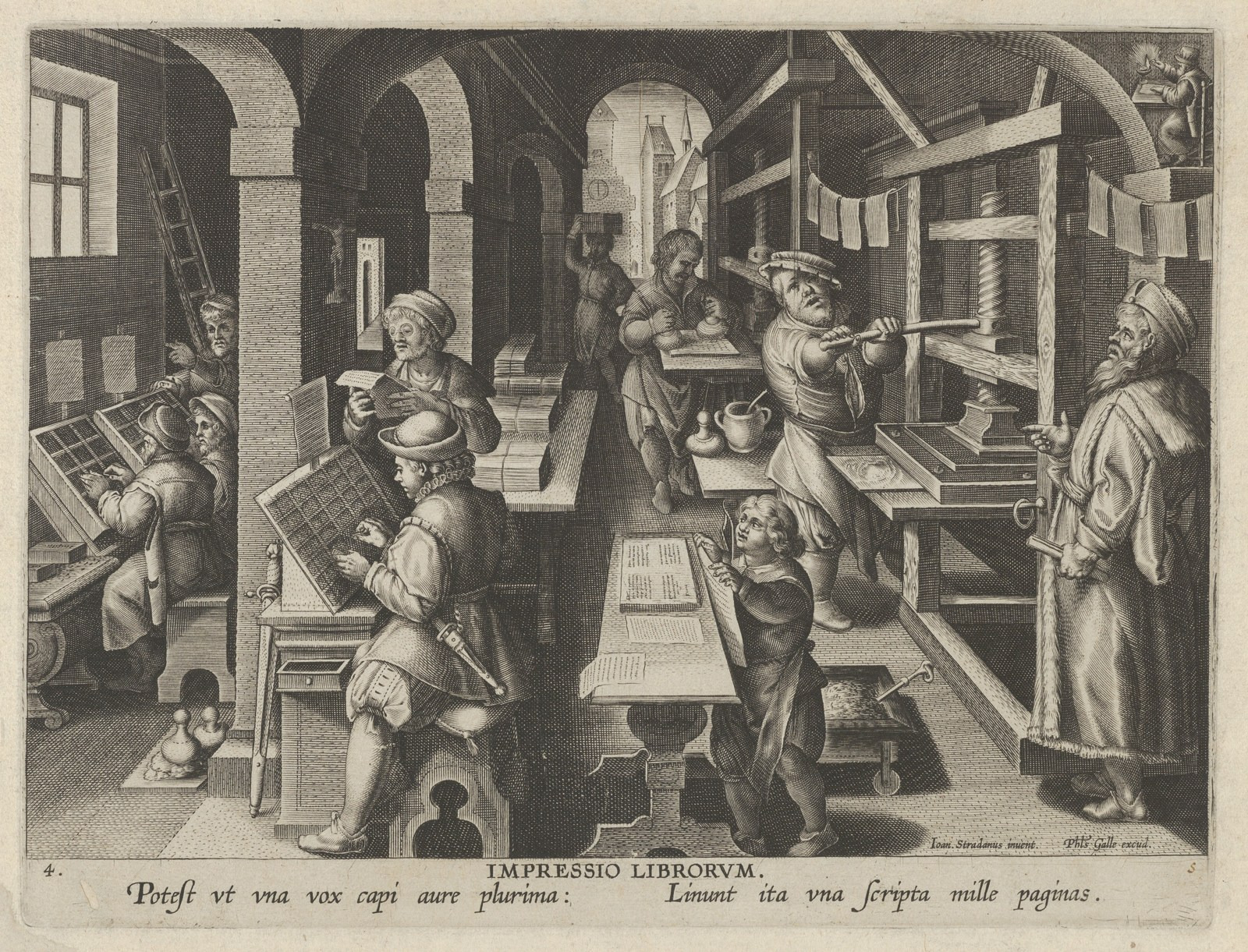
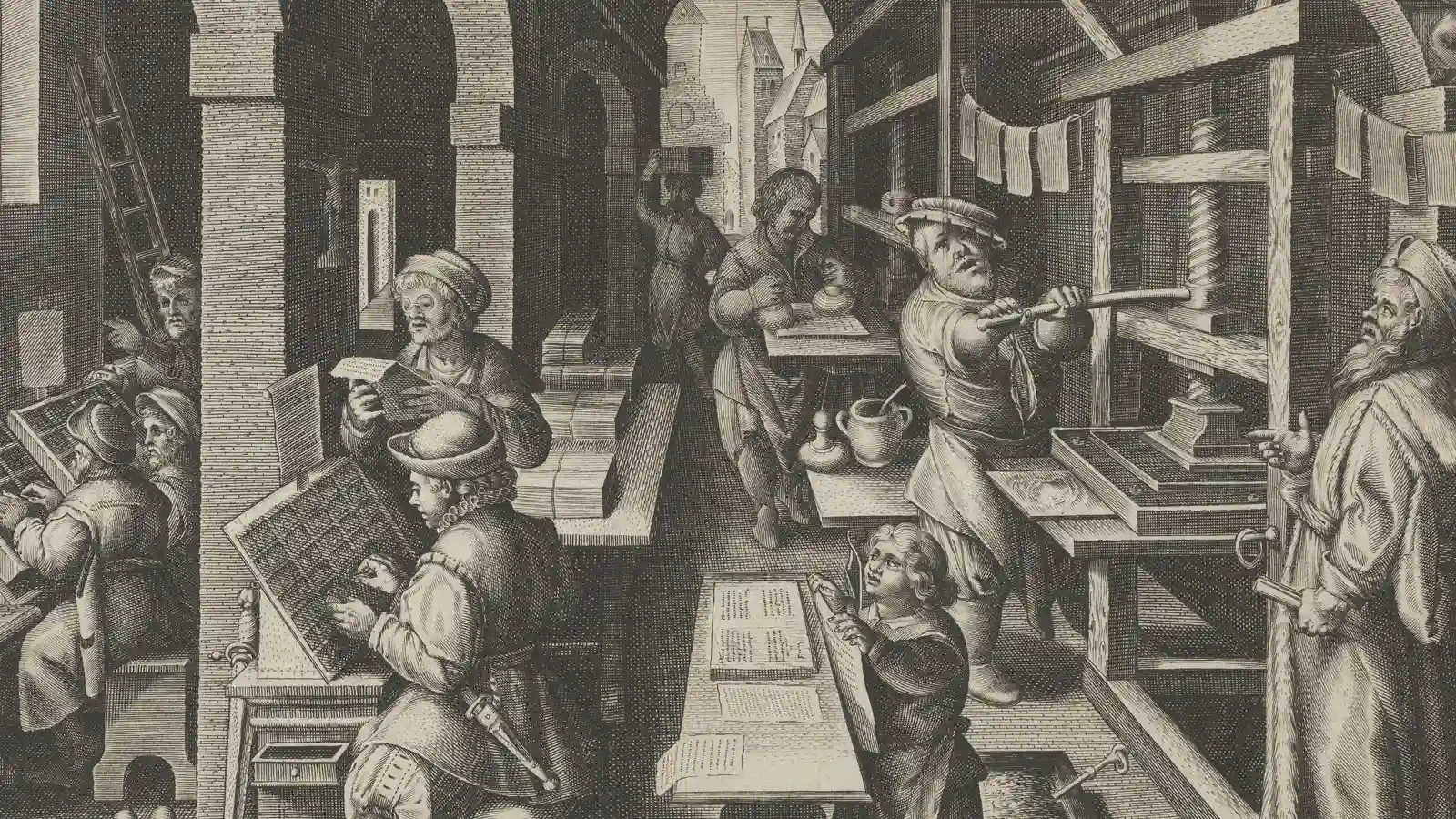
Look again at the workshop engraving. Type cases, handled sheets and readers occupy space alongside the press. The Met dates this representation to about 1600, well after Gutenberg. It cannot supply a view of his room, but its arrangement makes a useful point visible: a book depended on coordinated attention as well as pressure and ink.

Jan Collaert I after Stradanus · The Met · CC0 · previously resized; reused without further pixel edits.
More copies required more than a machine
The workshop chapter followed compositors, press workers and correctors. The Plantin-Moretus account describes their connected tasks in a later Antwerp setting. Someone had to select characters; someone had to check what emerged on paper. The repeated page was a result of these decisions, rather than a text that passed unchanged through an unattended device.
That labour gives the story of access another side. Readers encountered the work of people whose names might not appear prominently in a book. Choices about arrangement and correction shaped the text they could use. Describing printing only through its celebrated inventor makes these contributions harder to see, even when the surviving evidence lets us follow them.
ASK WHO COULD USE IT
Four conditions behind access
Price and supply
A copy must be obtainable. Repeated production does not establish what a particular reader could afford or find.
Language and literacy
A text needs a usable language and some route to understanding its words.
Interpretation and purpose
Readers and listeners encounter arguments through prior knowledge, discussion and particular reasons for using a text.
Permission and control
The ability to make copies does not guarantee that a work may be printed or circulated openly.
The language on the page mattered
The Reformation chapter moved from Latin theses to a German sermon and a German New Testament. The 1518 Sermon on Indulgences and Grace arranged a religious argument in numbered points. Its form offered a different invitation from an academic disputation. Printing helped carry that invitation, while the language and shape of the work helped determine whom it could address.
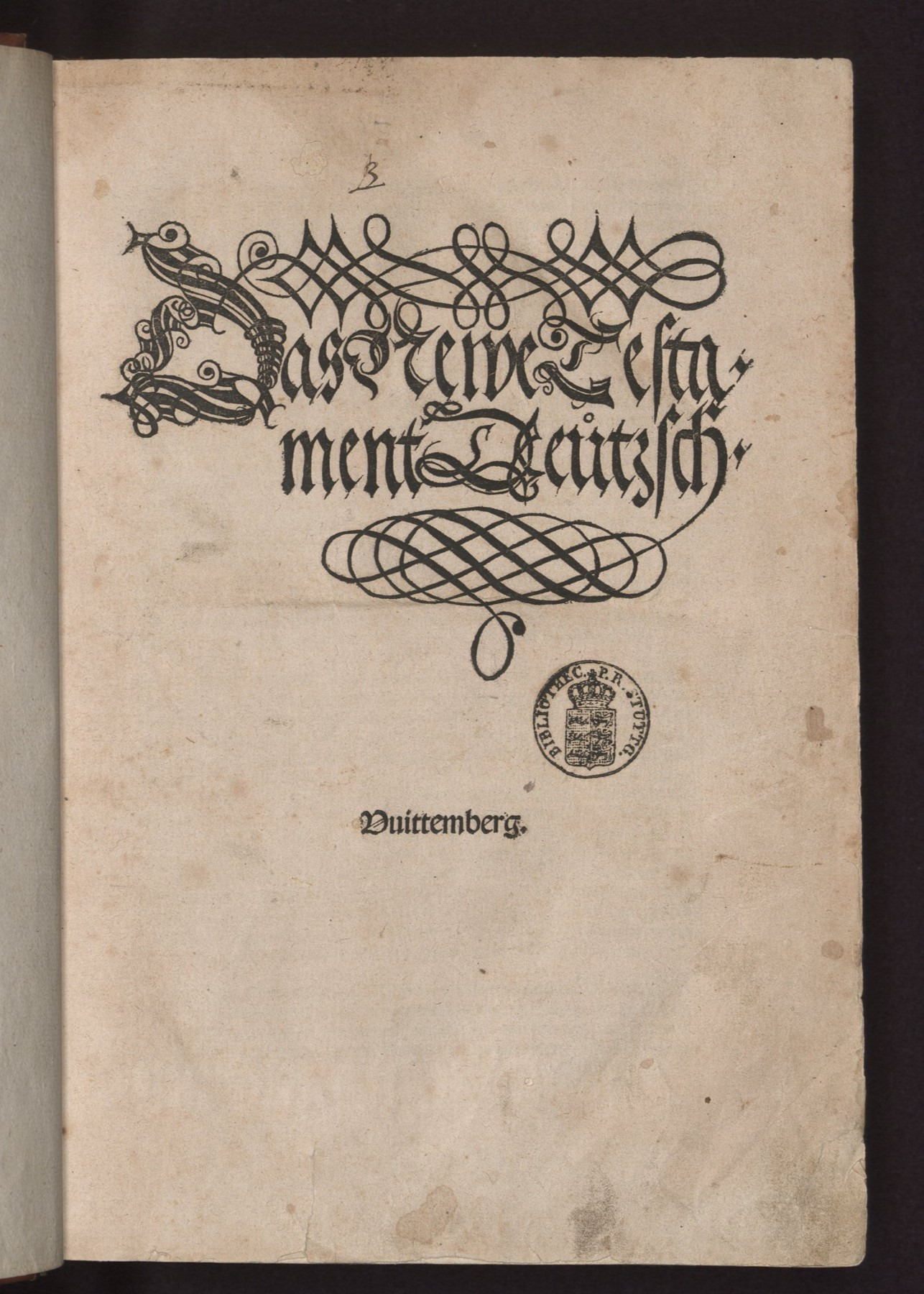
The conspicuous German title of the September Testament makes the issue visible. Pitts Theology Library identifies its publication in 1522 and the Greek text underlying Luther’s translation. This was a New Testament, not yet his complete Bible and not the first German biblical translation. A larger supply of copies and a choice of language were related changes, with different histories.
Even an illustrated or locally written work did not explain itself to every audience. The Passional’s paired woodcuts relied on recognising Christian stories and a hostile comparison with the pope. Their arrangement could focus an argument, but a picture was no guarantee of a shared interpretation. A reader could reject the accusation as well as accept it.
A reader’s voice could carry the page further
Access did not always mean owning a book and reading alone. Andrew Pettegree’s research places print alongside sermons, song and drama. A written argument could enter a wider exchange through discussion or oral presentation. The relevant audience therefore cannot simply be counted by matching each surviving copy to one silent, independent reader.
This is an opening for participation, and also a reminder of mediation. Someone else could select, explain or contest the words. A text could reach a listener without giving that listener equal control over its interpretation. Circulation, comprehension and persuasion remain different questions: counting editions does not count agreement.
Multiplying words also made them worth controlling
The English chapter followed the Stationers’ Company, ecclesiastical licensors and royal institutions. The Company’s 1557 charter connected a trade body with search powers. The ability to print operated within commercial claims and public authority. Expanding production did not leave books outside the reach of institutions concerned about what readers might encounter.
The 1586 Star Chamber decree addressed presses, locations and offending material. A rule states what authorities demanded, rather than proving that every printer complied. Yet the threatened seizure of equipment shows why control concerned livelihoods as well as ideas. More efficient reproduction could matter to those wishing to suppress a text, as well as to those wishing to share it.
TEST THE EVIDENCE
Does an intention to share prove equal access?
A freely distributed printed text must have reached everyone equally.

- SHOWS
- A Buddhist assembly and printed Chinese writing in the surviving opening.
- SUGGESTS
- Teaching was presented through an organised combination of image and text.
- CANNOT PROVE
- The opening does not show the dedication or identify the number and circumstances of recipients.
A better-supported reading
The dedication records a purpose; actual reach requires other evidence.
Dedication and object context: British Library / IDP · Diamond Sutra ·
British Library · CC0 1.0 · previously resized; reused without further pixel edits.
Survival is a beginning for research, not an audience survey
A scroll, a printed title page, a legal instrument and a regulation preserve different traces. The scroll lets you examine an object; the instrument records a dispute; the decree defines obligations. Bringing them together can explain relationships among production, use and authority. It cannot turn any one witness into a complete account of everyone who read or heard a text.
RETURN THROUGH THE PATH
Seven chapters, seven changes of lens
- Chapter 1
Did Gutenberg Invent Printing? The History Behind the Claim
Distinguish printing in general from Gutenberg’s European achievement.
- Chapter 2
The Diamond Sutra of 868: A Book Made to Be Shared
Separate a devotional intention to share from evidence of actual recipients.
- Chapter 3
How Movable Type Works: The Labour Behind Reusable Letters
Follow the work of preparing, arranging and reusing characters.
- Chapter 4
Johannes Gutenberg: The Man Behind a Costly Enterprise
Place technical achievement within finance and a documented dispute.
- Chapter 5
Inside a Renaissance Print Shop: The Work Behind a Book
Recognise the coordinated labour behind printed sheets and completed books.
- Chapter 6
Luther in Print: How Reformation Arguments Reached Readers
Distinguish circulation, interpretation and religious persuasion.
- Chapter 7
Who Controlled the Press? Printers, Licences and Censorship
Read commercial claims, licensing and suppression as related but separate powers.
Chapter order, not a claim that printing followed one continuous geographical route. The titles identify the previously delivered chapters.
What, then, was the printing revolution?
In these selected histories, printing enlarged the possibilities for repeating and circulating texts. Its consequences emerged through religious purposes, investment, skilled work, markets, language and regulation. These conditions explain why the same broad capacity could support a devotional gift, a substantial Bible, a short controversy or a closely supervised trade.
KEY THOUGHT
Making words repeatable changed the opportunities to share knowledge. People and institutions shaped who could use those opportunities.
Return to Wang Jie’s dedication with those distinctions in mind. The intention to share is real evidence of purpose; the unanswered questions about recipients remain real limits. The path closes with a more precise question for any claim about a communication technology: who could make it work, who could encounter its output, and who could decide what happened next?



,_frontispiece_and_text_-_BL_Or._8210-P.2.jpg)
