
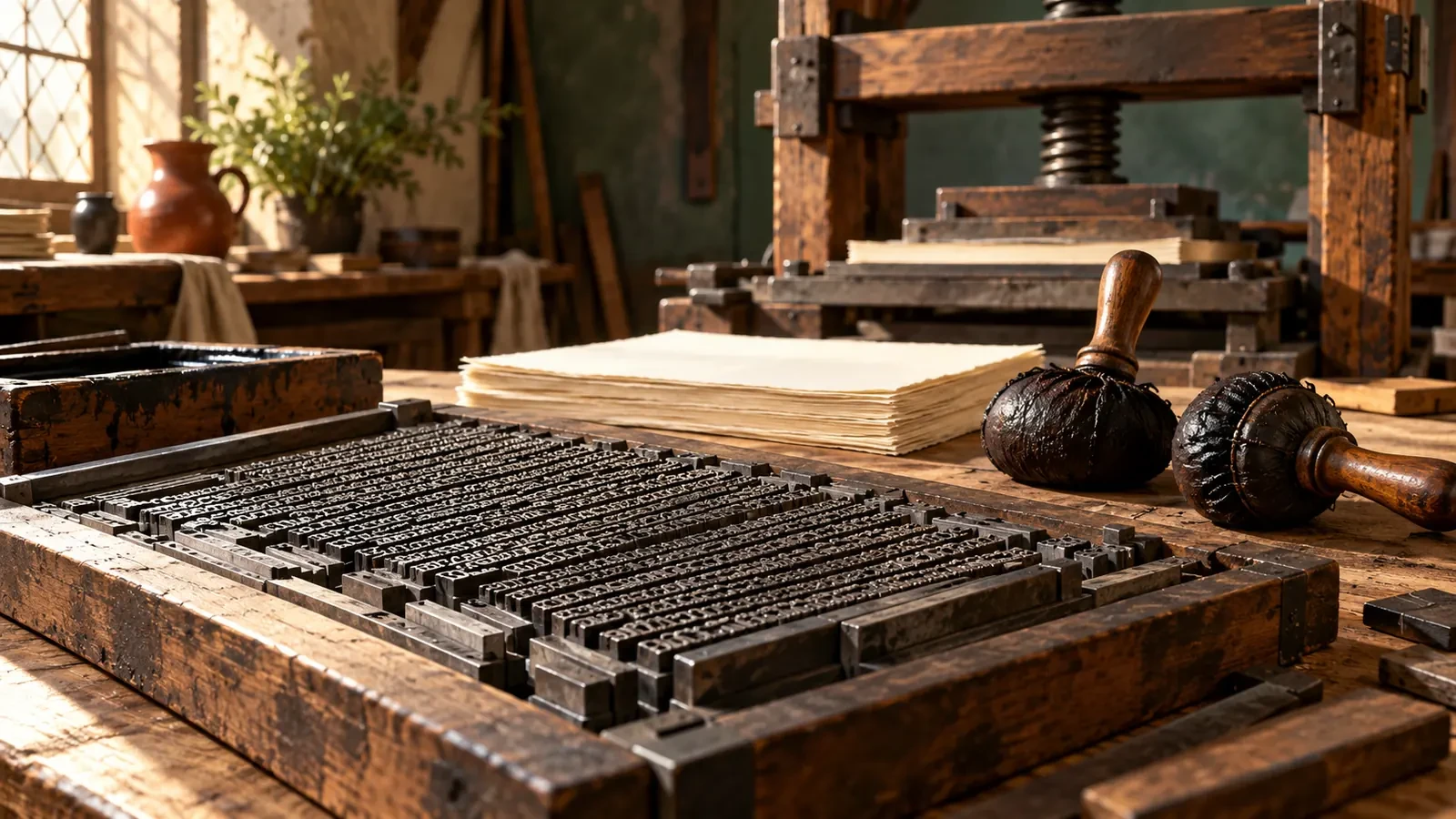
A book can settle a claim—and still leave the question unfinished. In Paris, the surviving second volume of the Jikji preserves a Korean printing achievement dated 1377. In Mainz, Gutenberg’s famous Bible belongs to the middle of the fifteenth century. Put those dates beside each other and “Gutenberg invented printing” immediately needs a more careful explanation. The earlier book matters, but a contest between two dates cannot explain the whole technology.
The short answer is no: Gutenberg did not invent printing in general, and he was not the first to use movable type. His achievement was the development of a movable-metal-type printing system in fifteenth-century Europe. To understand what that means, you need to separate three things often folded into one word: copying a page from a carved block, assembling reusable characters, and organising a press workshop that could turn those characters into books.
PLACE & TIME
Several beginnings, one European turning point
China · Korea · Mainz
East Asia and the Holy Roman Empire
8th–15th centuries CE
The scope
Before letters could move, a whole page could repeat
Imagine that you need another copy of the same page. One solution is to cut its writing into a wooden surface in reverse, leaving the marks raised above the surrounding wood. Ink the raised surface, bring paper against it, and you can take an impression. Once the block exists, each new copy does not require someone to write the entire page again. Woodblock printing was established in China centuries before Gutenberg.
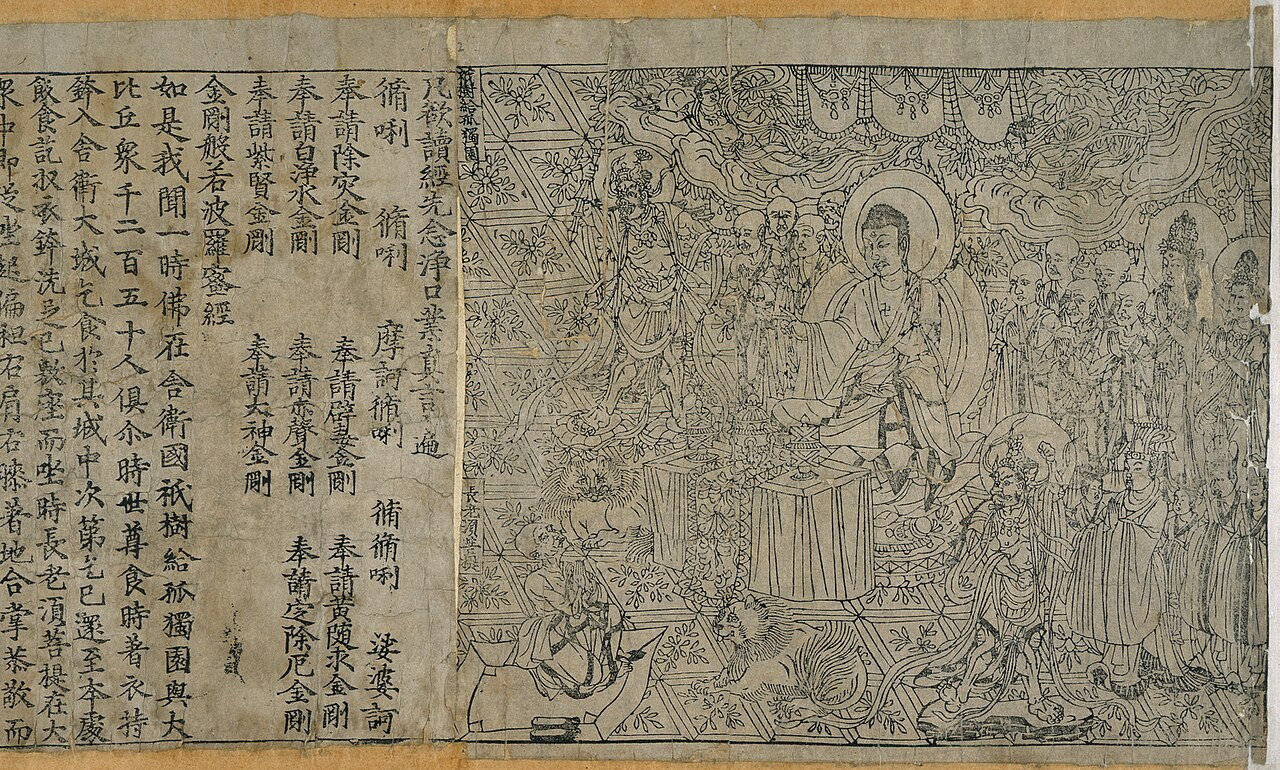
The Diamond Sutra dated 868 makes that earlier world tangible. It is a Chinese Buddhist scripture printed as a scroll, with an illustrated opening followed by text. Its dated dedication names Wang Jie and his parents. Discovered in a sealed library cave near Dunhuang, it is an exceptionally important surviving witness—not evidence that printing began on the day recorded at its end.
WORDS IN THE OBJECT
Reverently made for universal distribution
That dedication changes the question. The point was not merely to demonstrate a clever way of marking paper. Multiplying a Buddhist text could serve a religious purpose, connected here with honouring parents and distribution. A printed object carried words, but also the intention of the people who paid for it. We should not turn that intention into a count of copies or a claim that everyone could actually obtain one.
KEEP THREE THINGS APART
Printing is a family of techniques
Woodblock printing
A whole page or image is cut in relief on a block and printed from that fixed surface.
Movable type
Separate characters are arranged for printing, then can be taken apart and reused.
Printing press
A machine applies pressure to make an impression. Printing from blocks or type does not always require the same kind of press.
Movable type changed what could be reused
A carved block preserves one arrangement. If you want a different page, you need a different carved surface. Movable type offers another kind of flexibility: keep the individual characters and change their order. The reusable unit becomes smaller than the page. That sounds like a simple change, until you consider the work of making, sorting, finding and aligning all those separate pieces.
An eleventh-century account associates Bi Sheng with ceramic movable type in China, around 1040. This is important evidence of the idea long before the European Bible. It is also different evidence from a surviving printed book: a written description of an inventor and technique cannot answer every question about workshop practice, output or how widely the method was adopted.
WHAT GETS REUSED?
A page and a collection of characters
The printing surface
One carved arrangement holds the page together.
Separate pieces must be assembled into an arrangement.
A later printing
The stored block can print that page again.
The pieces can be rearranged for another page.
The practical choice
Useful when keeping a particular text ready to reprint matters.
Useful when reusing the characters for changing texts matters; assembly and storage still take work.
The Korean book that makes “first” difficult
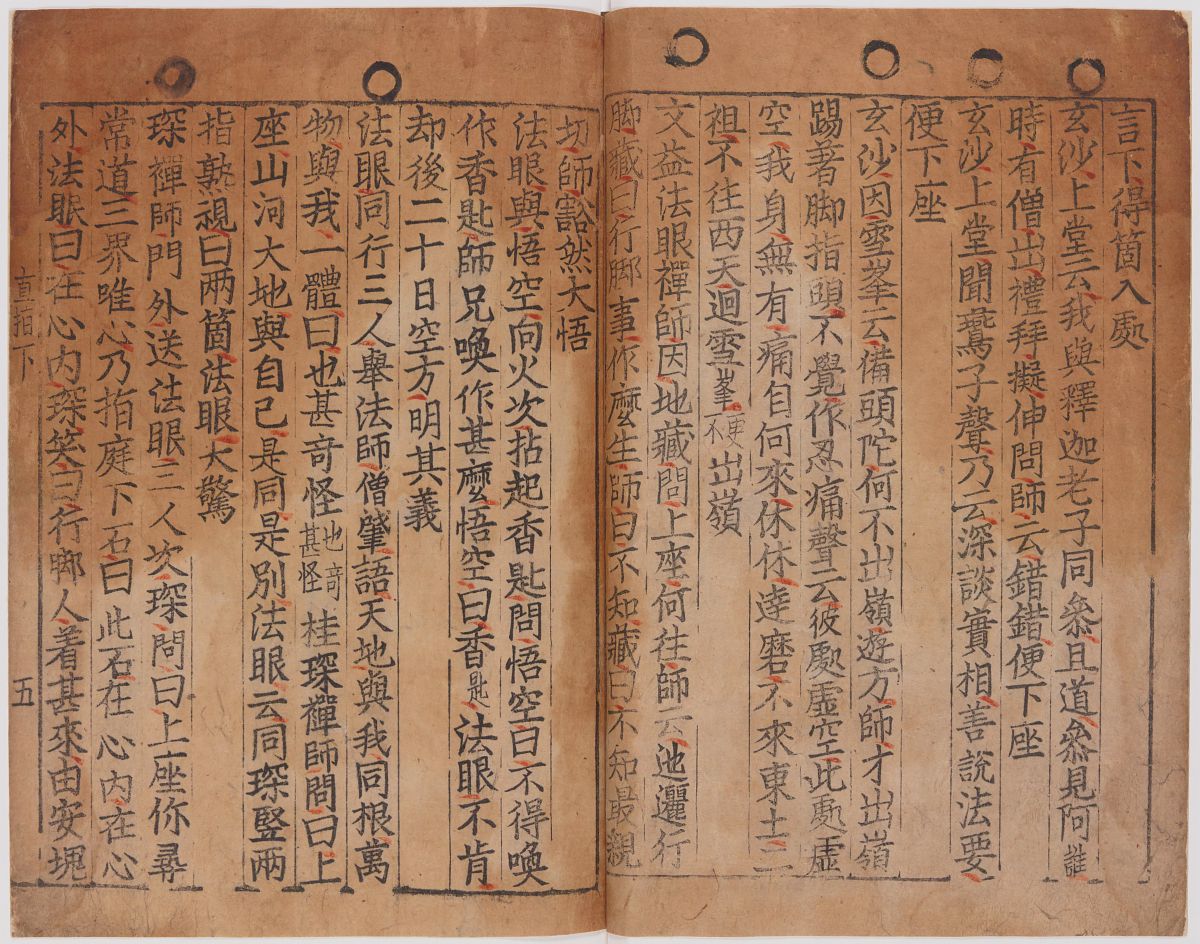
The Jikji brings another distinction into view: movable type made of metal. The Bibliothèque nationale de France identifies its 1377 edition as the oldest surviving book printed with movable metal type. The printing took place at Heungdeoksa, a Buddhist temple in Cheongju, in present-day South Korea. Its subject was Buddhist teaching. The second volume survives; survival should not be mistaken for a complete record of earlier production.
TEST THE CLAIM
Did Gutenberg make the first metal-type book?
Gutenberg was the first person to print a book with movable metal type.
- What the evidence shows
- The book’s colophon records a Korean metal-type printing in 1377.
- What follows
- Metal-type book printing was already practised before Gutenberg’s European project.
- What it cannot settle
- The oldest surviving example is not automatically the first made. It also cannot prove that Gutenberg learned the technique from Korea.
The result
The 1377 Jikji predates Gutenberg’s Bible by roughly eight decades.
Check the dated witness BnF account of the Jikji · BnF scan · public domain
Image: Historical makers unknown · Bibliothèque nationale de France scan · Public Domain Mark 1.0 · resized.
Nor did the metal-type edition make blocks obsolete. A woodblock edition of the Jikji followed in 1378. Storing blocks could keep a fixed text available for later printings. The coexistence matters: technological history is not always a ladder on which each new technique knocks away the rung beneath it. What a workshop wanted to print, and wanted to print again, shaped the usefulness of its tools.
SELECTED WITNESSES
Earlier does not mean directly connected
- 868
A dated Buddhist scroll
The Diamond Sutra survives as a woodblock-printed witness.
- Around 1040
Ceramic movable type
Bi Sheng’s reported experiments with ceramic type belong to this period.
- 1377
A surviving metal-type book
The Jikji is printed at Heungdeoksa in Korea.
- Around 1452–1455
A European Bible project
Gutenberg’s workshop produces its celebrated Latin Bible in Mainz.
These dates compare evidence. They are not a documented route from one workshop to another.
Gutenberg’s achievement was a working system
Return to Mainz, a city on the Rhine in the Holy Roman Empire, in present-day Germany. Gutenberg’s problem was larger than producing one impressive character. Many pieces of type had to work together as lines and pages; ink and pressure had to produce usable impressions. A book required repeated operations, supplies and people. The invention makes better sense as a production system than as a single inspired object.
FROM CHARACTERS TO COPIES
The jobs the system had to connect
Make reusable type
Produce characters that can stand together on a printable surface.
Compose the page
Arrange the pieces into lines and secure the arrangement for printing.
Ink and press
Apply ink and controlled pressure to transfer the arrangement to a sheet.
Continue the book
Repeat the work for other pages; finish and assemble the printed sheets.
The Gutenberg Museum describes the familiar method of making type with punches, matrices and a hand mould. A punch makes an impression in a matrix; the mould helps cast repeated type pieces. But research into early type production also questions how completely that tidy account describes Gutenberg’s actual practice. Explaining the conventional mechanism is useful. Claiming that every tool and operation in his workshop is securely reconstructed would go further than the evidence.
A printed Bible still needed hands
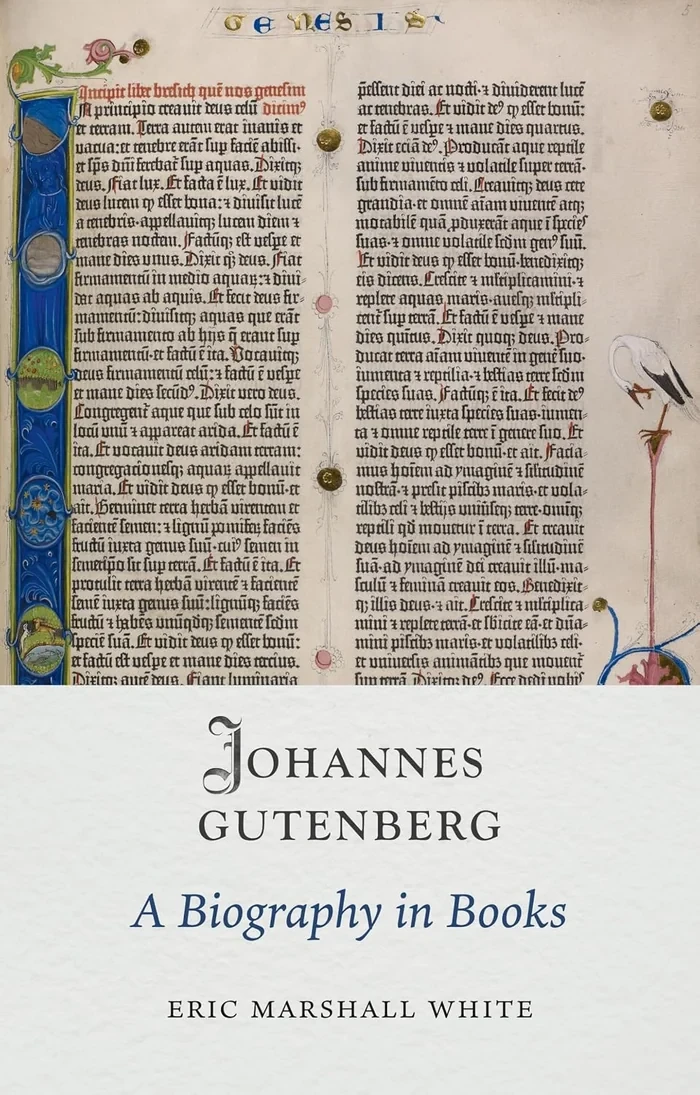
The Gutenberg Bible, produced around 1452–1455, helps you see both the achievement and its limits. Printing could repeat the black text, but it did not deliver a completely finished volume in one movement of the press. Colourful initials and other markings were added by hand. Printed bookmaking could incorporate skills already familiar from manuscript production rather than erase them.
LOOK AT THE PAGE
The page shows one part of the work
Columns of text
The regular layout shows the page organised through type and printing.
The limit of the photograph
This opening does not demonstrate every finishing step. Hand-added initials and marks are described in the museum’s production account.
Modern display
The photograph records a surviving book in a museum, not the moment the sheets were printed.

A Gutenberg Bible in a modern museum display in Mainz. The photograph records the book’s present appearance, not the workshop that produced it.
This is why “printing replaced handwriting” can mislead as an explanation of a page. Different operations could belong to different workers, even within one volume. Once you notice that division, a new question becomes possible: which parts of producing a book could be repeated, which still demanded individual attention, and who had the resources to organise both? Those questions will matter throughout this Story Path.
An earlier invention is not a proven route to Mainz
China, Korea and Europe did not exist outside a connected world. But contact in general is not proof that a particular technique reached a particular workshop. Scholars have investigated possible links between Korean printing and Europe; a possible connection remains different from a documented transfer to Gutenberg. Earlier Asian achievements stand on their own evidence. They do not need an unproven European destination to make them significant.
THE DISTINCTION THAT MATTERS
“Who did it earlier?” is not the same question as “Who learned it from whom?”
So give Gutenberg a precise achievement, and the history becomes larger rather than smaller. His European printing system belongs beside earlier woodblock and movable-type traditions. It did not invent the desire to share a text, nor establish the first means of making repeated impressions. It provided a consequential way of doing that work in a particular setting. What happened next depended on the people who used it.
Follow the copies, not only the inventor
The useful answer to “Did Gutenberg invent printing?” is therefore a set of distinctions, not another heroic first. Woodblocks multiplied pages before movable letters did. Movable type existed before Gutenberg, and metal-type books were printed in Korea before his Bible. His achievement matters most when you ask what his system made possible in Europe—and how people turned that possibility into actual books.
Our wider question is how multiplying texts changed who could share and control knowledge. Before following the European workshop, we will stay with the Diamond Sutra: a scroll whose dedication opens a different beginning. Who wanted its words to travel, and why? The next chapter looks closely at that object. The history of printing starts to change when you ask about the purpose of the copies as well as the machinery that made them.


,_frontispiece_and_text_-_BL_Or._8210-P.2.jpg)

