In April 1868, Japan’s new government announced that knowledge should be sought across the world to strengthen imperial rule. That was an arresting promise for a regime describing its arrival as a restoration. It claimed authority through the emperor and an ancient institution, yet looked abroad for ways to secure its future. The Charter Oath captured the combination: political legitimacy drawn from the past, with no promise simply to put the past back.
The Meiji Restoration overthrew the Tokugawa shogunate, the military government that had ruled from Edo for more than two centuries. It did not transform every institution in one day. Court nobles, domain leaders and samurai activists had to turn a contested claim to imperial government into control of territory, revenue and armed force. Their success changed who could issue orders across Japan—and whose work and resources those orders could reach.
PLACE & TIME
A claim to rule had to become control on the ground
Kyoto, Edo and competing domain governments
The Japanese archipelago
1853–1877 CE
Kyoto marks the imperial court. The map point is a reference within a conflict that crossed several regions.
The emperor and the shogun were different sources of authority
Before 1868, the emperor and court resided in Kyoto. The shogun governed from Edo, the city later renamed Tokyo. The emperor remained a source of political and ritual legitimacy, while the Tokugawa government exercised military and administrative power. Calling the emperor absent from politics would be misleading; treating him as the everyday director of the country would be equally wrong.
The shogunate also governed alongside domain lords, or daimyō. Domains possessed administrations, finances and armed retainers of their own, within an order supervised by the Tokugawa. A samurai might serve a lord rather than a single national bureaucracy. This distribution of authority mattered when the shogunate entered crisis: its opponents could draw on institutions and forces that already existed outside its direct household.
KEEP THE DISTINCTION
A title did not describe the whole political system
Imperial court
The emperor and court in Kyoto supplied a language of legitimate rule.
A coalition that gained court sanction could present an opponent of the shogunate as acting for a higher authority.
Tokugawa shogunate
The military government in Edo managed relations among lords and conducted foreign negotiations.
A failure to defend the country or command agreement could undermine its claim to lead.
Domain governments
Lords and their officials controlled regional resources and retainers.
Some domains could organise substantial resistance; they were not merely provinces awaiting instructions from Edo.
The ships in Edo Bay raised a question about government
In July 1853, Commodore Matthew Perry brought an American naval squadron into Edo Bay with a presidential letter and demands for a new relationship. Japan was not wholly cut off from the world: regulated Dutch and Chinese trade and other regional connections had continued. The challenge was an expansion of foreign access backed by conspicuous military power, not humanity’s first contact with an unknown country.
The shogunate’s response exposed the difficulty of making a binding decision. As the National Diet Library’s account of the translated letters shows, senior councillor Abe Masahiro sought the opinions of domain lords. Consultation could broaden support, but it also made foreign policy a question on which powerful outsiders to the central administration could press their views. Who had the right and the capacity to answer the foreign ships?
KEY IDEA
Agreeing to a demand could look like weakness; rejecting it could bring a war the government might not win.
The agreement of 1854 opened Shimoda and Hakodate for specified purposes, including supplies and assistance to American ships. It was not yet a general commercial treaty. Further agreements in 1858 opened a much wider trading relationship on unequal terms. Officials and activists disputed concessions, military preparation and the standing of the court. Foreign pressure became entangled with a struggle inside Japan over who could decide its response.
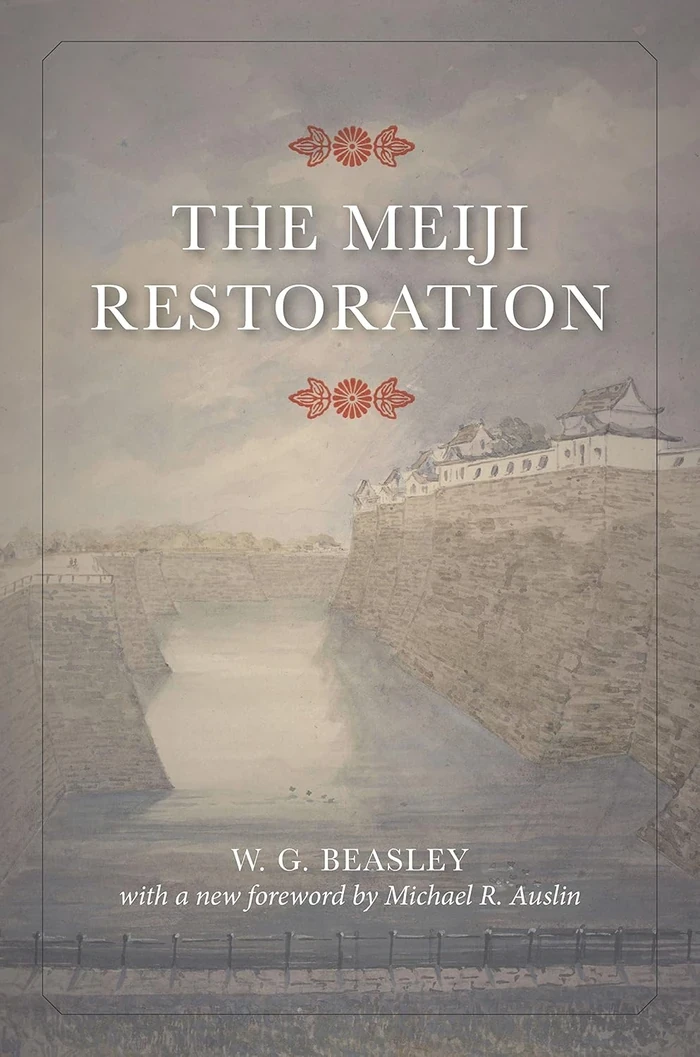
Opposing foreign pressure did not mean rejecting foreign equipment
The slogan often translated as “revere the emperor, expel the barbarians” joined loyalty to the court with hostility to foreign intrusion. Its users did not all possess the same programme. Assassination, confrontation and military action made the crisis violent, while encounters with foreign firepower altered calculations. The politics of the 1860s cannot be reduced to one unchanging party of isolation facing another party of progress.
Satsuma and Chōshū, powerful domains in southwestern Japan, became central to the coalition against the Tokugawa. Their leaders acquired modern arms and explored foreign connections. The shogunate pursued military and technical reform too. When forces later fought over the new government, imported weapons were available on more than one side. The outcome was not a simple contest between swords representing the past and guns representing the future.
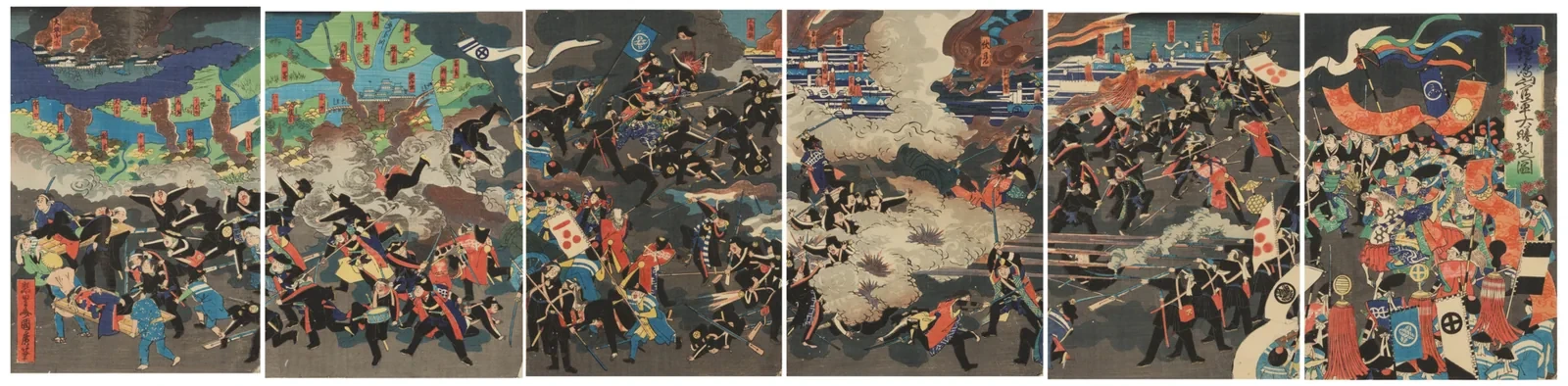
A colour print of fighting at Toba–Fushimi presents a victory of government forces. That description already takes a political position: whose army counted as the government’s? Imperial sanction helped the anti-Tokugawa coalition make that claim. Flags, titles and declarations mattered alongside weapons because they could affect whether a lord regarded continued resistance as loyal service or rebellion.
The shogun gave up office, but the struggle continued
In 1867, the last shogun, Tokugawa Yoshinobu, offered to return governing authority to the emperor. That did not necessarily mean surrendering every future political role. A reconfigured order might still include the powerful Tokugawa house. Different proposals for councils and public deliberation circulated; overthrow of the shogunate did not automatically imply that one already agreed replacement stood ready.
On 3 January 1868 in the Gregorian calendar, a court-centred coup proclaimed the restoration of imperial government and excluded the old shogunal arrangement. Forces associated with Satsuma and Chōshū were crucial to making it effective. Emperor Meiji, still a teenager, gave the new order its sovereign focus. The practical work of ruling depended on a coalition around him rather than on the emperor personally designing and executing every policy.
TURNING POINTS
Several turning points made the restoration
- 1853–1858
Foreign access becomes a political crisis
Naval pressure and treaties sharpen disputes over how Japan should be governed and defended.
- 1867–1868
The shogunate is displaced
Yoshinobu’s return of authority is followed by a contested proclamation of imperial government.
- 1868–1869
Civil war determines effective power
Fighting and negotiated submissions extend the new regime’s reach.
- 1871
Domains become prefectures
The government dismantles the territorial framework on which its own coalition had depended.
Exact dates before 1873 may appear differently in sources using Japan’s former lunisolar calendar. Dates stated as Gregorian here are converted.
Winning the country required more than controlling the palace
The fighting at Toba–Fushimi near Kyoto in early 1868 opened the Boshin War. The new regime’s forces advanced east, but the capture of power did not follow one method everywhere. Negotiation secured the surrender of Edo Castle in the spring. Fighting continued in other places, including the northeast, and the last major resistance ended at Hakodate in 1869. A declaration issued in Kyoto had needed armies, agreements and local decisions to become a national settlement.
The negotiated surrender of Edo Castle spared the city an anticipated large assault. It did not make the whole restoration bloodless. Battles elsewhere and fighting within Edo’s wider urban area brought deaths and destruction. The difference matters for how the new capital is remembered: one successful negotiation cannot stand in for the experiences of communities through which the war passed.
The Charter Oath left room for different political futures
The oath’s five articles called for discussion, a common effort in government, scope to pursue occupations, the abandonment of harmful old customs and the search for knowledge abroad. These were broad commitments rather than a detailed constitution. They could reassure groups needed by a government still fighting for control. They did not specify a universal vote or give every inhabitant an equal share in deciding policy.
IN THE SOURCE
Knowledge shall be sought throughout the world
The new central government’s institutions changed repeatedly. A Council of State system took shape, ministries developed, and officials argued over the distribution of powers. Restoring imperial rule therefore created a framework in which new institutions could be built. It did not reveal a complete ancient machinery of government that could simply resume operation after centuries out of use.
The decisive administrative break came after the war
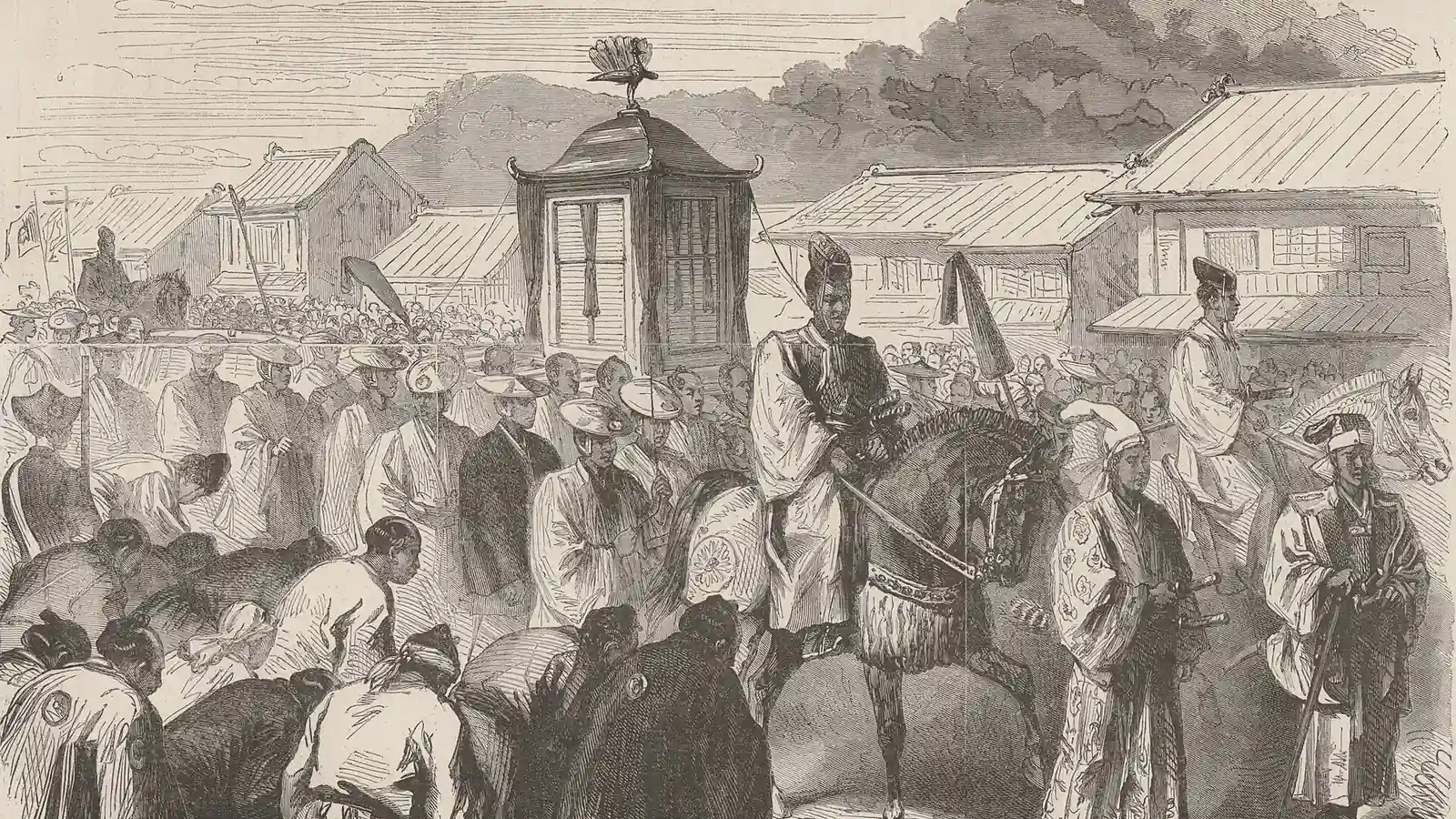
In 1869, leading lords returned formal control of their lands and people to the emperor, but domain administration continued under revised arrangements. The more radical step came in 1871: domains were abolished and replaced by prefectures. The National Archives preserves the order removing domain governors and directing them to live in Tokyo. Centrally appointed officials would govern in their place.
The distinction between 1869 and 1871 is essential. A declaration of submission did not by itself remove a regional administration, income stream or military interest. Abolishing the domains reduced the independent bases of power through which the restoration coalition had risen. The new government could now pursue national taxation, military recruitment and education with a different reach, although carrying policy into every locality remained further work.
FOLLOW THE PROCESS
How a coalition became a central government
Claim legitimate authority
Act in the emperor’s name and displace the shogunate’s claim to rule.
Secure the outcome
Fight, negotiate and obtain submission across regions rather than assume a palace decision controls them.
Remove competing territorial offices
Replace domain governments with a prefectural administration appointed from the centre.
Build recurring powers
Raise revenue, recruit personnel and support institutions capable of operating beyond a temporary alliance.
Reform created obligations as well as possibilities
The transformation of samurai status and hereditary income made the new state a threat to people who had helped establish it. Military service was reorganised through conscription in 1873, and hereditary stipends were eventually converted into bonds. Former retainers faced very different prospects depending on resources, education and access to office. Some entered government or new professions; others experienced insecurity and loss.
For rural households, a central state could mean new forms of taxation, military service and schooling. Calling these changes national strengthening does not tell us how a family replaced an absent worker or met a cash demand. Nor did the weakening of hereditary distinctions abolish discrimination or provide women with equal political power. A wider range of occupations and a more intrusive administration could develop together.
The contradiction became especially visible in 1877, when Saigō Takamori, a prominent former supporter of the restoration, led the Satsuma rebellion against the government. Its defeat showed the capacity of the new central forces and the divisions among those once united against the Tokugawa. It was not an untouched medieval society making one last appearance; it was a conflict produced within the changes of the restoration itself.
TAKE THIS WITH YOU
Restoration became transformation through institutions
Separate the turning points
The shogunate’s fall, victory in the Boshin War and abolition of domains were connected but distinct steps.
Avoid the swords-versus-guns story
Foreign techniques, modern arms and reforming officials existed on different sides of the struggle.
Follow the costs of state-building
National power depended on resources, service and work supplied by people whose gains were uneven.
The next chapter follows the change into Edo itself. Renaming a city Tokyo was easier than making it an imperial capital. Palaces, offices, streets and the livelihoods built around them would reveal what the transfer of power changed on the ground.