
The first chapter followed sugar from coerced work towards an Atlantic port. At the end of the Path, goods still travelled through Haitian ports, but the political relationships around them had been transformed. People could no longer legally be owned under the country’s constitution. France no longer governed the western colony as before. Yet in 1825 export earnings also helped support payments demanded by the former colonial power. The persistence of a connection did not mean that nothing had changed; it made the character of the change more important to understand.
The Haitian Revolution destroyed slavery in Saint-Domingue and created an independent state through collective struggle. Its achievement should not be measured against a requirement that every later injustice disappear. Nor should the achievement conceal the labour restrictions, unequal authority and violence exercised by governments that claimed to defend it. The Path’s question has two parts because emancipation and independence were decisive transformations without being complete definitions of everyone’s freedom.
PLACE & TIME
Follow the changing relationships behind freedom
Saint-Domingue and Haiti
Caribbean and Atlantic connections
1789–1825 CE
The fortress marks the defence of independence; this synthesis follows connections across the country and beyond it.
The plantation order did not dissolve through a declaration elsewhere
Colonial slavery joined law, ownership and the practical organisation of production. Fields, processing equipment, transport and commerce depended on people whom the law subjected to an owner’s commands. Their daily relationships nevertheless extended beyond those commands. Skills, family connections, movement and efforts to escape created possibilities the system sought to restrict. The first chapter’s hostile records help make those actions visible without supplying a complete voice for every person.
The French Declaration of Rights supplied a powerful language of equality, but it did not automatically release enslaved people. Free citizenship and emancipation initially concerned different claims. A free property owner could challenge racial exclusion while defending ownership of others. Recognising those overlapping positions makes the revolution more understandable than dividing the population into a few homogeneous groups whose interests were supposedly fixed.
KEEP THE DISTINCTION
Three transformations broke different relationships
Emancipation
One person’s legally recognised ownership of another.
Who would control land, movement and work after that relationship ended?
Independence
France’s claim to govern the country and decide its colonial future.
How would the new state govern its people and secure external acceptance?
Recognition
A foreign power’s refusal to acknowledge sovereignty.
What conditions could it impose, and who would bear their cost?
The revolution’s makers were larger than its list of leaders
The uprising of 1791 changed the scale of the challenge. People acted across plantations, and the inability to restore the old order became a political fact with which officials and rival powers had to deal. The later emancipation measures emerged within that continuing struggle and the widening imperial war. They were not simply the orderly implementation of principles already accepted by every participant in 1789.
Boukman, Louverture, Dessalines, Christophe and other commanders belong within this history. Their authority did not replace the work of cultivators, soldiers, organisers and people whose names remain difficult to recover. Nor did people under command necessarily share their leaders’ preferred settlement. A negotiated submission could leave resistance continuing elsewhere; an order to maintain plantation production could meet opposition from those expected to perform it.
FOLLOW THE PROCESS
A collective struggle created successive possibilities
Make the old order difficult to maintain
Flight, organisation and mass revolt challenged the ability to compel work and govern estates.
Alter the terms of alliance
War and emancipation changed which political partners could credibly claim to defend freedom.
Preserve the capacity to resist
Soldiers and cultivators judged promises against disarmament, repression and the experience of slavery elsewhere.
Build another political relationship
Military victory opened the possibility of a state beyond French sovereignty, whose arrangements still required decisions.
That sequence was contingent. The war of 1802–1803 combined French military advances, continued resistance, yellow fever, renewed coalitions and naval pressure. None of those forces alone explains the outcome. Treating the independence army as the only cause erases conditions in which it fought; treating disease as the sole victor erases the organisation and choices through which victory became independence.
Freedom changed the stakes of labour
The contrast between the Code noir and the constitution of 1801 shows an immense legal transformation. The earlier edict recognised enslaved people as property. The later constitution abolished slavery and proclaimed a free population. At the same time, it demanded uninterrupted agricultural production and empowered regulation of cultivators’ movement. Those clauses make the tension visible within a single document.
For a government, exports promised the means to maintain an army and public authority. For cultivators, the question also concerned control over their own work and the possibility of a household future on terms they could influence. A policy could serve national defence and still impose coercion on the population whose freedom was being defended. Explaining both sides does not require treating them as equally powerful.
KEY IDEA
Ending legal ownership did not make every form of coercion disappear. Continuing coercion did not make the ending of ownership meaningless.
This is why plantation output cannot stand as the sole measure of success after emancipation. The same quantities of exported goods could be produced under different arrangements of authority, distribution and bodily security. A fall in output might reflect destruction, war or a change in priorities, rather than one simple story about the capacities of a free population. Sources that automatically equated compulsion with prosperity need to be read through their interests.
National belonging combined equality and exclusion
The founding documents associated sovereignty with the defence of emancipation. The 1805 constitution prohibited slavery and established a common Black national designation while specifying exclusions and naturalisation exceptions. Its articles on property and belonging show a state trying to prevent a return to the colonial order. The national identity it proclaimed was a political construction with qualifications, not a simple inventory of skin colour.
The state’s authority was nevertheless concentrated in military and imperial government. Women, cultivators and people without high rank did not receive an equally shared political voice simply because the constitution described national unity. The new institutions could speak in the name of the people while limiting the means through which many people could contest their decisions. The question of who governed survived the question of whether France would govern.
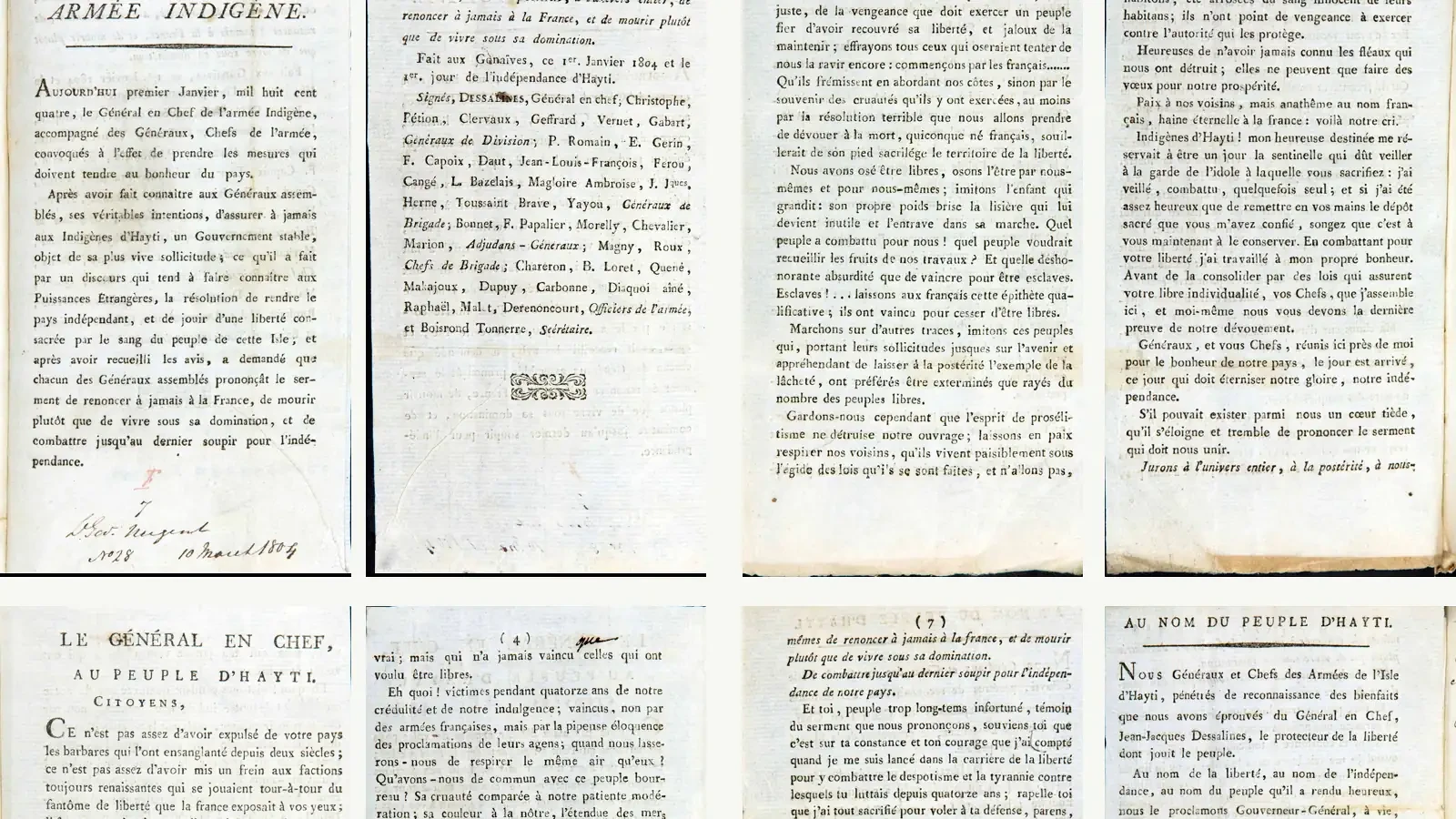
Violence after independence must also remain within the account. Dessalines’s orders against remaining French white residents produced mass killings of civilians. The recent experience of attempted reconquest and French atrocities explains the intensity of fear without making collective punishment justified. An account that omits the killings distorts the new state; one that uses them to deny the wrong of slavery or the legitimacy of emancipation distorts the larger transformation.
Independence required resources to defend it
The Citadelle Laferrière, shown in this article’s featured image, belongs to the early nineteenth-century state-building of Henri Christophe. UNESCO describes its strategic position in the mountainous interior. Its scale makes a problem tangible: a country fearing renewed attack needed defensive arrangements that could survive beyond a public declaration. Walls, equipment and supplies made security a material undertaking.
The monument should not be mistaken for a building that simply represents an agreed national solution. The state divided after Dessalines’s death, and different rulers organised power and production in different ways. The labour and resources demanded by state-building could raise further conflicts. A monument to independence can therefore be read both as a defence against outside domination and as evidence of the power exercised within the country.
LOOK FROM HERE
The same achievement could create different expectations
Freedom raised questions about secure family life, access to land and the capacity to direct work.
Revenue, military organisation and obedience could appear essential to protecting the achievements of the war.
Contact could offer opportunities without a commitment to recognising Haiti on equal terms.
France found another way to make a claim
In 1825 the former colonial power linked recognition to compensation and preferential commercial terms under naval pressure. The ordinance’s direction of payment is decisive. The society that had overthrown slavery was required to finance claims associated with the losses of former colonists. The original articles show how an independent country could be subjected to an arrangement carrying elements of the colonial property order into a new legal relationship.
The loan taken to finance a first payment created another set of obligations. That mechanism mattered because a formal acceptance of sovereignty did not prevent resources from being transferred outward on unequal terms. The debt should be specified rather than treated as one timeless figure: the original demand, actual borrowing proceeds and later settlements describe different stages. Precision makes the burden more understandable without reducing it to a slogan.
KEEP THE DISTINCTION
Three pairs of things the Path keeps distinct
A legal declaration and its enforcement
A text can establish a right or claim authority.
People and institutions still determine whether and how it becomes effective.
Commercial contact and diplomatic equality
Goods and money can move through continuing connections.
The governments and people involved may still deny one another equal standing.
Historical achievement and continuing injustice
The destruction of slavery and French rule changed lives and political possibilities.
Coercion, exclusion and unequal financial power could continue within the new setting.
An unfinished struggle is not an unsuccessful revolution
The Path’s answer begins with collective action that transformed the possibilities of a slave colony. Plantation workers and insurgents made the old system increasingly untenable; emancipation and military organisation changed alliances; renewed resistance defeated reconquest and opened the way to independence. The participants did not need a single final plan from the beginning for their actions to create a political result of extraordinary importance.
Freedom remained contested because ownership, sovereignty, work, citizenship and recognition were different relationships of power. Removing one could expose another more sharply. The military government’s authority, cultivators’ demands and France’s financial claims were not proof that the original achievement was imaginary. They were the conditions through which people had to make something of it. The history concerns their decisions and conflicts rather than a country sentenced in advance to one outcome.
TAKE THIS WITH YOU
Follow the relationship that freedom was meant to change
Name the achievement precisely
Ending ownership and rejecting French rule were decisive transformations, not promises invalidated by every later injustice.
Keep people and power in view
Leaders, cultivators, soldiers and families did not possess equal influence or necessarily seek the same settlement.
Read connections through their terms
Trade, recognition and finance could continue while the authority and cost within those connections changed.
Return to the journey from the field to the port. Under slavery, that journey depended on an owner’s claim over the people producing the goods. After independence, no such claim could legally define a Haitian’s status, yet the question of who directed work and received its value remained urgent. The difference between those situations is the revolution’s achievement. Following what remained contested is how we understand its unfinished struggles.