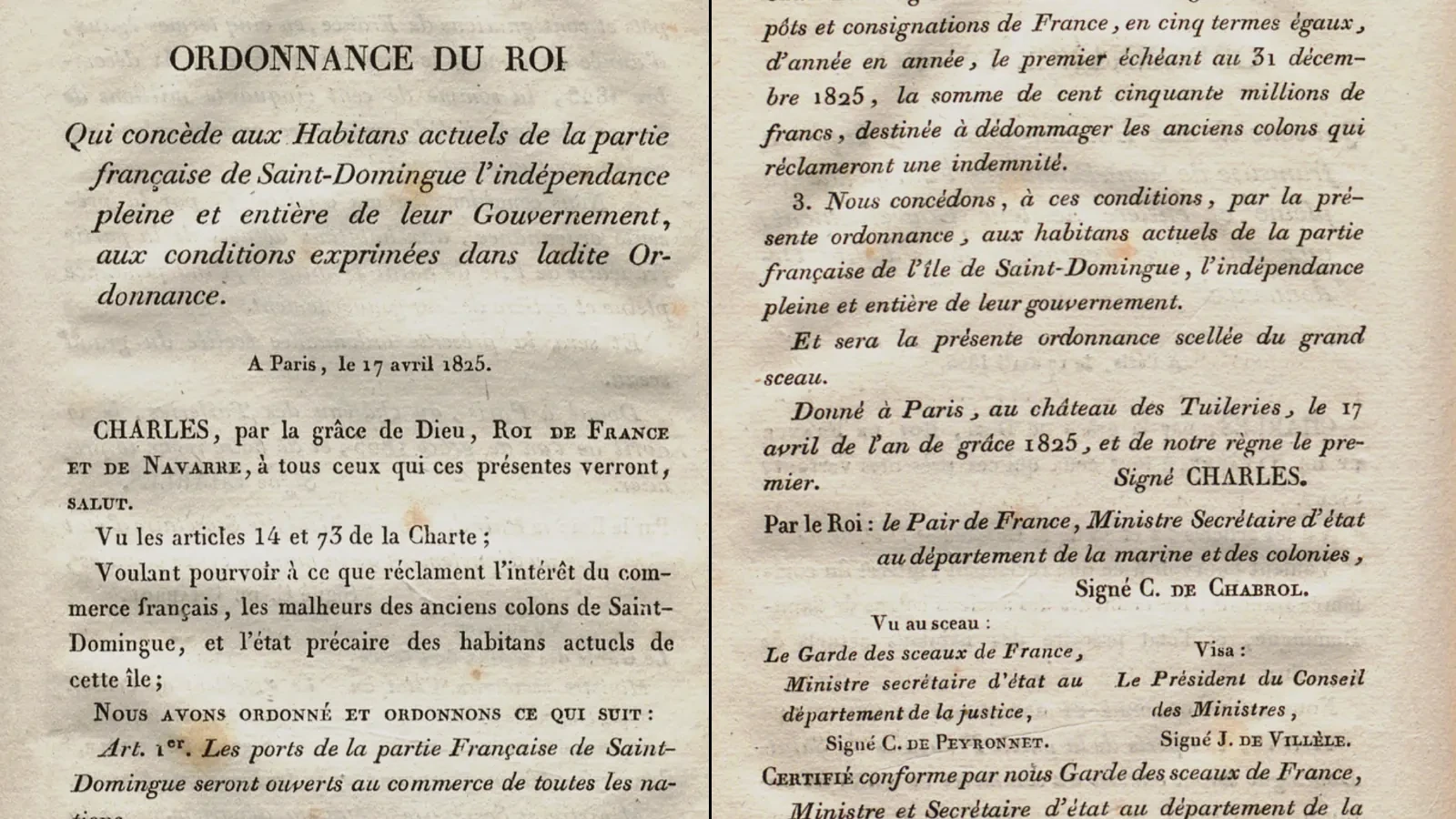
On 17 April 1825, Charles X issued an ordinance concerning a country that had declared independence twenty-one years earlier. France offered recognition on conditions: commercial advantages for French ships and an indemnity of 150 million francs for former colonists. When the demand reached Haiti, it came with a naval force. The issue was not whether Haitians had already won independence, but what another powerful state would require before acknowledging it.
President Jean-Pierre Boyer accepted the terms under pressure in July, and the Haitian Senate registered the arrangement. The decision opened a route towards a different relationship with France while imposing a burden Haiti could not easily meet. The three articles of the ordinance make the connection explicit. Trade, compensation and recognition were parts of one conditional settlement.
PLACE & TIME
A political demand across the Atlantic
Port-au-Prince and Paris
Caribbean and France
1825 CE
The marker locates Haiti’s capital, not the overseas institutions receiving and financing the payments.
Haiti existed before France chose to recognise it
The new state had governed itself since 1804. France nevertheless continued to treat the former colony as a possession whose future remained open to French claims. Threats of reconquest and disputes over relations mattered to Haitian governments seeking security and trade. Recognition could reduce a danger without creating sovereignty from nothing. The distinction prevents the ordinance’s language of concession from becoming the historian’s description of how Haiti came into existence.
Nor had the country simply ceased to trade with the world. Merchants and foreign governments did not all respond in the same way, and commercial contact could exist without full diplomatic acceptance. Julia Gaffield’s work describes recognition as layered, involving practical relationships as well as formal declarations. That is a more useful setting for 1825 than the assumption of a completely sealed country suddenly permitted its first outside connection.
KEEP THE DISTINCTION
Three relationships were not interchangeable
Independent government
Haitians exercised authority after the military defeat of France.
That every foreign government had accepted Haiti’s standing.
Commercial contact
Goods, ships and merchants could move through negotiated or contested connections.
That all participants enjoyed equal political recognition or bargaining power.
French recognition
France agreed to acknowledge the government’s independence under specified terms.
That France had created the country or that the terms were freely chosen between equals.
Negotiation took place under a military imbalance
Earlier Haitian leaders had considered discussions about compensation without accepting a return to colonial rule. Boyer governed a country whose western divisions had been reunited and whose authority had also extended into eastern Hispaniola in 1822. The ordinance, however, referred specifically to the former French part of Saint-Domingue. Its territorial language should not be silently expanded to mean that France was recognising every political claim Boyer made across the island.
The French envoy, the baron de Mackau, arrived with a squadron capable of enforcing threats against Haiti’s ports. Gaillard-Pourchet’s account traces the July acceptance. Boyer faced a choice under coercion: accept a very costly arrangement or risk renewed hostilities and a blockade. That was still a consequential decision by a Haitian government, but it was not an ordinary purchase in which a buyer could simply walk away without another danger.
KEY IDEA
The agreement was accepted by Haitian authorities under an armed threat.
The distance from military victory in 1803 is important. A government seeking to preserve an independent country had to judge a new strategic and financial situation, not replay a completed battle under identical circumstances. Understanding that setting is more useful than assuming that the capacity to defeat one expedition made all later French pressure easy to resist.

The ordinance joined trade preferences to compensation
Article 1 opened the ports to international commerce but gave French shipping a privileged position: the relevant duties were reduced by half for the French flag. Article 2 demanded 150 million francs in five annual instalments. Article 3 made recognition conditional on the preceding terms. The sequence matters. The financial clauses were not an unrelated bill attached after a generous recognition of equality.
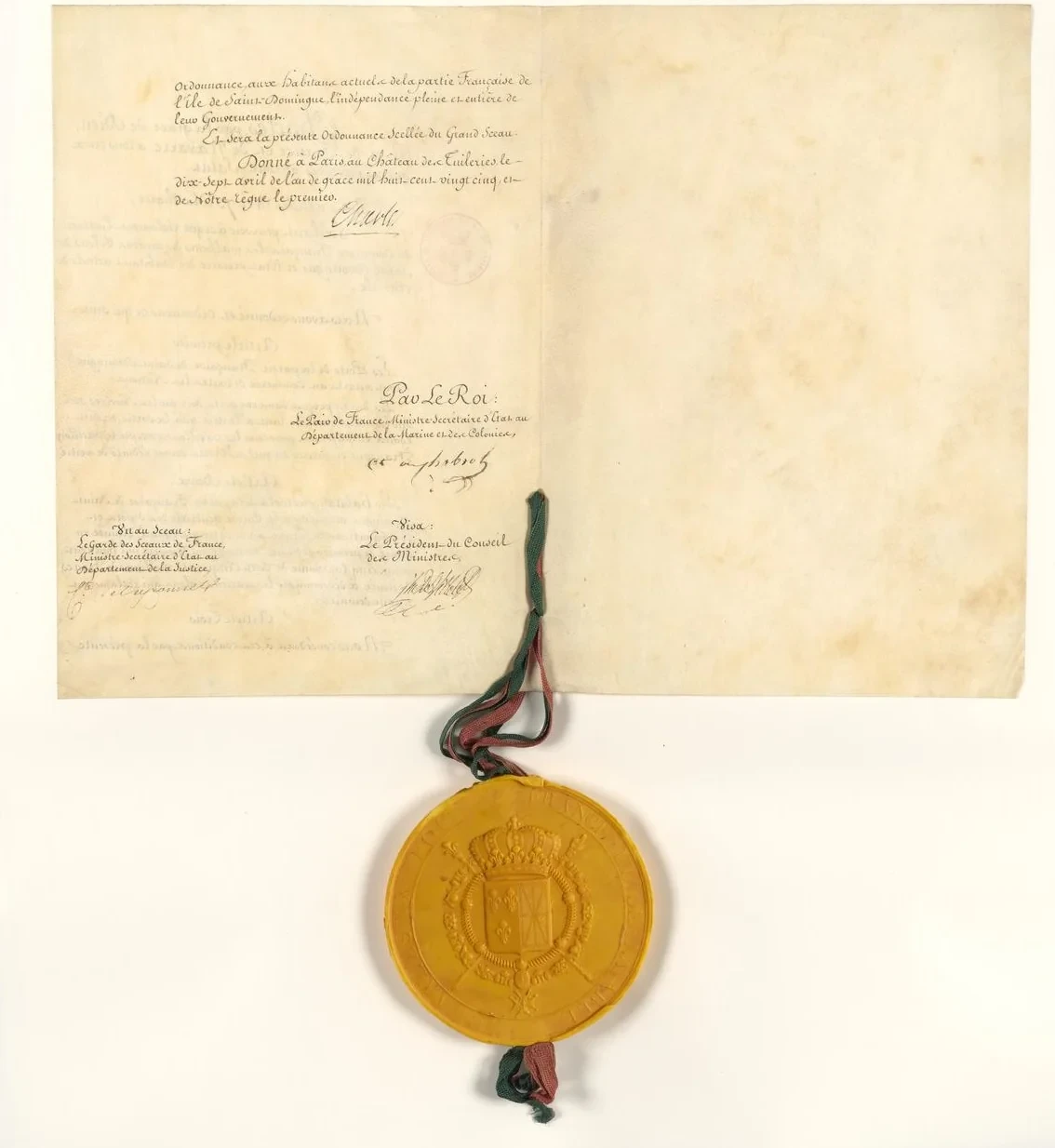
The stated beneficiaries were former colonists claiming compensation. The people who had survived enslavement and fought for freedom were not being compensated for that exploitation. The arrangement instead validated claims associated with the property order they had overturned. Its legal vocabulary made the direction of the transfer appear administrative, but the underlying question was political: whose losses would the new relationship recognise and finance?
The ordinance did not list a purchase price for each formerly enslaved person. Later compensation procedures valued former estates and other property, with the enslaved workforce embedded in the productive wealth being assessed. The history of the valuations requires that distinction. Calling the indemnity compensation for colonial losses is accurate; reducing every calculation to a simple per-person invoice would be misleading.
Borrowing to pay did not make the burden disappear
Five equal instalments of a 150-million-franc indemnity meant an annual payment of 30 million francs. To help meet the first demand, Haiti contracted a loan on the French market with a nominal value of 30 million. The money actually available was lower: the transaction yielded 24 million after the discount and associated costs. The country therefore acquired a loan obligation that exceeded the immediate cash it received.
These figures explain the phrase “double debt”. One obligation was the indemnity payable in connection with former colonists’ compensation. Another was the financial debt to the people and institutions financing a payment. Research on the loan’s creditors follows their different claims. Borrowing could satisfy part of the first demand while creating another future stream of repayments and interest.
FOLLOW THE PROCESS
Follow the first payment without double-counting
Start with the demand
150 million francs, divided into five annual instalments of 30 million.
Distinguish a loan’s face value
A 30-million-franc borrowing obligation did not put 30 million in usable cash into Haiti’s treasury.
Track actual proceeds
About 24 million reached Haiti; additional resources were needed to meet the full first instalment.
Track the remaining claims
A payment reduced the indemnity balance, while the loan still had to be serviced. Do not add every headline number as if it described a separate unchanged stock.
This is why “double” should not be read as a simple instruction to multiply 150 million by two. Principal, payments already made, interest, commissions and later refinancing are different accounting categories. The word describes the linked burdens through which an imposed obligation generated borrowing. A clear account follows those connections instead of producing an impressive total from incompatible figures.

A state debt reached people who had not negotiated it
The agreement was between governments, but the resources came from a society still rebuilding after prolonged war and political division. Export earnings and customs revenues connected rural production to the state’s ability to pay. A cultivator did not need to sign a French loan contract for the burden to affect the fiscal pressures around their work. The formal location of the debt and the social location of its cost were different.
The trade preference intensified that problem. The same settlement demanded a large transfer and gave French commerce a reduction in duties. Whether a particular transaction increased or diminished total revenue depended on trade and collection, but the rule unquestionably limited the equal tariff treatment promised for other flags. Recognition came with terms affecting how the government could raise money through its ports.
LOOK FROM HERE
Three positions in the financial relationship
It had to obtain cash, maintain public authority and consider the consequences of refusing a demand backed by naval power.
The arrangement created procedures through which losses associated with the colonial property order could become payments.
They expected repayment under a loan contract, whose legal form and later bargaining differed from the indemnity itself.
A creditor could present the loan as a normal investment or even as assistance to the new country. The terms through which that investment became necessary must remain in the picture. The origin in coercive recognition did not vanish when money passed through a private financial contract. Equally, the differences among creditors matter if we want to understand who pressed which demands later.
The terms were renegotiated, not paid away in 1825
The original schedule proved unsustainable. In 1838 a new financial settlement fixed the outstanding indemnity at 60 million francs. This is conventionally described as reducing the original indemnity to a total of 90 million, taking the earlier 30-million payment into account. The treaty’s article 1 specifies the 60-million balance. It is important not to report that figure as though it were the original demand or a complete total including every separate loan charge.
Later repayments, borrowing and refinancing extended the consequences well beyond 1825. They did not all belong to the same unchanged contract. A claim about a final repayment date must identify which obligation it concerns. The first indemnity, the loan taken to meet it and later debts cannot responsibly be merged into one timeless number with one self-explanatory ending.
TURNING POINTS
Separate the decision from its later financial history
- 1804
Independence declared
Haiti rejects French sovereignty after military victory.
- 1825
Conditional recognition
The ordinance and naval pressure impose compensation and commercial privileges; borrowing helps finance the first payment.
- 1838
A revised settlement
The outstanding indemnity is fixed at 60 million francs under a new schedule.
- Later nineteenth century
Continuing creditor relations
Repayment, claims and financial arrangements evolve; each requires its own accounting.
This chapter explains the change of 1825, with later dates used only to distinguish its aftermath.
An imposed burden is a cause to investigate, not a complete destiny
Money transferred abroad could not be used for another purpose within Haiti at the same time. Debt service therefore constrained public choices, while the conditions of collection also mattered to the population. This is a substantial consequence without attaching an unverified modern-dollar equivalent or assuming we can calculate every road, school or alternative future that would otherwise have existed.
The indemnity is not a sufficient explanation for every later crisis, policy or inequality. It is a concrete mechanism through which the former colonial relationship continued to extract resources after independence. Its significance becomes clearer when its terms, beneficiaries and financing are specified. The injustice does not need exaggerated arithmetic; it is already visible in the direction of the claim and the pressure that made it effective.
TAKE THIS WITH YOU
Recognition came with terms that carried colonial claims forward
Read the three articles together
Commercial preference, indemnity and recognition belonged to one conditional arrangement.
Keep the accounts separate
150 million demanded, 30 million per original instalment, 24 million in loan proceeds and the later 60-million balance describe different things.
Follow the cost beyond the signatories
Public revenues linked an international settlement to the work and choices of people who had not negotiated it.
The concluding chapter returns to the Path’s question. The revolution had won emancipation and independence. What followed shows how those achievements could remain real while social power and the terms of international recognition continued to limit the freedom people could exercise.