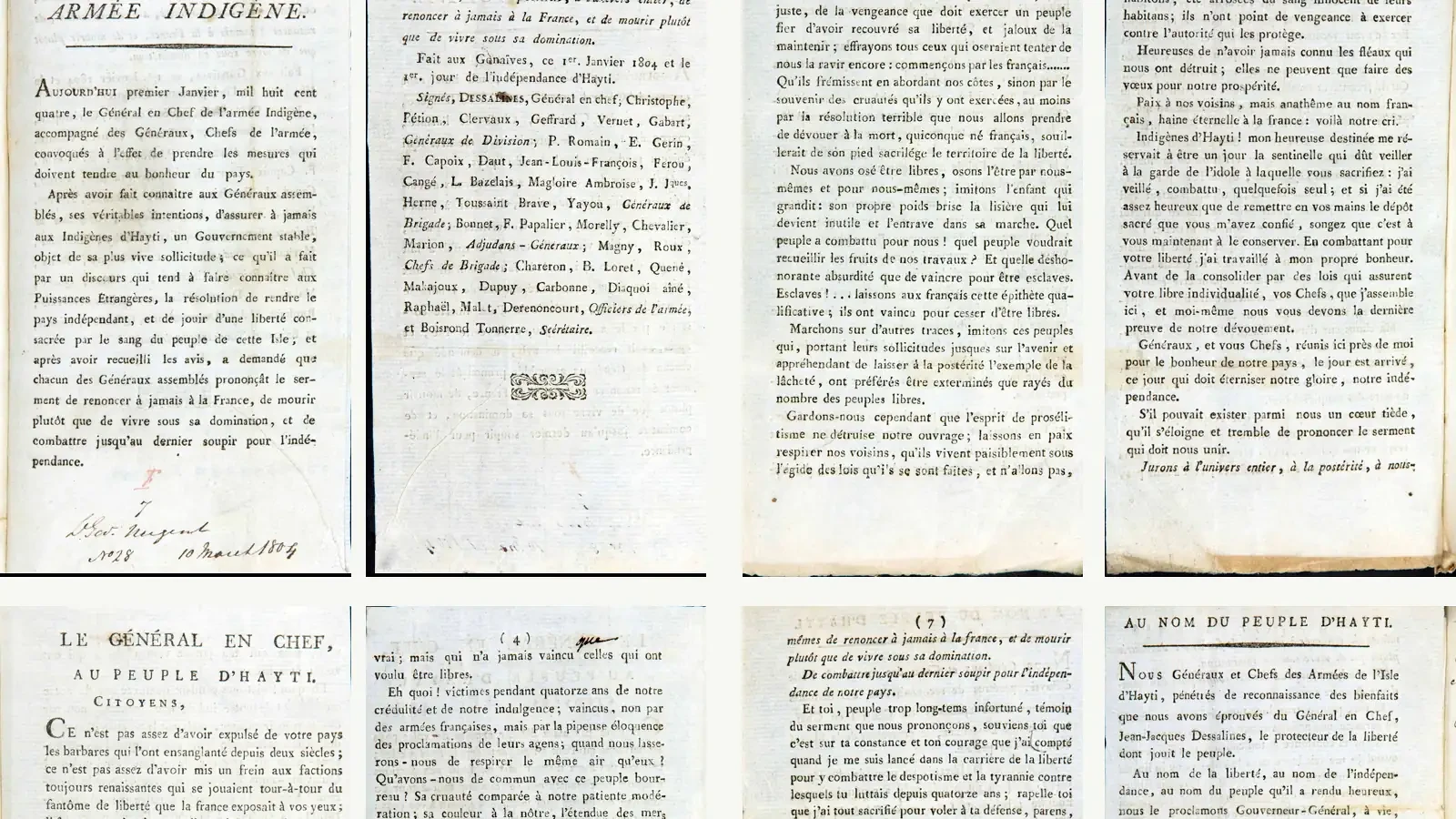
The declaration made at Gonaïves on 1 January 1804 asked its audience to think beyond the expulsion of an army. The accompanying address insisted that the danger of renewed enslavement had to be ended permanently. Separation from France was presented as the means of securing that future. The declaration and military oath therefore concerned the survival of freedom as well as the existence of a new state.
That was an immense achievement. People whom colonial law had treated as property had defeated a power that tried to regain control of them. Yet “freedom” could answer several questions: freedom from ownership, freedom from foreign rule, the ability to choose work, access to land and participation in government. Independence changed the relationship with France without automatically making every one of those answers identical.
PLACE & TIME
A sovereign state with unfinished social questions
Gonaïves and the western part of Hispaniola
Caribbean
1804–1806 CE
The proclamation’s city is a reference point for debates that concerned a much wider society.
The founding act separated the country from France
The surviving document includes an address and an act in which commanders commit themselves to renouncing French domination and defending independence. These are political interventions addressed to different audiences, not a complete account of what every person wanted. Military leaders spoke in the name of a people whose efforts had made victory possible. The form of the act reflects the army’s central place in the state taking shape.
Its urgency came from recent experience. French republican authority had once recognised emancipation; a later French expedition had sought to subdue the colony while slavery was being maintained or restored elsewhere. The guarantee of freedom could no longer safely depend on a metropolitan decision remaining unchanged. Independence aimed to remove that power over Haiti’s future. It was not merely a replacement of officials while the old sovereign retained the right to decide.
KEEP THE DISTINCTION
Four meanings of freedom require four questions
Freedom from ownership
Could a person legally be held as someone else’s property?
Whether labour would be freely chosen under the new government.
Sovereignty
Could France again claim the right to govern the country?
Whether other states would recognise Haiti or cease threatening it.
Material autonomy
Could people obtain land, support families and decide where to work?
How former plantations and public property would be organised.
Political participation
Who could influence laws and command the state?
Whether military victory would lead to an equally shared voice in government.
Military leadership became the basis of government
Dessalines’s authority grew from the struggle that had expelled the French. During 1804 he moved from the position of governor-general to emperor. The constitution of 1805 organised an independent empire and recognised him as its head. Calling Haiti the first Black republic is a familiar way of marking its historical significance; it should not obscure the actual form of government adopted in these first years.
The constitution’s provisions on executive power concentrated authority in the emperor and allowed him to designate a successor. The document spoke in the language of the people’s will, but that claim was different from a political system in which everyone could equally choose the government. A population could have won freedom from enslavement and still face a powerful military state whose decisions it could not easily control.
KEY IDEA
Liberation from foreign domination could support a commander’s claim to rule. It did not automatically supply equal political influence to those who had fought, worked and survived.
This does not make the defeat of slavery a merely symbolic event. The right of another person to own someone and the right of a government to command work are different forms of power, even when both can be coercive. Their distinction helps explain the new possibilities of life after emancipation and the conflicts that continued within them.
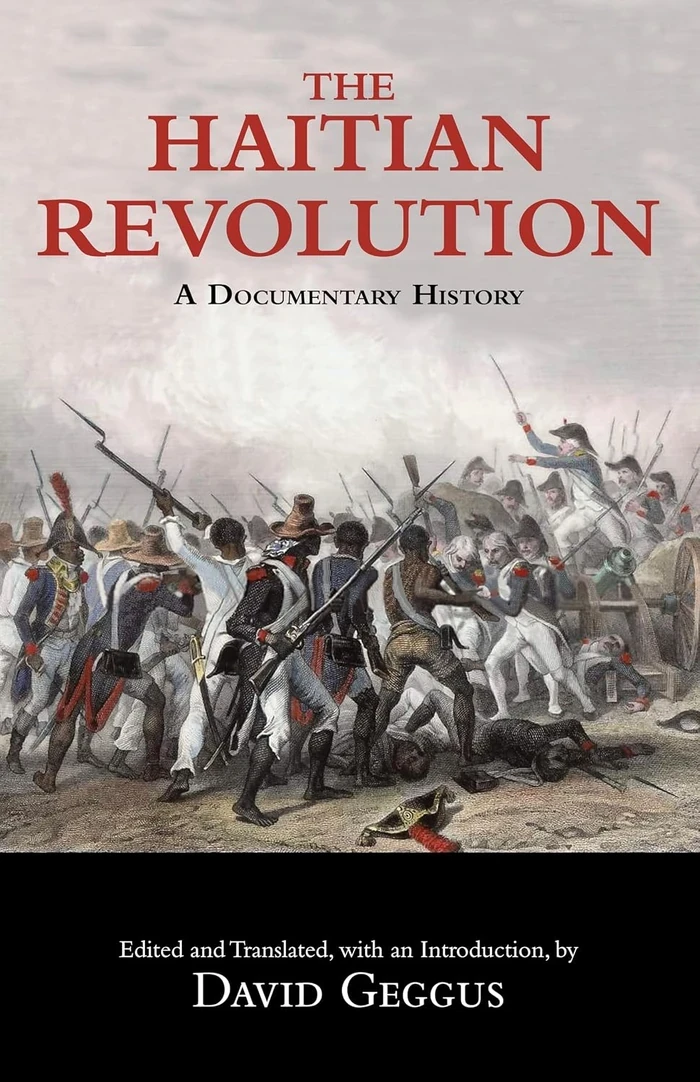
Citizenship was shaped by the defence of emancipation
Article 2 of the 1805 constitution abolished slavery forever. Article 12 barred white people from entering as masters or property owners and from acquiring property. These provisions addressed the fear that returning owners could restore the relationships the revolution had destroyed. A rule about property therefore carried a memory of plantation slavery as well as an assertion of the new state’s power to decide who could establish ownership within it.
The next article complicated any simple equation between whiteness and exclusion. It made exceptions for certain white women naturalised by the government and their children, and for naturalised Germans and Poles. Article 14 then declared that Haitians would be known under the general designation of Black. Reading articles 12–14 together shows a political construction of national identity that cannot be reduced to a biological description of everyone admitted.
FOLLOW THE PROCESS
How the constitution defined belonging
Protect against a return
Exclude the position of the white master or property owner associated with colonial domination.
Specify exceptions
Recognise particular naturalised people rather than impose one mechanically uniform rule.
Assert a common identity
Use Blackness as a collective national designation across distinctions the constitution sought to suppress.
Retain state authority
The government still controlled admission and claimed the power to define duties and acceptable conduct.
A shared designation did not make older social distinctions disappear in practice. Wealth, military rank, colour prejudice and connections could still shape influence. Constitutional language tells us what the state proclaimed and sought to enforce, not that it had already produced complete social equality. The value of the document is greatest when those two levels remain distinguishable.
The defence of freedom did not justify killing civilians
In 1804 Dessalines ordered mass killings of remaining French white residents. Civilians, including women and children, were among the victims. These killings belonged to the aftermath of a war marked by French atrocities and a profound fear of renewed domination. That context helps explain the policies and claims through which violence was organised. It does not turn every targeted civilian into an invading soldier or make the killings a necessary definition of freedom.
The case is especially important because it resists a comforting division between a wholly innocent new state and violence located only in the former colony. A liberation struggle can destroy a system of dehumanisation while its victors commit grave wrongs. Historical explanation must preserve both the reality of the achievement and the responsibility for decisions made after victory. The exceptional protections and exclusions in later constitutional language do not erase the deaths.
LOOK FROM HERE
Whose security was being described?
The recent expedition gave people compelling reasons to demand a state capable of preventing a return to ownership.
Its leaders could present centralised authority and coercive measures as indispensable to national defence.
A person’s classification did not establish individual guilt or make violence against them harmless to the society being founded.
The plantation’s future remained a social question
Independence left extensive estates and other property whose ownership or administration had been transformed by flight, confiscation and war. The new state needed revenue, imported supplies and an army. Cultivators needed land, time and a way to sustain their households. An export policy could promise the means to defend independence while demanding labour arrangements that frustrated the people doing the work.
This conflict had not begun in 1804. The constitution of 1801 had already paired abolition with restrictions on cultivators’ movement. Those earlier agricultural provisions explain the inheritance facing independent Haiti: rejecting French sovereignty did not by itself determine whether estates would remain large, how revenues would be divided or who could leave a workplace. A political act of separation still had to be followed by social decisions.
Freedom from sale and inherited slave status changed the relationship between people and property fundamentally. It also enlarged the stakes of work and family. Decisions about cultivation, residence and access to land now concerned what a person could make of a legally free life. Treating those disputes as mere laziness or disorder repeats the viewpoint of authorities who measured liberty chiefly through the continuation of output.
The nation’s family was not a promise of equal power
The constitution used a familial language of national unity and described the good citizen through roles such as father, husband and soldier. It also specified protections relating to children and family. Women nevertheless appear in the state’s legal arrangements without receiving equal participation in its political authority. Recognising their presence in war, labour and household life requires more than adding their names to an otherwise unchanged story about male rulers.
The exceptions for naturalised white women are a useful example. Their inclusion shows that the categories were legally constructed and qualified. It does not demonstrate political equality for women as a whole. The question remains what particular recognition allowed a person to do, own or claim, and what remained under another authority’s control.
A territorial claim was not the same as secure control
The new government asserted a broad territorial future, but French forces remained in eastern Hispaniola after the defeat in the west. The 1805 campaign against French-held Santo Domingo brought further war and violence to eastern communities. The island’s political history should therefore not be flattened into a single population experiencing the same liberation at the same moment. Claims to defend independence could also create conflict over the rule imposed on others.
Dessalines was killed in 1806, and rival political centres emerged. These later divisions do not prove independence had achieved nothing. They show that the new state’s social settlement was contested rather than completed by a proclamation. Julia Gaffield’s account of Haiti’s early international connections likewise encourages a distinction between a declaration, recognition and the practical relationships that sustained a sovereign country.
TAKE THIS WITH YOU
Independence secured a future that still had to be governed
Keep the transformations distinct
Abolition, national sovereignty and an equal political voice were related without being interchangeable.
Read the qualifications
The constitution’s national Black identity, exclusions and exceptions must be read together.
Explain without excusing
The threat of re-enslavement matters to the history of state violence; it does not justify collective punishment of civilians.
The next chapter follows one of the most consequential outside pressures on this new freedom. In 1825 France offered recognition on conditions that transferred money and commercial advantage back towards the former colonial power.