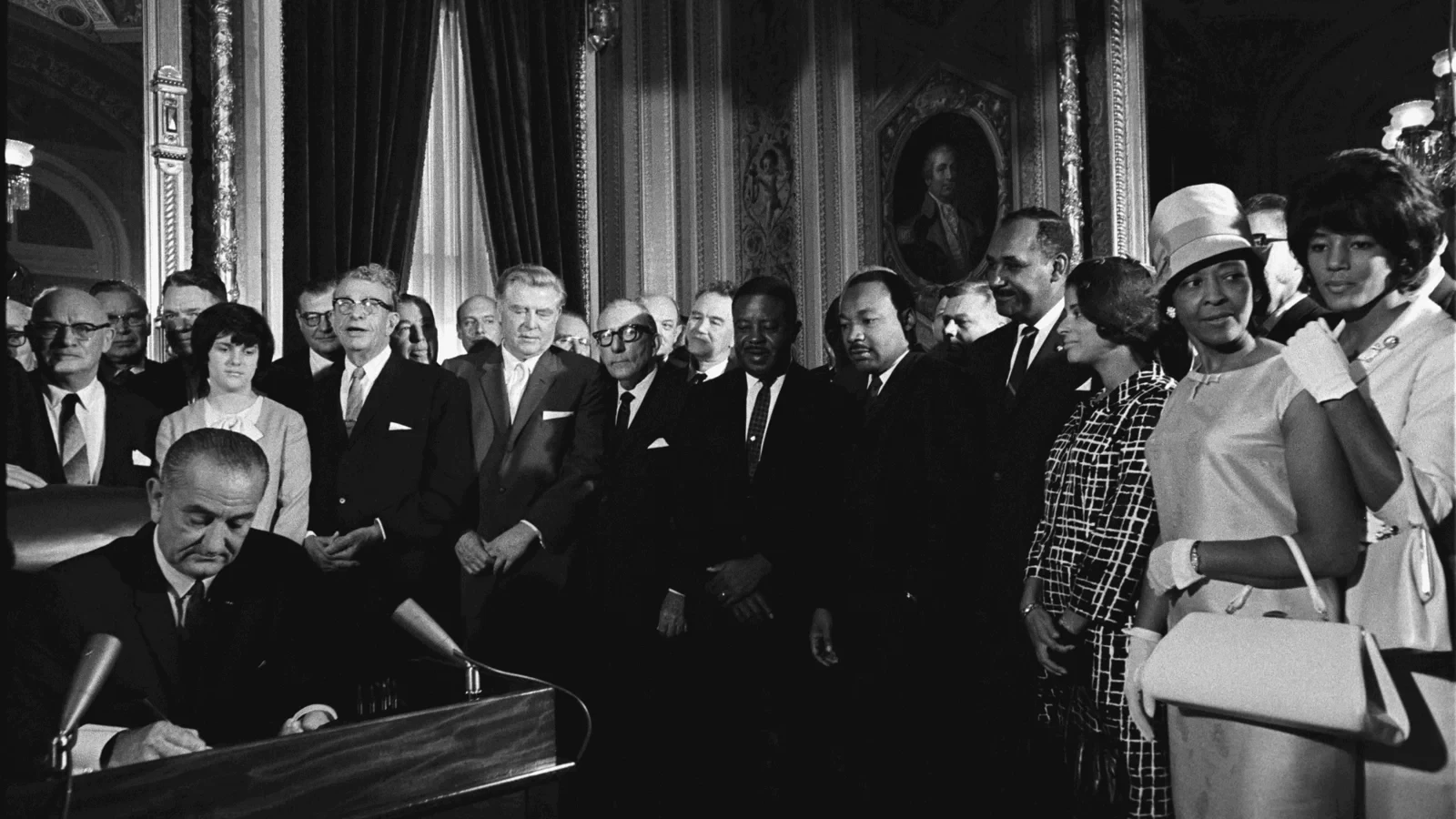
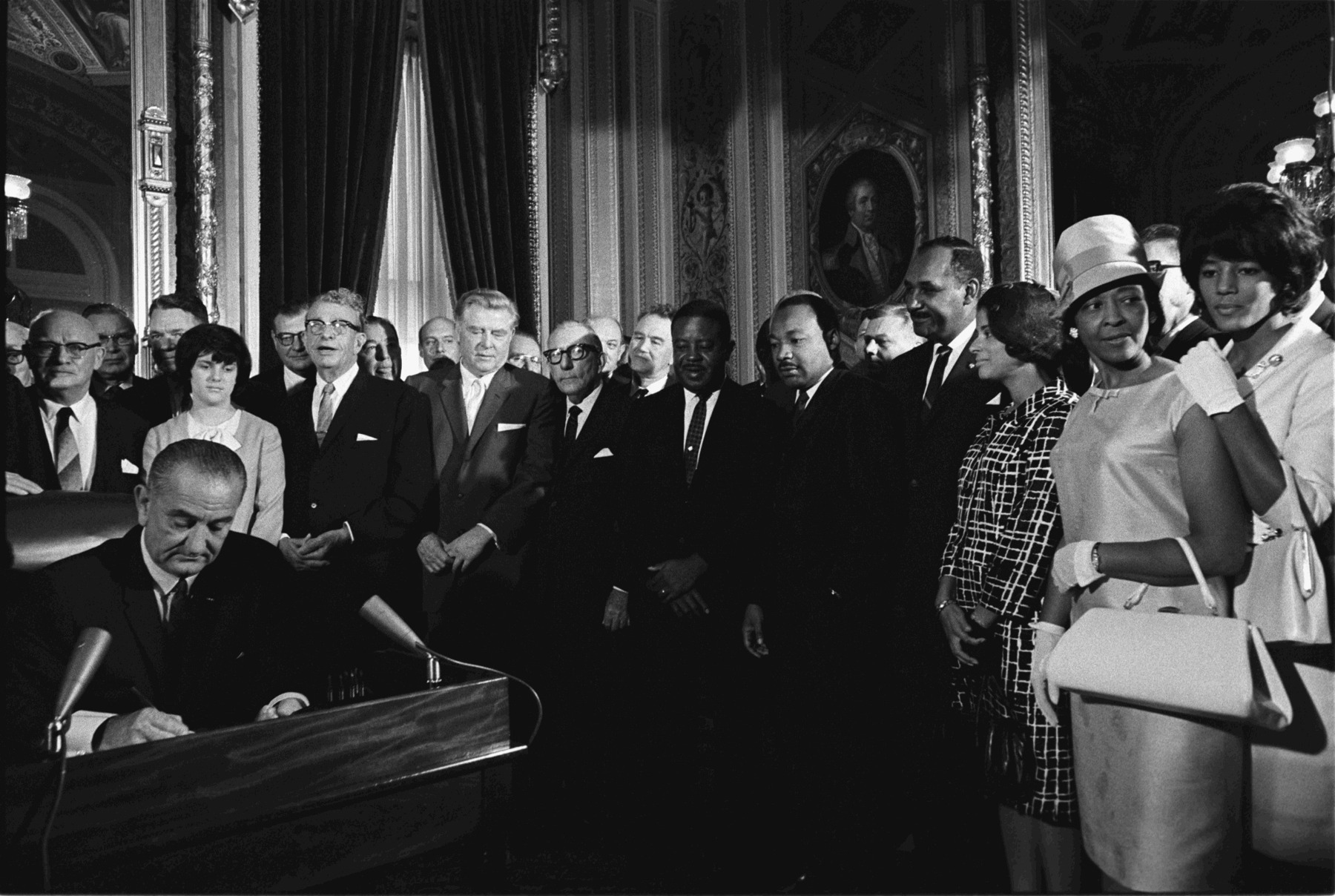
On 6 August 1965, President Lyndon B. Johnson signed the Voting Rights Act in Washington. The photograph of the ceremony gives the struggle a clear milestone. For a Black resident trying to register in the South, however, the next question was practical: would the registration office now accept the application, and could that person vote without retaliation?
The law changed the federal government’s ability to intervene. It helped open voter rolls that discriminatory officials had kept closed. It did not instantly remove intimidation, replace local political organisations or ensure that new voters could elect their preferred candidates. Follow the years from 1965 to 1968 to see both the substantial change and the work it required.
PLACE & TIME
A national law, tested in local politics
Hayneville · Lowndes County
Alabama · Southern United States
1965–1968 CE
Local case
What did the Voting Rights Act of 1965 change?
The constitutional promise was older. The Fifteenth Amendment, ratified in 1870, prohibited denying or abridging citizens’ voting rights because of race, colour or previous enslavement. Yet a promise could be obstructed through registration rules, discriminatory administration and violence. The 1965 Act addressed the machinery of exclusion, rather than inventing the right from nothing.
Section 2 of the original Act prohibited racially discriminatory voting qualifications and practices nationwide. Other provisions supplied special remedies for covered jurisdictions. Their initial coverage formula combined use of a test or device on 1 November 1964 with registration or presidential-election participation below 50 per cent of the voting-age population. Coverage was not simply another name for every Southern state.
- Suspended tests and devices: covered jurisdictions could no longer use the specified barriers to determine voting eligibility.
- Federal examiners: where appointed under the Act, they assessed applicants and listed qualified people for voting.
- Federal observers: where authorised, they could watch voting and ballot counting.
- Preclearance: covered jurisdictions needed federal clearance before enforcing covered changes to voting procedures.
Federal enforcement could bypass an obstructive gatekeeper
A literacy test was more than a neutral reading exercise when officials controlled its questions and marked applicants differently. The Act’s definition of tests and devices also reached requirements involving educational attainment, good moral character and vouchers from registered voters. Suspending those devices reduced officials’ ability to make racial exclusion look like an ordinary qualification.
Examiners added a different route. Under Sections 6 and 7, federal appointments depended on the statutory conditions; the law did not send an examiner automatically to every county. Qualified applicants were placed on federal lists, and state or local officials had to put those names on the official voting lists. The registration office’s refusal was no longer necessarily the last word.
KEY THOUGHT
A prohibition became more effective when officials enforcing exclusion could be bypassed, observed or required to submit changes for review.
Why did changes to voting rules need federal review?
Removing one barrier left a danger: an authority could introduce a replacement. Section 5 required covered changes from the rules in force on 1 November 1964 to obtain federal clearance. One route was a declaratory judgment from the federal district court in Washington; another was submission to the attorney general, with no objection within sixty days.
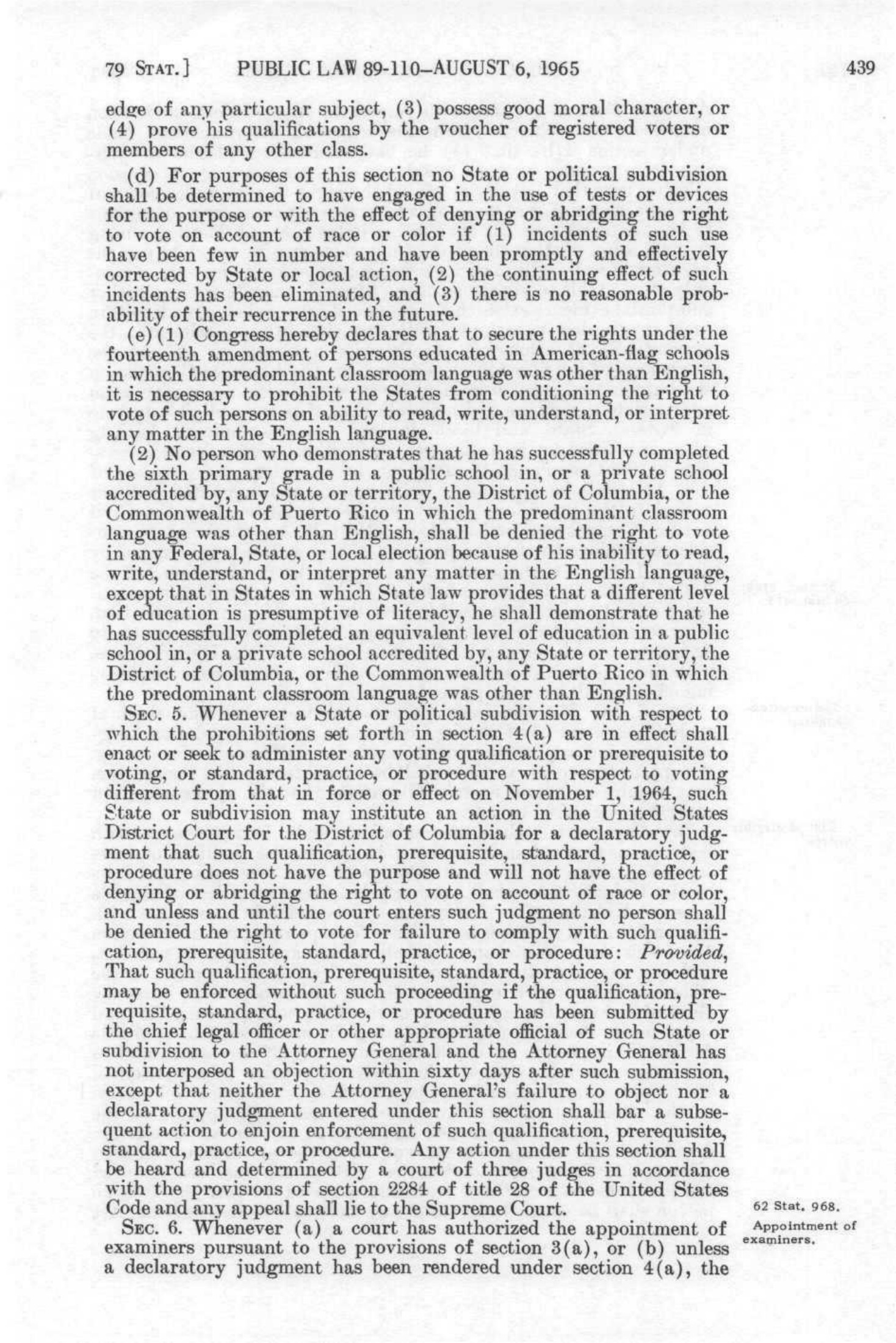
That review addressed racial purpose and effect. It shifted some work from challenging an implemented rule to checking a change before enforcement. Clearance still did not make a measure immune from a later challenge. Nor should this historical account be read as a description of present-day law: the mechanism discussed here is the one enacted in 1965.
Yoichi Okamoto · White House / LBJ Library · Public domain · resized and jpeg encoded.
Mississippi’s registration figures show a large shift
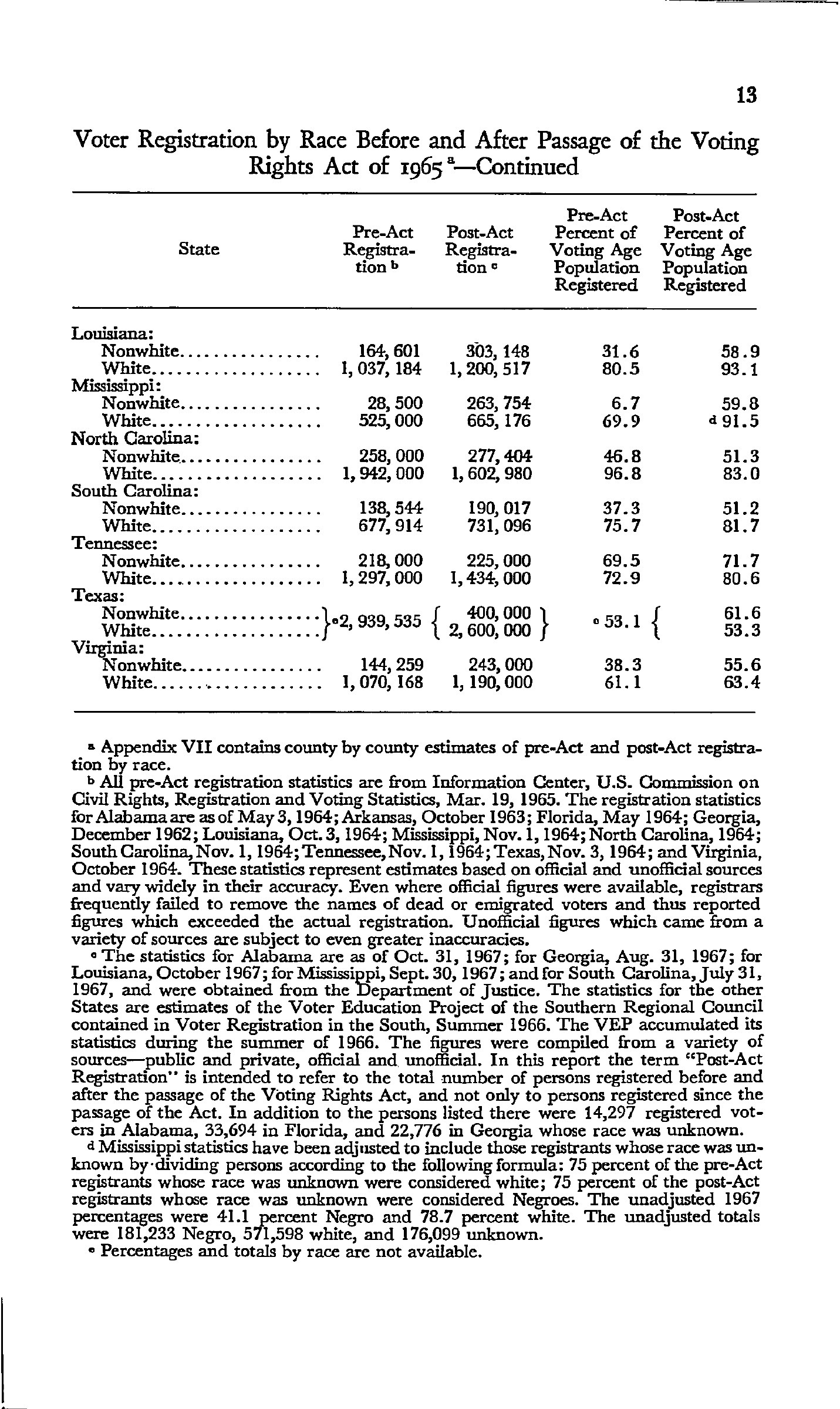
A near-contemporary comparison comes from Political Participation, the U.S. Commission on Civil Rights report issued in May 1968. Its table gives Mississippi’s estimated Black registration rate as 6.7 per cent before the Act and 59.8 per cent afterward. The observations are dated 1 November 1964 and 30 September 1967—not the day before and the day after the signing.
| Mississippi observation | Estimated Black voting-age population registered |
|---|---|
| 1 November 1964 · before the Act | 6.7% |
| 30 September 1967 · after the Act | 59.8% |
Subtracting the two published percentages gives a rise of 53.1 percentage points. That is substantial evidence of expanded registration. It is not a measurement of how many people cast ballots, how they voted or which candidates won. The later registration total includes people already registered before the Act as well as subsequent registrations.
The footnotes are part of the result
The Commission warns that its earlier figures draw on official and unofficial estimates of uneven accuracy. Rolls could retain people who had died or moved away. For Mississippi, it also allocated registrations whose race was unknown: 75 per cent of the earlier unknown group was treated as white, and 75 per cent of the later unknown group as Black.
The report gives the unadjusted 1967 Black percentage as 41.1, alongside a large group whose race was not recorded. That does not cancel the increase. It does mean that 59.8 should be described as the report’s adjusted estimate, rather than an exact count of identified Black registrants. A decimal point cannot remove uncertainty in the underlying records.
TEST THE EVIDENCE
Does 59.8 per cent mean that many people voted?
The table proves that 59.8 per cent of Black Mississippians cast ballots in 1967.
- SHOWS
- Registration totals and percentages, with Mississippi among several states.
- SUPPORTS
- Access to the voter rolls expanded greatly between the dated observations.
- CANNOT PROVE
- Ballots cast, individual choices or the law’s isolated effect apart from organising and other changes. Racial allocation assumptions affect the Mississippi figures.
A better-supported reading
It reports an adjusted registration estimate as a share of the voting-age population. It does not report turnout.
Original table: Political Participation · page 13 and footnotes ·
U.S. Commission on Civil Rights · Public domain · pdf page rasterised and jpeg encoded; text and footnotes retained.
What happened after registration?
An accepted name created an opportunity; using it required further steps. Organisers helped people navigate elections and connect a ballot to the powers of particular offices. A registration increase therefore measures one important part of participation. It cannot stand for every task involved in building an effective political constituency.
KEEP THE DISTINCTION
Access and influence leave different evidence
Registration
A qualified person gets onto the voting lists.
Will that person be able to cast a ballot safely?
Voting
A ballot is cast and counted.
How do district boundaries and election rules affect representation?
Candidacy
A candidate qualifies to appear on the ballot.
Can an organisation campaign, win office and influence decisions?
Lowndes County connected the vote with county government
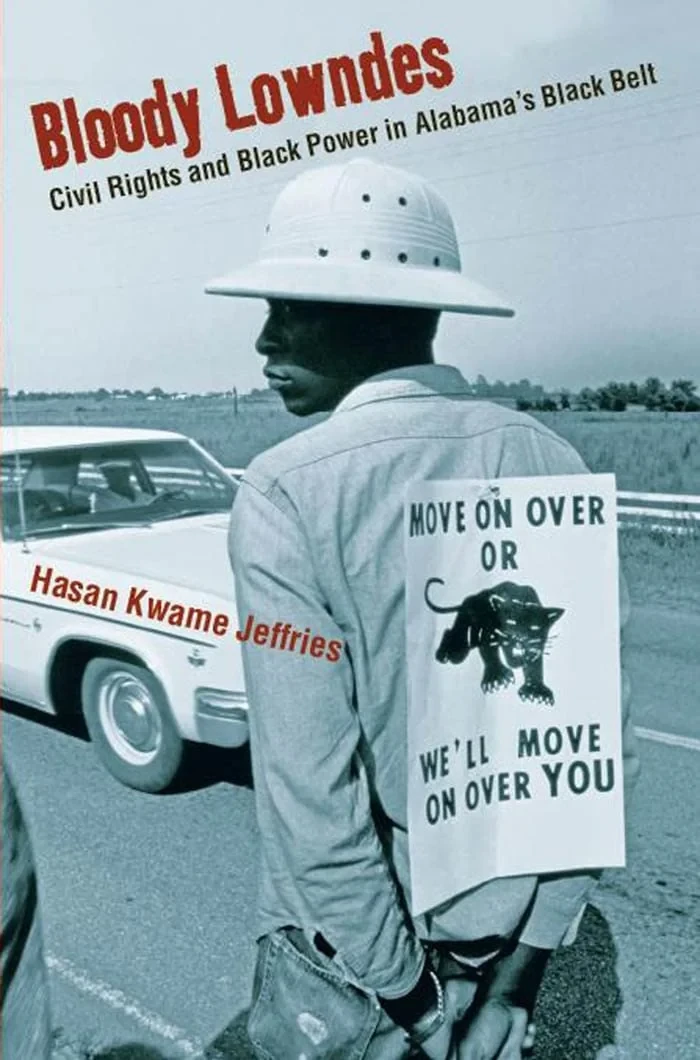
In Lowndes County, SNCC—the Student Nonviolent Coordinating Committee—worked with the local Christian Movement for Human Rights to register Black residents. Its political education work in 1965–1966 also explained the powers of county offices. Workshops and comic-book pamphlets explored positions such as sheriff, tax collector and school-board member. The question became what those offices could do for local people.
Residents formed the Lowndes County Freedom Organization, an independent political organisation with a black panther as its ballot symbol. This was a local attempt to choose candidates and organise around government decisions. The voting-rights struggle could continue through election work, rather than end once federal legislation existed.
New voters still faced barriers to candidacy and voting
The Commission’s report supplies a concrete example from Lowndes. In February 1966, the county Democratic executive committee increased primary filing fees tenfold. The fee for sheriff rose from $50 to $500. The report records both an LCFO attorney and the county solicitor interpreting the increase as an obstacle to Black candidacy; that interpretation is attributed, rather than presented as an admission by the committee.
LCFO instead fielded seven independent candidates in the November 1966 general election. All lost. The SNCC Digital Gateway’s later account describes fear of retaliation and coercion of tenant farmers among the reasons. A vote could put someone’s housing or livelihood at risk even when registration had become legally easier. Defeat did not mean that no change had occurred: Black residents had organised to choose and support their own candidates.
Yoichi Okamoto · White House / LBJ Library · Public domain · resized and jpeg encoded.
Officials could change the relationship between votes and seats
Across the areas it examined, the Commission documented obstacles extending beyond registration. These included changes in election structures, impediments to candidacy, unequal treatment at polling places, intimidation and exclusion from party affairs. Its findings help explain why enforcement had to address political participation as well as the application form.
One mechanism was a switch from district elections to countywide, or at-large, elections. Where Black voters were concentrated in a district, a countywide contest could weaken their ability to elect a preferred representative. The report discusses Mississippi legislation of 1966 in this context. The relevant question is how the structure affected representation in a particular place, rather than whether every at-large election necessarily had the same effect.
- Watch the voter rolls: who can qualify and be listed?
- Watch the polling place: who can cast a ballot and have it counted?
- Watch the election structure: which voters choose which seats?
- Watch local power: who controls candidacy, party procedures and the risks of participation?
The 1968 report records progress and continuing enforcement needs
The Commission investigated 55 counties in ten Southern states, using interviews, official materials and other evidence, largely concerning the 1966 elections. It selected counties for specific issues and contrasts; this was not a random survey of every Southern community. The report distinguishes allegations and interview accounts from its broader findings, and should not be treated as a complete catalogue of every election.
By May 1968, the change was clear enough to document without claiming completion. Federal intervention had helped enlarge participation; local organising turned new opportunities into campaigns. Retaliation and changes to political rules could still obstruct influence. The Act altered the struggle’s conditions and gave people stronger tools. It also made the next questions—about representation, enforcement and power—harder to avoid.