
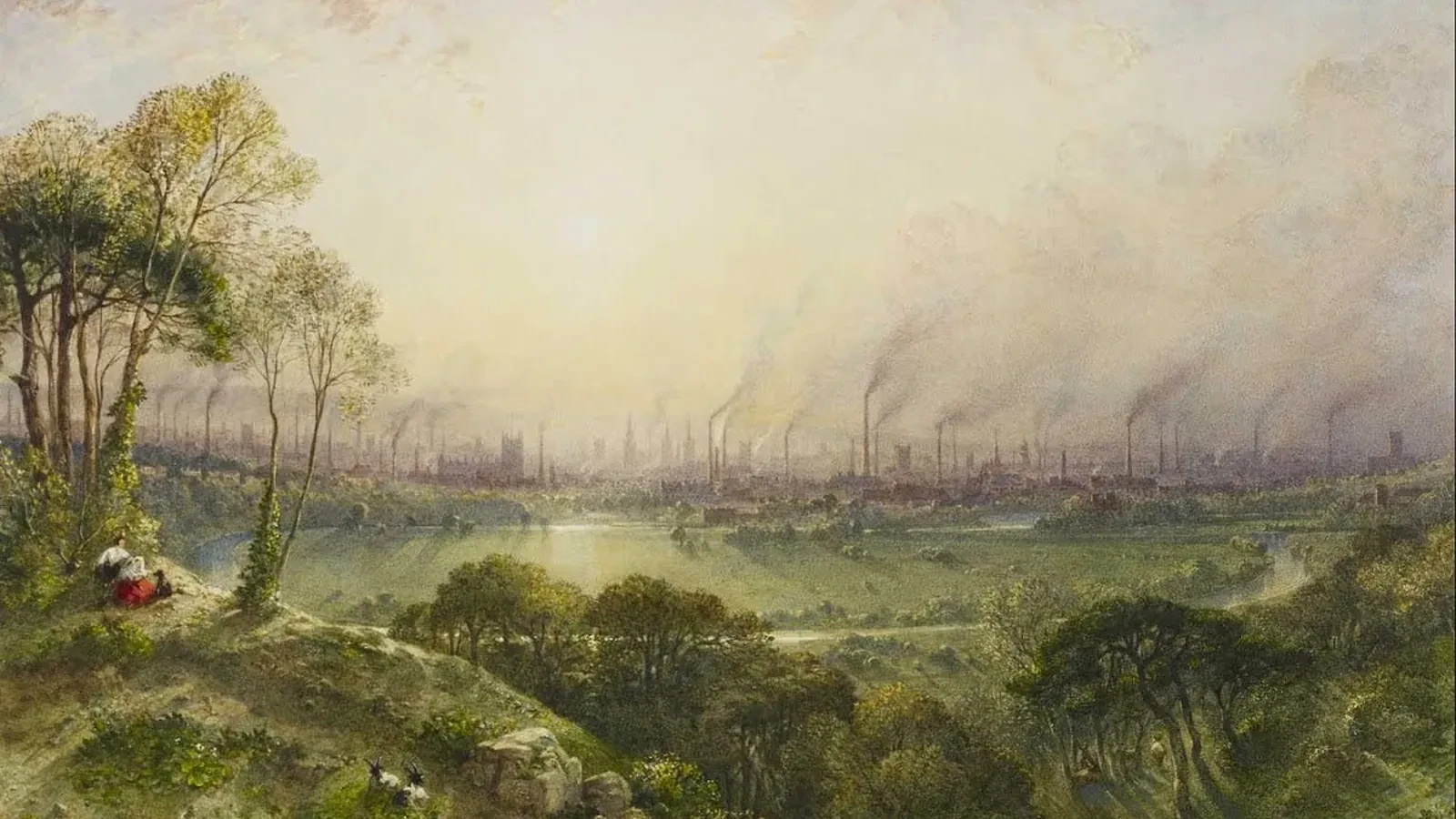
From Kersal Moor, Manchester looks almost magnificent. In William Wyld’s 1852 watercolour, evening light catches the city beyond a green hillside. Chimneys punctuate the horizon; figures and goats occupy the foreground. Distance makes industrial growth into a landscape. It also keeps the working day, the household budget and the cotton field beyond the Atlantic out of sight.
That distance is the problem this story path has gradually closed. We entered mills, followed power and fibre, listened to accounts of childhood work, and examined protest, unions and regulation. Its final question needs more than a balance sheet: who benefited from the Industrial Revolution, when, and in what part of their lives? A larger economy could coexist with restricted choices. Improvements could be real without arriving together.
PLACE & TIME
One transformation, several measures of progress
Britain and the Atlantic cotton economy
Map anchor: Ancoats, Manchester
c. 1760–1878 CE
Period covered in this article
The skyline shows expansion. It cannot show the distribution.
Wyld painted this view after Queen Victoria’s visit to Manchester in 1851. The Royal Collection’s account explains its royal commission and picturesque composition. Smoke belongs to the city’s visual presence, but the painting is neither an air-quality survey nor a record of workers’ earnings. Its beauty is useful precisely because it invites a question: what does a view of progress leave outside the frame?
LOOK CLOSELY
A city seen from a comfortable distance
Begin with the hillside
The figures and goats give the foreground a pastoral character. They are not a sample of Manchester’s factory workforce.
Follow the distant chimneys
The skyline makes a growing industrial city visible. It cannot tell us how much each person earned or how safely they worked.
Notice the inviting light
This is a composed watercolour commissioned for a royal collection. Its atmosphere belongs to an artistic interpretation of the city.

Manchester from Kersal Moor, with rustic figures and goats, William Wyld, 1852. Royal Collection, RCIN 920223.
The opening chapter’s cotton mills offered another viewpoint: buildings connected to canals, merchants and a distant supply of fibre. Their survival helps us recover how production was organised. Yet a successful mill was not a single experience. An investor, an employed child and a person forced to pick its raw material could stand in the same commercial network while having radically different claims on its rewards.
A better machine answered an engineering question
Consider Old Bess, built in 1777 for Matthew Boulton’s Soho works. It pumped water back into a supply feeding waterwheels. Steam supported an existing power arrangement rather than instantly replacing it. The chapter on steam and water matters here because industrial change was assembled: useful machinery depended on a particular site, its fuel, its water and the work it was meant to do.
Reliable production could benefit owners and sustain employment. It did not itself decide pay, working hours or control over the day. Those outcomes depended on employment arrangements, household alternatives and regulation. An engine’s capacity and a person’s wellbeing belong in the same history, but they are different measurements.
More output was not the same as more purchasing power
Economic historian Robert C. Allen makes the timing problem concrete. In the series discussed in his 2009 article, British output per worker rose by 46 per cent between 1780 and 1840, while the real-wage index he uses rose by 12 per cent. These are reconstructed aggregates, with contested alternatives—not each family’s experience. They challenge the assumption that productivity and purchasing power rose together. Allen also identifies stronger wage growth later in the nineteenth century; timing changes the assessment.
- Output per worker asks how much production a worker’s labour supported.
- A real wage adjusts earnings for prices: how much those earnings could buy.
- Neither measure alone tells us about hours, safety, freedom or political rights.
A household also had more than one possible earner. Research by Jane Humphries and Benjamin Schneider brings poorly paid hand-spinning, often performed by women, into the picture. A wage series built around particular occupations cannot simply describe them all. Who supplied paid work, who performed unpaid care, and whose employment could disappear were questions concealed by the phrase “the worker”.
That is why the chapter on children’s employment placed the factory day inside family survival. Humphries’s child-labour research connects early employment with vulnerable household finances as well as demand for young workers. A child’s earnings could meet an immediate need while narrowing time for school or rest. Recognising that pressure does not turn the decision into a comfortable choice; it explains why a useful reform could also require households to adjust.
The cotton connection needs a different question about freedom
Across the Atlantic, rising demand reached people whose labour was legally coerced. Global Threads’ research traces connections between Manchester’s McConnel & Kennedy mills and cotton grown in the Caribbean and the United States. The comparison of plantations and mills therefore changes the unit of the story. Britain’s industrial economy cannot be understood only through the people who received British wages.
In his 1853 memoir, Solomon Northup described Louisiana plantation work: cotton was weighed, shortfalls could bring punishment, and the day began early. Production could be demanded through violence. An enslaved person’s circumstances cannot be captured as a low point on a British wage scale: being held as property was a different legal condition, with different constraints on movement, family and refusal.
IN THE SOURCE
An hour before day light the horn is blown.
The connection does not make every factory worker responsible for every plantation practice, or identify the source of each bale in a surviving image. It does make the boundaries of a national success story inadequate. A cheaper manufactured good could travel through a chain that combined commercial opportunity with coercion. Its low price gives us one fact about consumption; it cannot certify the conditions under which the fibre was produced.
TEST THE EVIDENCE
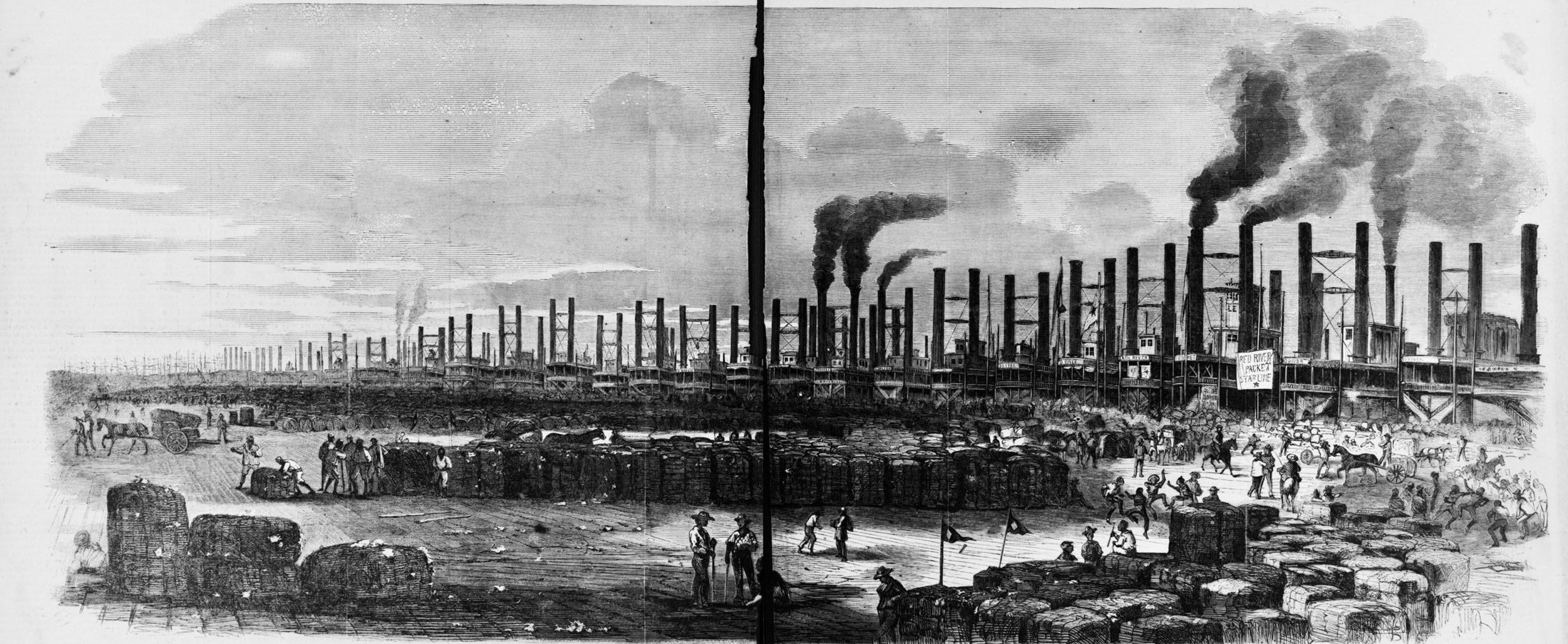
Whose gains are visible on the cotton levee?
All this activity proves that the cotton trade made everyone better off.
- VISIBLE
- Bales, steamboats and people on a commercially active waterfront.
- SUPPORTS
- Cotton depended on transport, handling and connections between places.
- CANNOT ESTABLISH
- The depicted people’s legal status, income, individual identities or each bale’s plantation of origin.
A better-supported statement
The engraving depicts cotton commerce. Other records are needed to establish the rights, earnings and conditions of the people connected to it.
Image: New Orleans levee · published 1860 · E. H. Nelson Jr. / Frank Leslie’s Illustrated Newspaper · Public domain
A voice in the city was another kind of gain
People could help sustain an industrial economy while having little formal influence over government. The Peterloo chapter followed reformers who assembled in Manchester in 1819 and met violent dispersal. The surviving sources recover a demand for representation, not merely a dispute about wages. A person’s contribution to production did not automatically bring a vote or protection for a political meeting.
The 1832 Reform Act changed representation and voting qualifications, but excluded most working men and specified male voters. Recognising reform means examining its boundaries: who gained access, who stayed outside, and how much influence those admitted could exercise.
KEEP THE DISTINCTION
Three changes that did not arrive together
More goods
Greater productive capacity and a wider supply of manufactured articles.
Higher earnings, safe employment or freedom for everyone in the supply chain.
Better earnings
More purchasing power where wages rose relative to prices.
A shorter day, equal household opportunities or protection against interruption of income.
New rights
A stronger legal or political basis for challenging decisions.
Universal inclusion, effective enforcement or the end of economic insecurity.
Security could be built collectively—and still have boundaries
The early-unions chapter brought us to contributions, rules and funds. In Thomas Wright’s 1867 discussion, engineers’ organisation appears through support for circumstances such as sickness and unemployment. Members pooled small payments to make an individual setback less solitary. This was a different achievement from increasing production: it tried to make continued livelihood less dependent on an uninterrupted run of good fortune.
Membership and eligibility mattered. A craft organisation’s protection cannot be extended in our account to every unskilled worker, woman or child simply because all worked in the industrial economy. The Trade Union Act of 1871 improved unions’ legal position, but did not settle every question about collective action. A stronger organisation could expand some people’s options while leaving many others reliant on different kinds of support.

Protection changed the question inside the workplace
The factory-laws chapter showed why a rule on paper needed evidence, inspection and an enforceable boundary. Regulation addressed aspects of the day that an earnings figure could miss: the hours children worked, schooling arrangements and exposure to machinery. The 1878 Factory and Workshop Act consolidated a wider framework. It passed in 1878 and began operating on 1 January 1879, beyond this path’s closing year.
LAYERS OF TIME
Selected changes, not a single turning point
- 1777
An engine supports waterwheels
Old Bess illustrates a specific way of combining steam and water at Soho.
- 1819
Representation is demanded
The Peterloo reform meeting brings political exclusion and state violence into view.
- 1832
Reform with exclusions
Voting qualifications change, while most working men and women remain outside the franchise.
- 1871
A changed position for unions
Legislation strengthens the legal basis for trade-union organisation.
- 1878 → 1879
A wider regulatory framework
The Factory and Workshop Act is enacted in 1878 and commences in January 1879.
These dates mark different kinds of change. They do not imply that every person gained the same protection or opportunity.
These changes were significant without being complete. A shorter permitted day was a gain in time; schooling conditions concerned learning; safety provisions addressed bodily risk. Their practical effects depended on coverage and enforcement. None could be inferred simply from a mill’s profitable operation, and none required us to pretend that all industrial experience was misery before a single reform date.
Ask who, when—and what became possible
The answer to the closing question is therefore uneven. Owners could gain from expanded production and investment. Some workers acquired better earnings, collective support or greater protection, at different times and within different boundaries. Consumers could benefit from a larger supply of goods. Those opportunities sat alongside difficult family calculations, political exclusion and a cotton economy involving enslaved labour. No one group’s improvement cancels another’s constraint.
FOLLOW THE PROCESS
A better way to assess industrial progress
Name the people
Specify the worker, household, owner or supplier; avoid an imaginary average life.
Fix the period
Separate the early decades from later changes, and enactment from operation.
Choose the measure
Ask about purchasing power, time, safety, freedom, education or influence.
Check the reach
Identify exclusions, enforcement and connections beyond the place being studied.
Later gains could not restore an exhausted childhood. Yet acknowledging earlier losses should not erase opportunities people subsequently made through learning, association and political struggle. Chronology and individual circumstances allow us to recognise both.
KEY IDEA
More production changed what an economy could supply. Rights and resources changed what a person could do.
Industrial Lives began with a city taking shape. It ends with the people whom a skyline cannot contain. Following their work reveals connected transformations rather than a verdict of universal triumph or universal decline. When we return to Wyld’s Manchester, the chimneys still catch the light. We can now ask what lies behind them: who controlled the day, who carried its risks, and who could help decide what happened next.



_-_The_Forge_-_601_-_Blackburn_Museum_and_Art_Gallery.jpg)