Edward Stanley could hear Henry Hunt’s voice, but not his words. Watching from a room above the Manchester magistrates, he could see across the meeting ground without hearing every exchange below. That difference between seeing and knowing becomes essential to reading what happened at Peterloo.
On 16 August 1819, tens of thousands gathered at St Peter’s Field to demand parliamentary reform. Cavalry entered the crowd, and a meeting became a scene of death and injury. To understand the day, follow the decisions that brought horsemen into the field—and keep the witnesses’ different positions in view.
PLACE & TIME
A meeting ground inside an industrial city
St Peter’s Field · Manchester
North-west England · Great Britain
16 August 1819 CE
Period covered in this article
Why gather to demand a voice?
Manchester’s industrial importance did not give its inhabitants a corresponding place in Parliament. The town had no MPs of its own, while voting rights elsewhere depended on restrictive qualifications. Decisions about taxes, food and government reached households whose members had little say in choosing the people making them. The People’s History Museum places Peterloo within this demand for reform.
The movement drew on textile communities beyond the large factory. Handloom weavers were important participants, and neighbouring groups organised disciplined processions with banners. Hunt, the principal speaker, was a prosperous farmer and reform campaigner. The meeting brought different people together; it was not simply one factory’s workforce leaving its machines.
- Parliamentary reform: changing representation and the rules governing who could vote.
- Universal suffrage: in this movement, commonly a demand for votes for men.
- Hustings: the raised platform from which the speakers addressed the meeting.
- Yeomanry: local volunteer cavalry, distinct from the regular army.
Orderly marching was part of the reformers’ public argument. It could demonstrate numbers, seriousness and collective discipline. Authorities could read the same organisation as a threat. Those competing interpretations matter, but fear of a crowd does not by itself establish that the crowd had assembled for armed rebellion.
From an arrest warrant to a cavalry charge
The magistrates’ arrest warrant named Hunt and other leaders. It rested on Richard Owen’s sworn claim that the town was in danger and on accusations about their intentions. This was a decision to intervene, not a neutral description of everything happening in the field. A document can establish what officials authorised without proving every allegation used to justify it.
Local Manchester and Salford Yeomanry entered to assist the arrests. The regular 15th Hussars subsequently advanced to disperse the meeting. Keeping those stages separate prevents a blurred account in which an arrest order and every later use of force become one action. The recorded sequence and the eyewitness accounts help distinguish them.
FOLLOW THE PROCESS
How an intervention became mass violence
Order the arrests
Magistrates issued a warrant against Hunt and other meeting leaders.
Reach the platform
Local yeomanry entered the dense crowd to support the arrests.
Disperse the meeting
Regular cavalry advanced into the field as the intervention widened.
Try to escape
People facing horsemen also faced the pressure of a crowded meeting ground.
Stanley describes drawn sabres, horsemen advancing towards the hustings and people pressed together. In his account, constables, cavalry and the crowd occupied space that could not simply open on command. An instruction to clear a meeting did not give every person a safe route out. His description on pp.15–16 makes that physical problem visible.
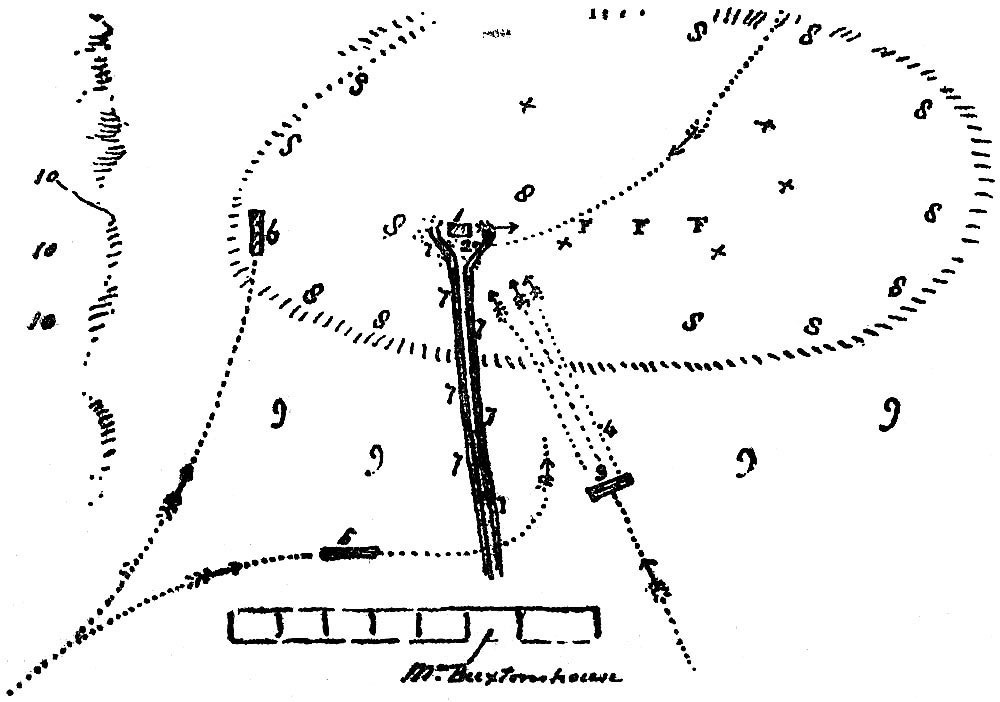
Read Stanley’s sketch with its key: the platform is numbered 1, the constables 7 and the crowd 8; another area is marked comparatively empty. He warned that distances were approximate. The drawing helps relate people, obstacles and movements. It is not a surveyed plan from which we can calculate an exact route for every rider.
A witness can see violence and miss the whole exchange
Stanley’s position offered an overview, with limits. He heard Hunt speaking but could not distinguish the words. In later testimony he said he had neither seen nor heard the Riot Act being read. That establishes the limits of his observation; it does not prove that no reading occurred anywhere.
IN THE SOURCE
I could distinctly hear his voice, but was too distant to distinguish his words.
William Jolliffe offers another view. An officer in the 15th Hussars, he participated in the advance. His letter describes regular cavalry rescuing yeomen caught among the crowd and defends his regiment’s conduct. Yet it also acknowledges swords used with their edges as well as their flats and people crowded together in attempts to escape.
Jolliffe wrote in April 1845, more than twenty-five years after the event. Some earlier movements appear as information given to him, rather than actions he witnessed. His account is valuable evidence of a participant’s perspective, but its defence of the regiment should not be adopted as an independent verdict. Read what he observed separately from how he justified it.
KEEP THE DISTINCTION
Two viewpoints, different kinds of access
Where was the witness?
Above the magistrates, with a view across the meeting ground.
A serving officer among the regular cavalry entering the field.
What could the view miss?
Words spoken below and exchanges beyond his hearing.
Earlier decisions and movements he knew through other people.
When was the account shaped?
A retrospective written account, with later trial testimony.
A letter written in 1845, defending the regiment’s conduct.
Women were organisers, not just figures in a crowd
Mary Fildes, president of the Manchester Female Reform Society, stood on the platform. The People’s History Museum traces women’s organisation around Peterloo, including their public presence and political work. Their participation belongs in the explanation of the meeting, rather than appearing only when the story reaches casualties.
That involvement needs its own historical terms. A demand for universal male suffrage did not include women in the parliamentary electorate. Women could organise a movement whose immediate voting demand excluded them. Recognising that tension gives their activity more precision than making Peterloo a ready-made version of later women’s suffrage campaigns.
LOOK CLOSELY
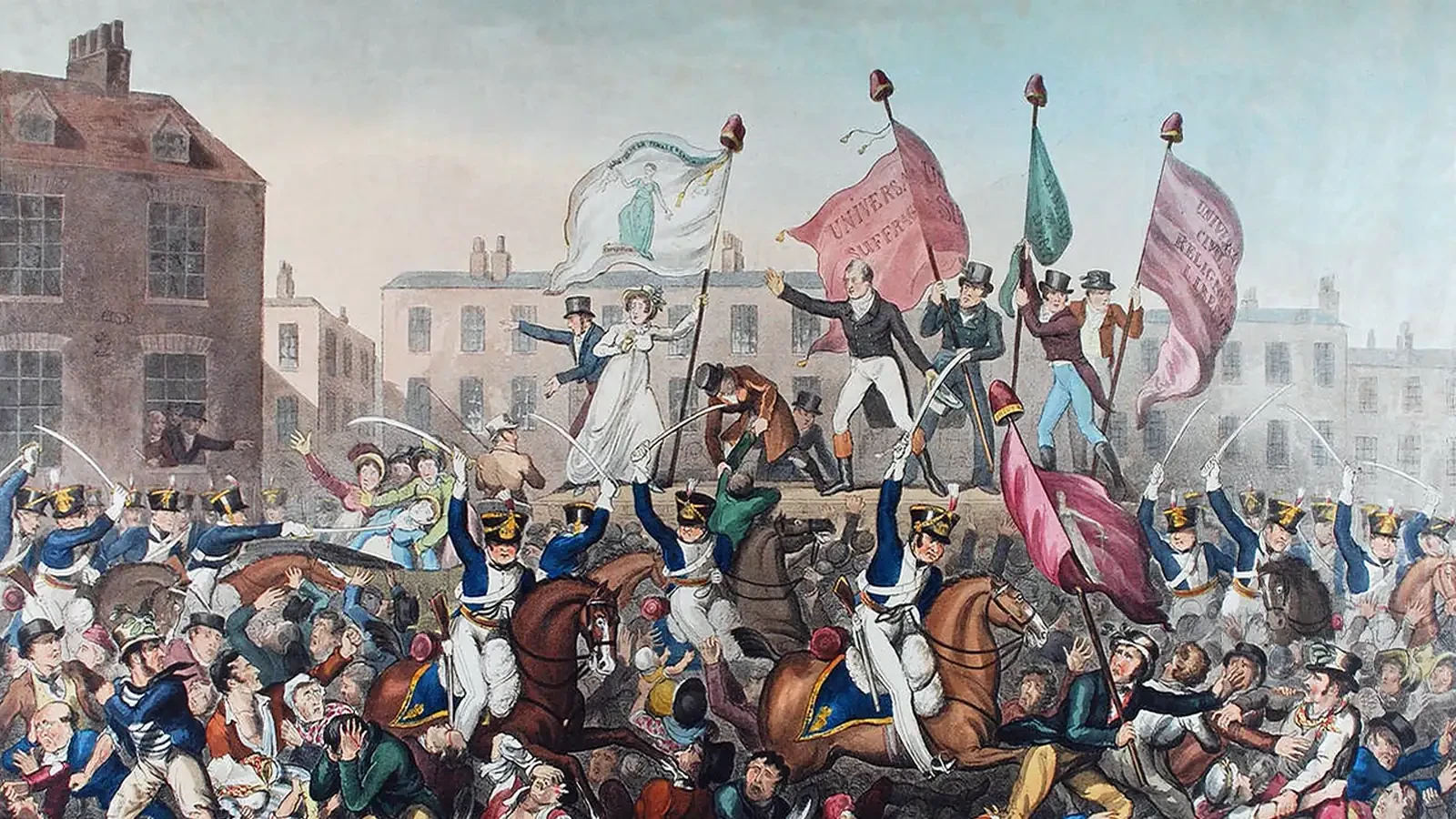
An image that makes an accusation
Find the platform
The speakers and banners make the gathering recognisable as a political meeting.
Find the people below
Women are visible among the crowd. The scene presents civilians facing mounted force.
Read the publisher’s purpose
Published after the event, this print condemns the attack. It is an argument about Peterloo, not a complete inventory of everyone present.
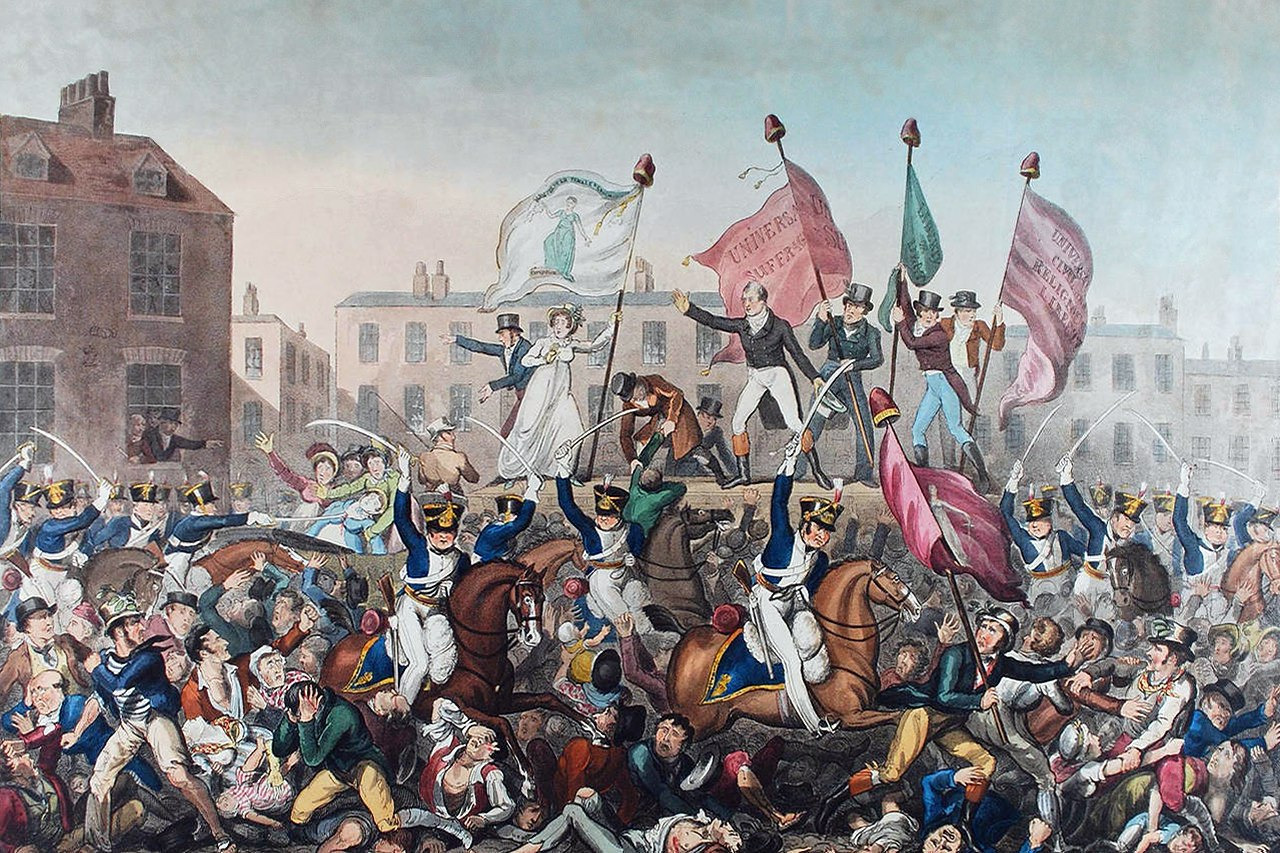
Political print published by Richard Carlile on 1 October 1819. The scene condemns the attack.
Who gets to call an intervention necessary?
The University of Manchester’s collection introduction identifies 18 deaths and around 700 injuries. Historical totals vary, including as later consequences are traced. The human costs extended beyond a single moment: wounds, loss of earnings and bereavement entered households after the horsemen had left the field.
On 23 August, a Home Office letter conveyed royal approval of the magistrates’ conduct. Official endorsement and the victims’ experience could therefore coexist in radically different accounts of the same intervention. Approval tells us how power responded; it is not an impartial reconstruction of the day.
TEST THE EVIDENCE
Does a pictured axe prove the weapon used?
This print proves the cavalry attacked people with axes.
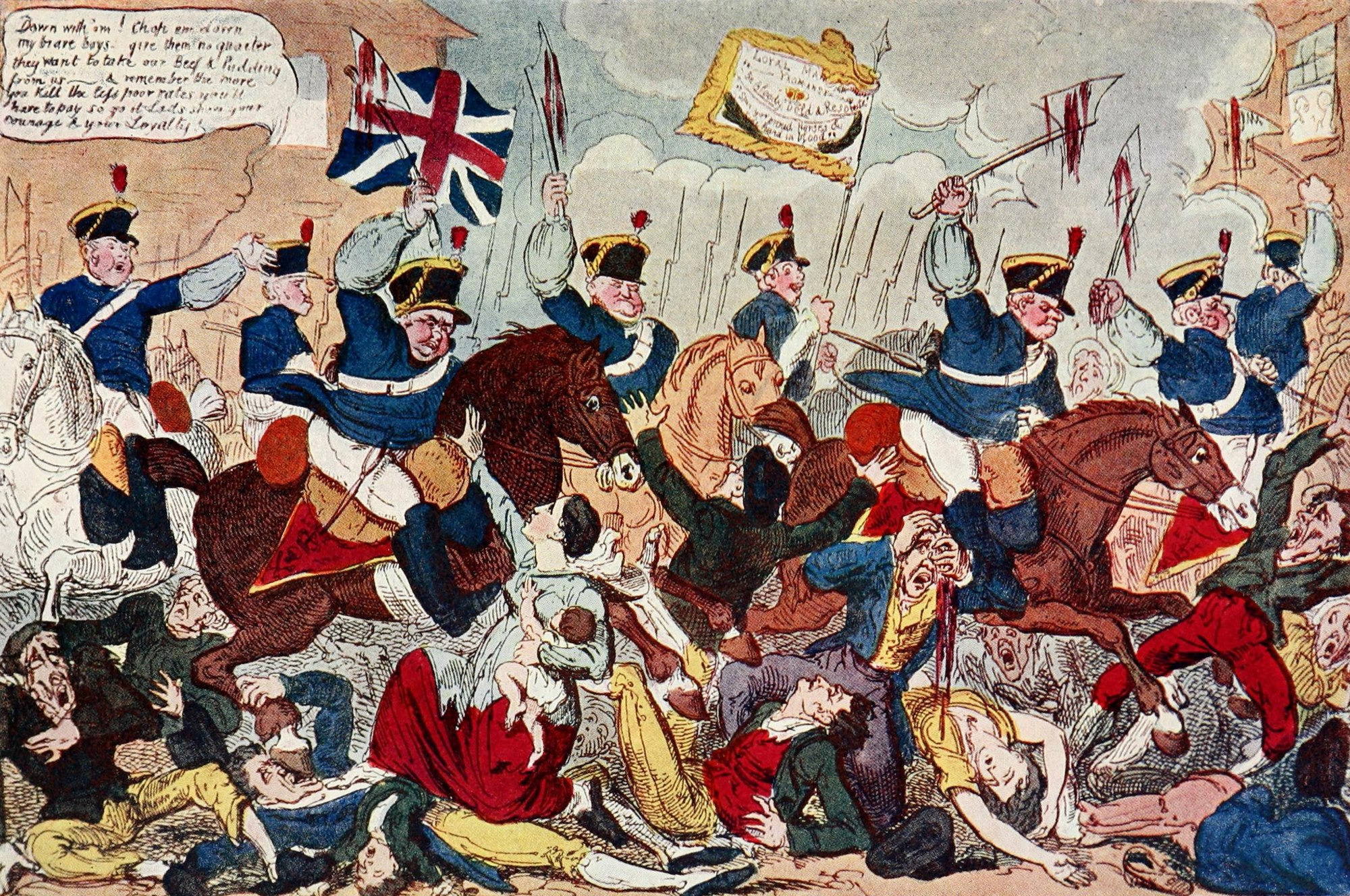
- VISIBLE
- Bloodied axes, injured civilians and accusing speech balloons.
- ARGUES
- The intervention should be understood as a brutal attack.
- CANNOT ESTABLISH
- Actual weapons or the exact words spoken by cavalrymen.
A better-supported statement
The axes intensify the accusation of brutality; actual equipment needs other evidence.
Source: George Cruikshank’s 1819 satire · George Cruikshank · Public domain · resized
That limit does not make the print useless. It shows an accusation made public and a way of turning violence into a memorable political image. For what cavalrymen carried, said and did, compare other records. Evidence of how Peterloo was represented answers a different question from evidence of each action in the field.
Repression came before limited reform
Hunt’s later prosecution ended in a conviction in March 1820 and imprisonment for two and a half years. His subsequent story prevents the narrative from ending with the crowd’s dispersal. Leaders and participants faced consequences within the legal and political order they had sought to change.
The Six Acts passed in late 1819 restricted meetings and tightened controls affecting political publication, alongside other measures. They reveal a governmental response shaped by fears of disorder. Restrictive legislation did not mean all dissent disappeared, but the immediate aftermath was not a swift victory for the meeting’s demands.
LAYERS OF TIME
Attack, repression and reform were separate stages
- 16 August 1819
The meeting is attacked
Arrests and cavalry intervention turn a reform gathering into violence.
- Late 1819
The Six Acts
Government responds with restrictions on meetings and political activity.
- March 1820
Hunt is convicted
The reform leader receives a prison sentence of two and a half years.
- 1832
Limited parliamentary reform
Manchester gains representation, while the franchise remains restricted.
The thirteen-year gap matters. Peterloo belongs within a longer reform struggle, not a single-event explanation of the 1832 Act.
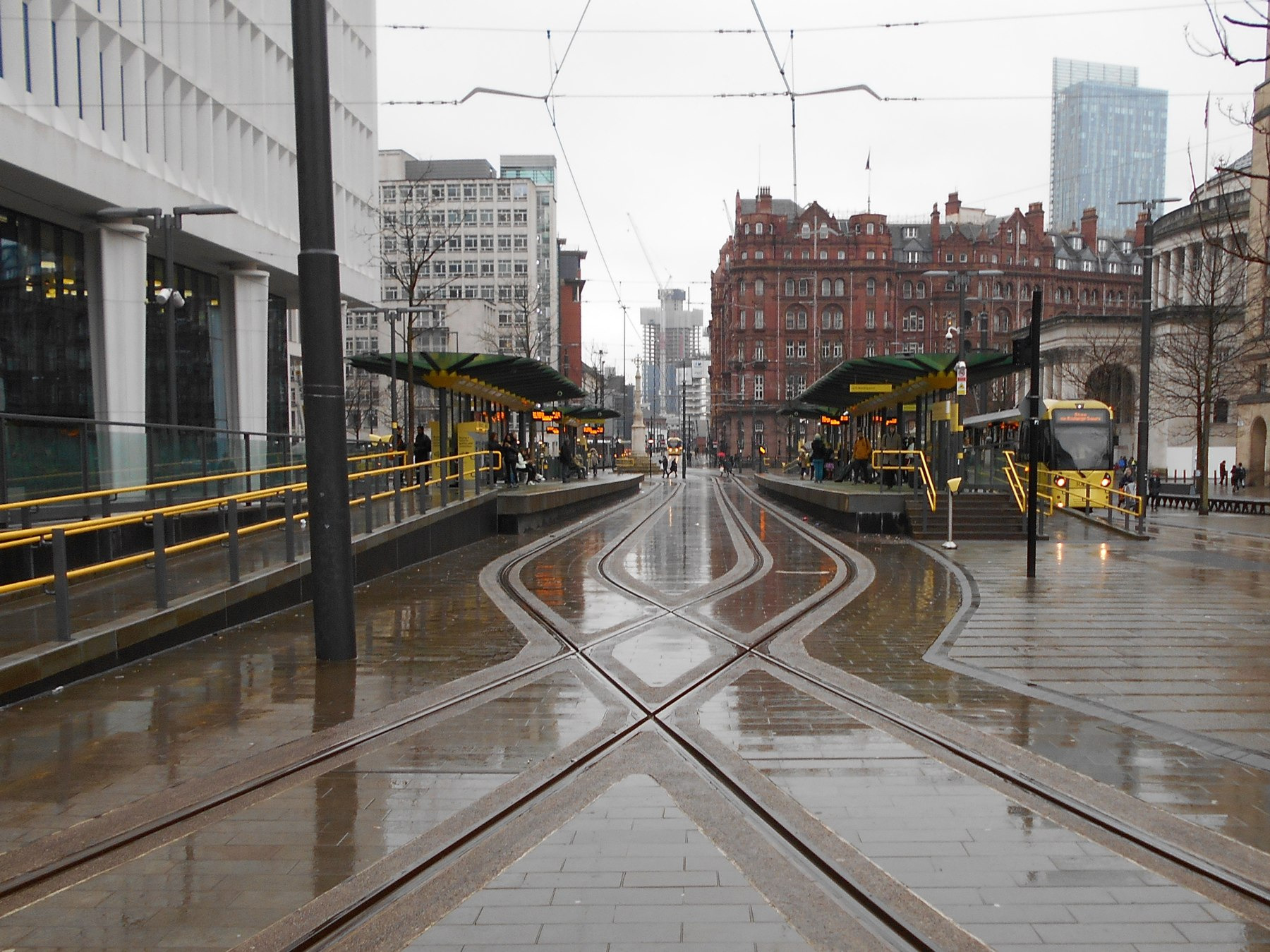
Manchester gained two MPs in 1832. The Reform Act’s property qualifications still excluded most working men, while women remained outside the parliamentary franchise. Reform had occurred, but “the people got the vote” would be a misleading conclusion. Representation, eligibility and meaningful political access were different questions.
What Peterloo exposed
Peterloo made the struggle over political participation inseparable from an argument about authority and violence. The same industrial society could generate collective organisation, official fear and competing accounts of public order. Its consequences were material as well as symbolic: injuries, imprisonment and restrictions affected people whose names do not all survive.
KEY IDEA
Political exclusion made the meeting necessary; decisions by authorities made it violent.
The clearest account keeps several distinctions open: seeing and hearing, observation and defence, arrest and dispersal, reform and redress. Reading those differences does not soften the violence. It explains how we know about it and why its meaning was contested. The next planned chapter turns to workers organising together, carrying the question of collective power from the meeting ground into working life.