The machine could turn the reel, but it could not make a woman’s attention unnecessary. To produce a usable silk thread, a reeler had to keep the fine filaments coming from cocoons and replace those that ran out or broke. An uneven result could lose value in a distant market. Industrial growth depended on that close work at the basin, not only on the engine and the people who had purchased it.
Tomioka Silk Mill, opened by the Meiji government in 1872, was designed to improve raw-silk production and spread new techniques. Women came to learn and work there; some later became instructors. The mill offers a powerful way into their history, but a dangerous shortcut if treated as the experience of every worker. The conditions of a state model factory and those of a private mill recruiting rural girls could differ substantially.
PLACE & TIME
Follow the hands that kept the thread running
Tomioka and the mills around Suwa and Okaya
Gunma and Nagano, central Honshū
1872–1912 CE
Tomioka is the starting case, not a point representing all Japanese mills or every worker’s journey.
The factory entered an existing world of skilled production
Women were already working in agriculture, households, commerce and textile production before the Meiji period. Silk did not begin as an occupation when a large brick mill opened. Rural families raised silkworms and processed their cocoons, and hand-reeling techniques had developed before the new government’s industrial projects. What changed was the scale, equipment and organisation of some of that work, together with its relationship to expanding export markets.
After the treaty ports opened, raw silk became a major Japanese export. European demand and problems in overseas silkworm production gave Japanese producers opportunities, but buyers also cared about consistency. A thread of uneven quality could not simply be improved by a larger export target. The government’s investment in Tomioka addressed a practical production problem as well as the political ambition to earn foreign income.
FOLLOW THE PROCESS
A cocoon was not yet a marketable thread
Prepare the cocoons
Sort and prepare the material so that the fine filaments can be drawn out.
Find and combine filaments
Use heated water to loosen the filament ends and bring several together into a thread.
Keep the thread consistent
Watch the running thread and replace exhausted or broken filaments while reeling continues.
Prepare it for sale
Re-reel, inspect and organise the raw silk for further manufacture and shipment. Reeling thread is distinct from weaving cloth.
Tomioka was intended to teach as well as produce
French specialist Paul Brunat helped plan the mill, import equipment and organise the new production system. Japanese officials and builders made the project possible, combining timber construction and tiled roofs with brick walls and French technical designs. The mill was not a foreign machine planted in an otherwise empty industrial landscape. It relied on local labour, materials, water and a region already supplying cocoons.
Its training purpose was fundamental. Women recruited from different areas were expected to acquire techniques that could be used elsewhere. French women served as instructors alongside the broader technical staff. The resulting transfer of knowledge cannot be explained through the biography of a male engineer alone: the people learning and demonstrating the work were part of the mechanism through which the project could have an effect beyond its own walls.
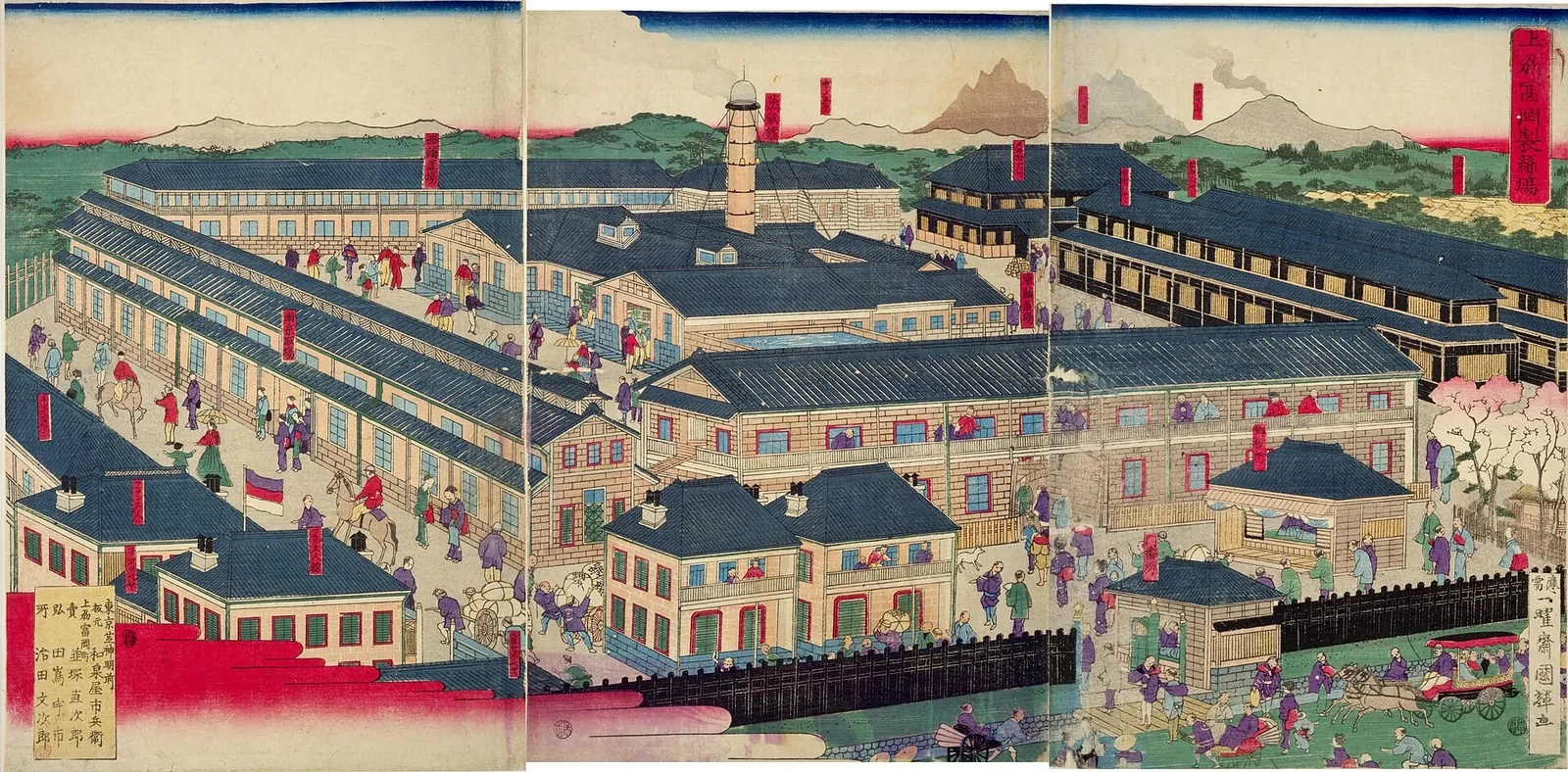
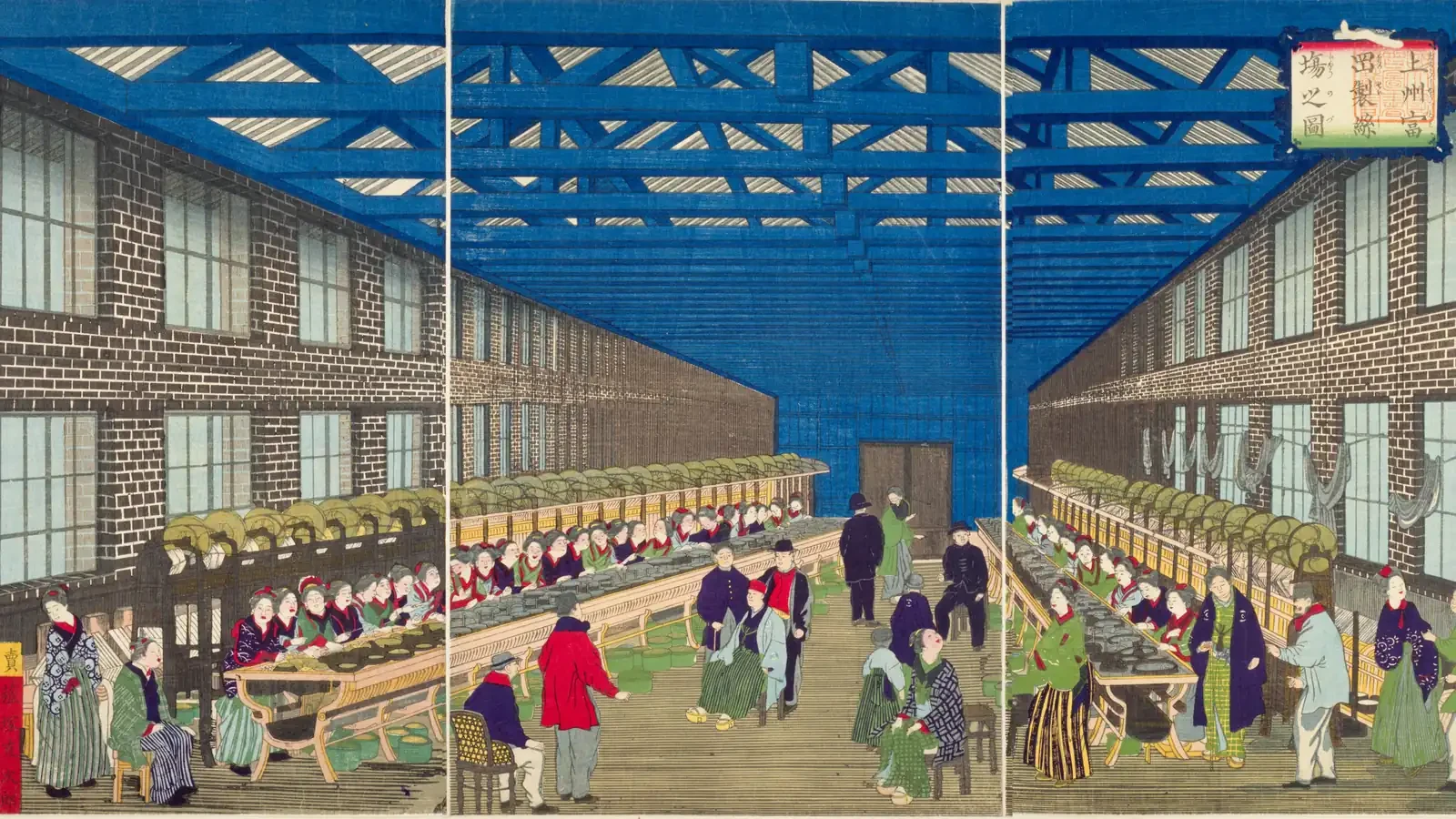
An early print of the complex presents the factory as an organised industrial place. The featured interior view brings women and rows of machinery into that picture. Both are historical representations, with carefully arranged viewpoints and an interest in the new enterprise. Neither can establish that all workers felt contented, that every day ran smoothly or that the depicted order was achieved without effort and supervision.
One worker’s career makes the training connection visible
Wada Ei, also known as Yokota Ei, came from a former samurai household in Matsushiro, in present-day Nagano. She entered Tomioka in 1873 while in her teens and worked there into 1874. The National Diet Library’s account of her recollections follows what came next: she taught women at a mill in her home region and later became an instructor at the Nagano prefectural mill. Learning at one factory could become an occupation in another.
Her written account requires careful dating. She recorded memories from 1907 onward, decades after the early Tomioka experience; editions appeared in 1931. The familiar label “Tomioka Diary” should not make us imagine an untouched day-by-day notebook written beside the reeling basin in 1873. A retrospective account can preserve valuable experience while also reflecting the later circumstances in which it was remembered.
KEY IDEA
Wada’s route from trainee to instructor shows how women could transmit industrial knowledge.
The distinction makes her story more useful, not less. It replaces the anonymous image of hands attending imported machines with a person whose expertise travelled. It also raises a question for the wider industry: under what arrangements could another worker turn acquired skill into greater choice, better pay or a position outside the original mill? Training and opportunity were connected, but they were not identical.

Living at the workplace joined provision to supervision
Tomioka provided accommodation and other facilities within its compound, including an infirmary; the early operation also observed a weekly day of rest. These arrangements helped sustain a workforce gathered from different places. They are concrete provisions, not grounds to declare every part of factory life either benevolent or oppressive. Housing could make employment possible while also bringing the worker’s time outside production within an employer’s space.
For a young woman leaving home, living with other workers could mean new relationships and experience beyond the household. It could also involve rules over movement, conduct and contact with outsiders. The two possibilities do not cancel one another. To understand a dormitory, we need to ask who controlled access and what choices the residents retained, not simply whether a building for them existed.
LOOK FROM HERE
Three kinds of dependence met at the mill
Employment might offer earnings or training, while rules and supervision limited what could be decided independently.
A family’s need for money could shape recruitment, the use of earnings and expectations about returning home.
The mill needed workers who could maintain quality and remain available through the working season.
Private recruitment could bind a household to an employer
A surviving agreement from Hirano in the Suwa district, dated 1895, puts those relationships into a compact form. It records a three-yen advance to a worker’s family and promises her service for the specified period. It restricts other employment and requires a substitute if she cannot work. The family head signs. The contract reproduced by Masanori Nakamura and Corrado Molteni is evidence of one arrangement, not a contract that can be assigned to Wada or to Tomioka in 1873.
An advance was money available before the season’s earnings. That could matter greatly to a household needing cash, but it also created an obligation before work was completed. A promise made by the household head affected the worker’s ability to change course later. The most useful question is not simply whether she received wages, but what the agreement allowed her to do if the job became unacceptable.
KEEP THE DISTINCTION
Training, employment and freedom to leave are different questions
Training
What skill could the worker acquire, and where else could it be used?
That valuable learning automatically supplied control over the employment relationship.
Payment
Who received an advance or earnings, and how were obligations accounted for?
That a headline wage described the money freely available to the worker.
Movement
Could the worker leave, change employers or return home without a penalty?
That living away from the family meant independence from every other authority.
This was not the legal ownership of a person. It was a restrictive labour relationship shaped by money, family authority and the employer’s demands. Keeping the distinction clear does not make the restrictions trivial. A person could be legally free and still face powerful obstacles to leaving or renegotiating work. The precise mechanism matters if we want to understand where leverage lay.
A model factory cannot supply the timetable of an industry
A 1900 survey of private filatures reproduced in the same study lists daily hours ranging from twelve to fifteen in the establishments shown. The table records particular mills and employer reports, not every worker in Japan. It is enough to demonstrate why an early model-factory account should not become a universal eight-hour working day. Site, period and kind of evidence have to travel with the number.
Long hours mattered alongside the demands of the task. Keeping attention on a fine running thread was work even where a machine supplied rotation. A longer day could produce more output while increasing fatigue and reducing time available for recovery. Neither the absence of very heavy lifting nor the small scale of a filament makes the work effortless.
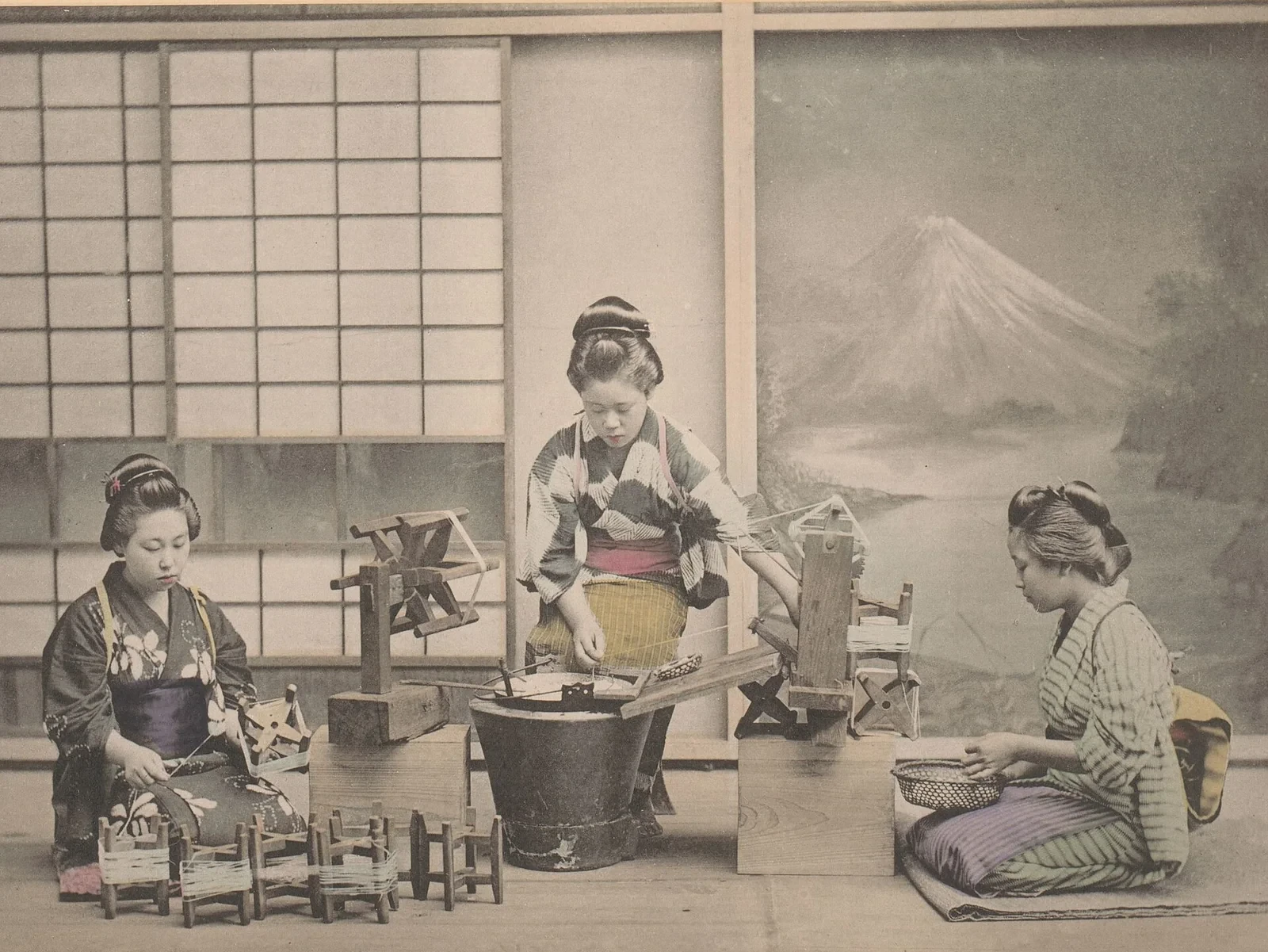
A commercial image of women reeling silk, made around the end of the nineteenth century, gives an apparently calm view of manual technique. Its arrangement and photographic setting are part of the evidence. It is not a candid record of a named Tomioka shift or a measure of the length of a factory day. Looking closely can reveal a gesture or a tool without answering every question about the terms under which work was performed.
Workers’ knowledge developed with changing equipment
The wider industry did not simply reproduce Tomioka’s equipment and buildings. The Japan Society of Mechanical Engineers’ account of the Okaya collection distinguishes French-type machines from the Suwa-type equipment developed by combining French and Italian techniques. Producers adapted machinery to local resources and requirements. Different arrangements also changed what a worker had to watch, handle and learn.
Women’s skill was therefore not a fixed natural quality that machinery merely used. It involved practice, instruction and familiarity with an operating system. Employers could describe delicate work as especially suited to women, but that claim must not be substituted for an explanation of how skill was acquired or why women were recruited on particular terms. Gender expectations helped organise the labour market; they did not turn training into biology.
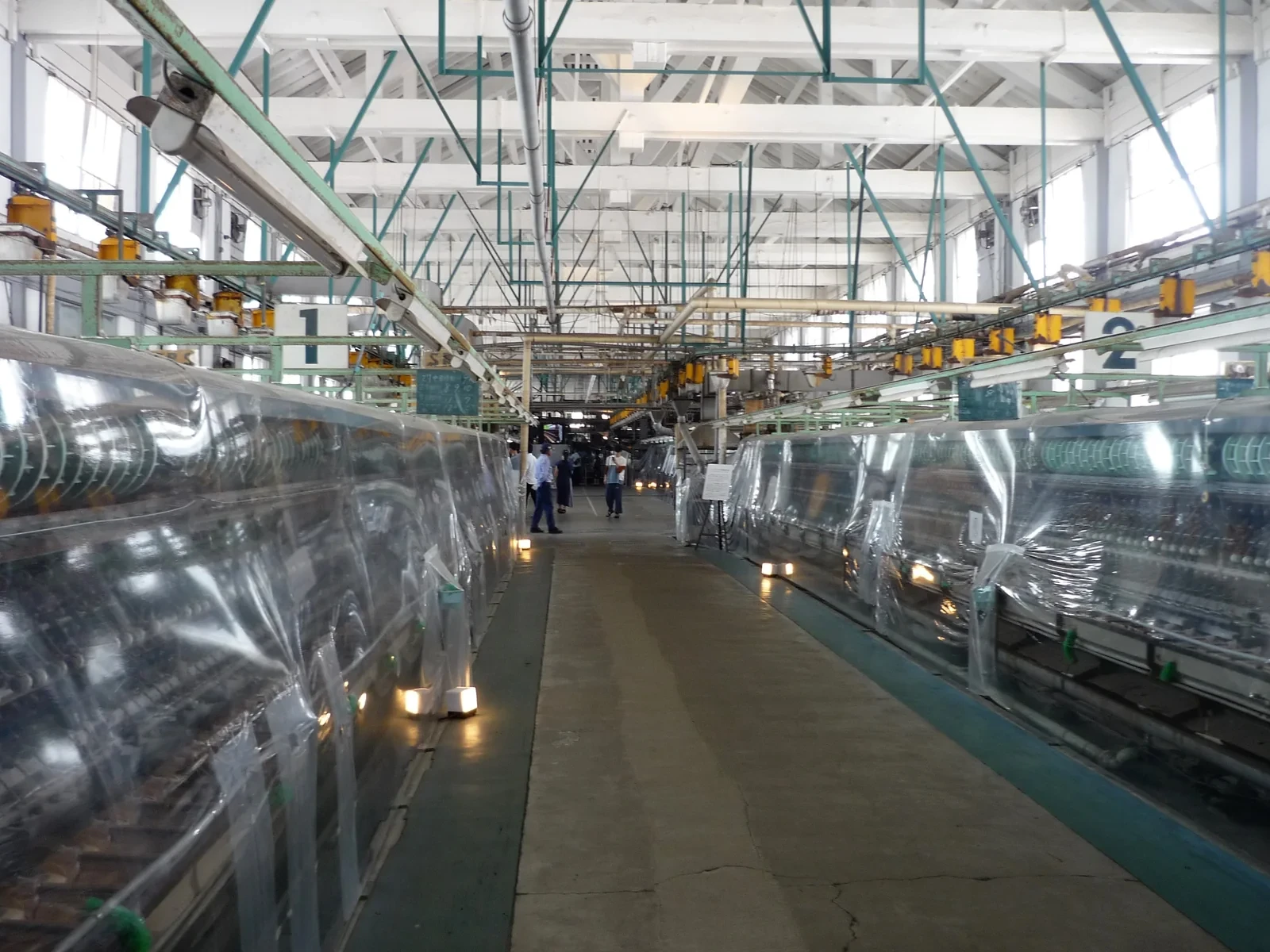
The surviving Tomioka reeling hall helps make the scale of an organised workplace visible. The modern photograph shown here contains later equipment, not the original 1872 arrangement. It cannot be used to count early workers or reconstruct their exact reach across a machine. The long building and its present contents have different histories; preserving the distinction lets the site inform the story without freezing more than a century of operation into one moment.
A successful industry could distribute gains unevenly
Farm households supplied cocoons, workers reeled thread, inspectors and merchants assessed quality, and transport carried material towards export markets. The railway chapter traced some of those movements. Here their human requirement comes into focus: the saleable result depended on repeated skilled actions that were easy to overlook when success was measured only through national output or foreign earnings.
The state, an employer, a household and an individual worker did not receive the same benefit from the same transaction. A family might value earnings that helped meet obligations. A worker might value those contributions while also seeking less demanding hours or a different future. These interests could coincide without becoming interchangeable. Their differences are part of explaining industrial growth, not an optional emotional addition after the economic account.
The achievement included women who made it reproducible
Tomioka’s original purpose was not exhausted by its balance sheet. Its training and technical example could matter beyond the output sold from that factory. It passed into Mitsui ownership in 1893 after its government-operated period. That change is another reason not to assign one set of conditions to the whole Meiji era: ownership, equipment, recruitment and the surrounding industry continued to develop.
Wada’s later teaching offers one clear way of seeing the achievement. A worker became someone able to explain and supervise a technique elsewhere. The private contract and hours survey expose other arrangements within the expanding industry. Read together, these cases replace a single anonymous “factory girl” with a history of different positions, skills and degrees of control.
TAKE THIS WITH YOU
Industrial growth depended on skilled work under unequal conditions
Keep the processes clear
Reeling silk thread is different from raising silkworms or weaving cloth; each depended on particular knowledge and work.
Keep the evidence located
A later memoir, an 1895 contract and a 1900 hours survey describe different people, places and moments.
Ask what the worker could decide
Training, income, residence and freedom to leave did not necessarily develop together.
The first four chapters have moved from a claim to govern the country to the skill required to keep a thread running. They meet in the same question: who gained the capacity to act, and whose time and resources made the change possible? The next part of the Path follows education, independence and empire through the opportunities and limits of the new order.