
At the end of the Diamond Sutra of 868, a man’s name appears beside a date and a dedication to his parents. Wang Jie wanted this Buddhist teaching to circulate. More than a thousand years later, that brief note lets us ask a surprisingly personal question about an early printed book: what made its copies worth producing?
The answer is written into the object’s design as well as its closing words. An image introduces a teaching, printed sheets carry it, and a dedication explains the sponsor’s purpose. The British Library’s surviving scroll is a landmark in printing history. Looking closely also reveals a religious act, shaped by people who valued what the words could do.
PLACE & TIME
A ninth-century scroll, found near Dunhuang
China · Mogao Caves near Dunhuang
Tang-period China; modern findspot in Gansu
11 May 868 CE · discovery history from 1900
The object and its later journey
A book you unroll rather than turn
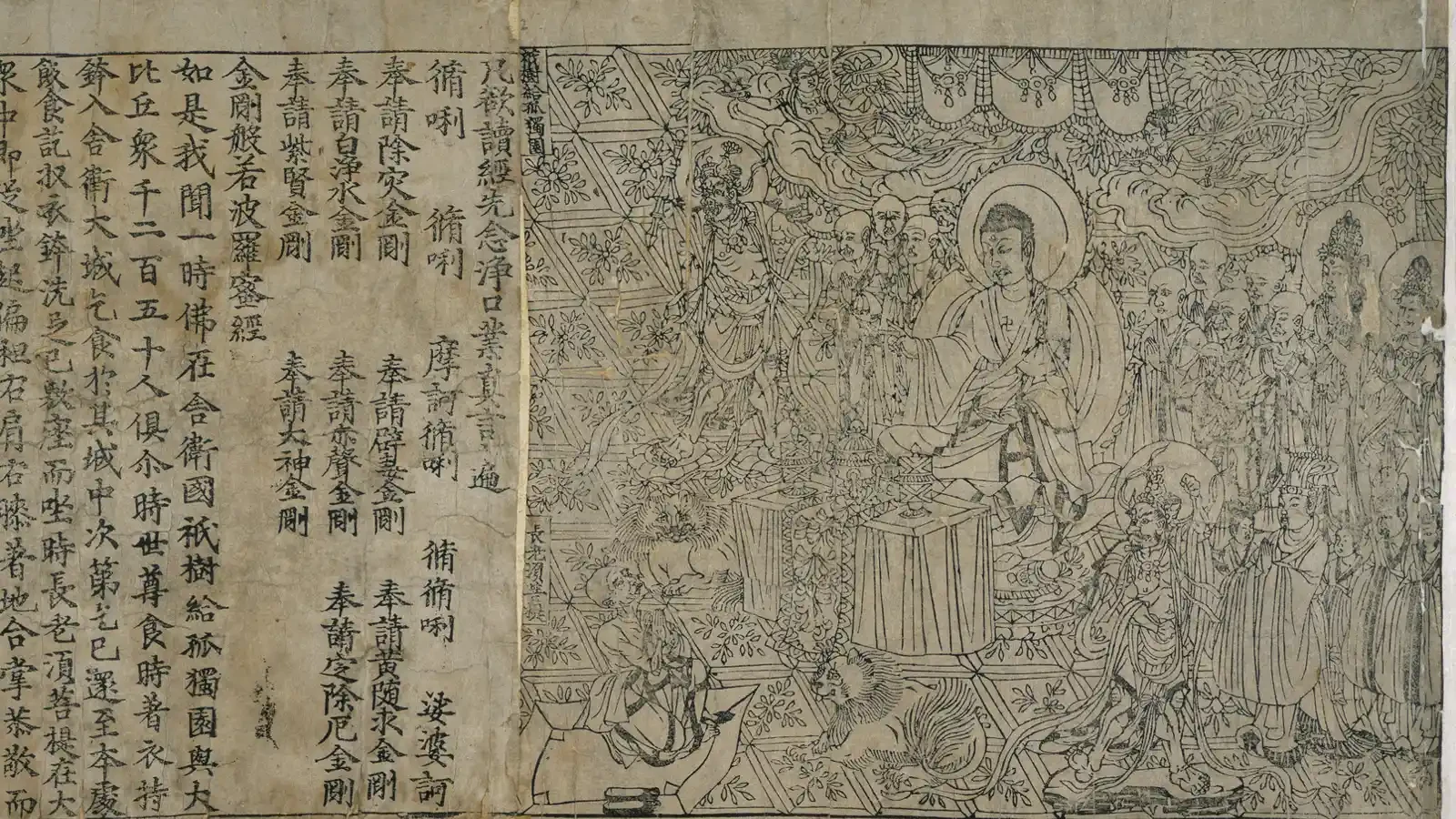
This book has no spine and no stack of turning pages. The catalogue records a scroll 27.6 centimetres high and 499.5 centimetres long—almost five metres. Its Chinese writing and opening illustration were printed on paper. Calling it a book describes a sustained text; it need not mean the bound format most familiar today.
The reproduced opening makes the reading direction tangible: the illustrated gathering occupies the right, while vertical columns of writing continue to its left. Your eye encounters a scene before following the text. The picture is more than an ornament attached to an age record: it introduces the kind of encounter the scripture presents.
EXPLORE THE SCROLL
An image introduces the words

Image: British Library · CC0 1.0.
How a carved surface became a scroll
Woodblock printing transfers an arrangement already cut into wood. Chinese craftspeople carved words and pictures into blocks, inked them and pressed paper against the surface. Raised lines left marks; the cleared areas did not. The work of preparing the block came before the repeated impressions. A printer could reproduce the same arrangement without writing it out afresh each time.
FROM BLOCK TO SCROLL
Three operations behind a printed book
Prepare the printing surface
Carve the arrangement in reverse, leaving the lines that will receive ink raised above the cleared wood.
Take an impression
Ink the surface and bring paper against it. Repeating this operation reproduces the fixed arrangement.
Assemble the reading object
Join the printed sheets into a scroll. The 868 Diamond Sutra was assembled from seven sheets.
The result joins several kinds of labour: designing what will appear, carving a usable surface, controlling the impression and assembling sheets. A block preserves a particular arrangement, so the picture and writing need not be recreated by hand for every copy. That is a practical advantage for repeating a valued text, although this surviving scroll does not tell us its edition size.
It would be a mistake to call this the birth of printing. Getty’s object account interprets the sophisticated design as evidence of an established craft. It suggests Sichuan as a possible production region, rather than identifying a known workshop. A find near Dunhuang establishes where the scroll survived, not necessarily where craftspeople carved its blocks.
KEEP “FIRST” PRECISE
What does the date establish?
Printing was invented when this scroll was made in 868.
- What is recorded
- The closing dedication dates this copy and names its sponsor.
- What the design suggests
- A developed practice capable of combining detailed illustration and writing.
- What remains unknown
- Its date does not identify the earliest printing experiment, the print run or a confirmed workshop.
A better-supported statement
The Diamond Sutra is the earliest surviving complete printed book with a recorded date. Earlier printing existed.
Check the distinction: IDP account of the dated scroll ·
Image: British Library · CC0 1.0.
Wang Jie’s dedication gives copying a purpose
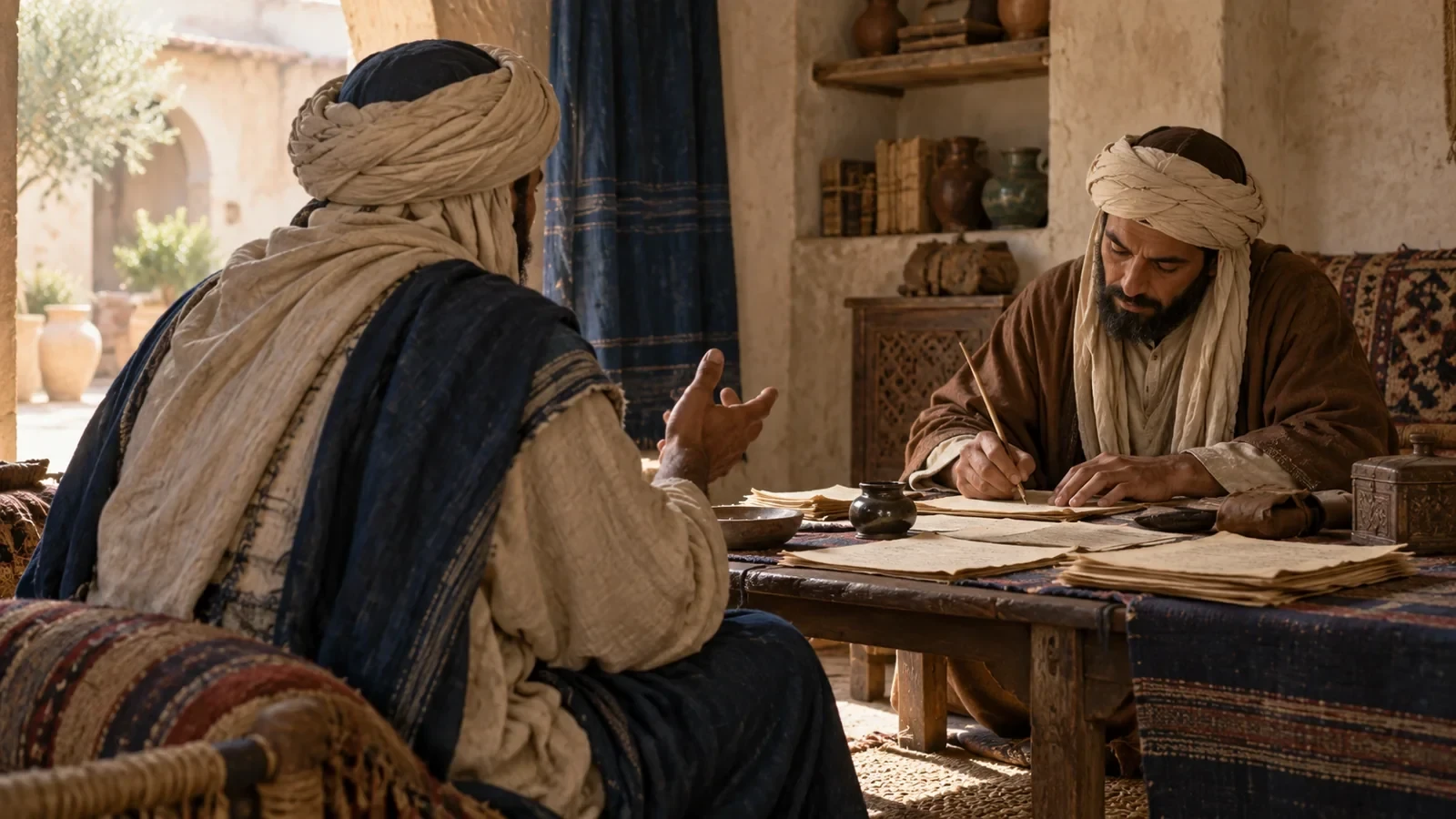
A colophon is a short closing note that can name the maker or sponsor, give a date, or explain why a text was produced. This one names Wang Jie and his two parents. Its Chinese calendar date corresponds to 11 May 868. The named person is a sponsor; the note does not establish that he personally carved the blocks or took every impression.
WORDS AT THE END
Reverently made for universal distribution
That wording changes the object’s story. The labour of reproducing a scripture could count as religious generosity. The IDP explains the sponsorship in terms of Buddhist merit: beneficial consequences associated with good actions, here dedicated to parents. The personal dedication and broad intended distribution sit together. Making copies could honour a family while carrying a teaching beyond it.
THREE USEFUL WORDS
Reading the dedication
Sutra
A Buddhist scripture presenting a teaching attributed to the Buddha.
Colophon
A closing note giving information about a text’s production, date or sponsor.
Merit
In this religious context, the beneficial consequences of good actions, which may be dedicated to others.
Distribution is a stated intention, rather than a delivery record. There is no recipient list here to show whose hands received copies, how far they travelled or how many people listened. The distinction makes the dedication more useful, not less: we hear the sponsor’s purpose without pretending to have measured its success.
The words were meant to be heard, too
The scripture presents a conversation between the Buddha and Subhuti. Sam van Schaik’s account places it within the Perfection of Wisdom tradition, where teachings challenge the idea that things possess an independent, fixed existence. The “diamond” belongs to an image of wisdom cutting through mistaken ideas. It is not an instruction to acquire a precious stone.
This printed object also carries ritual instructions. Getty records a mouth-purifying mantra before the main scripture, invocations of eight vajra deities, and another mantra afterwards. Those additions matter: looking at the sheet as a container for information misses the acts of recitation it supported. A book could organise a spoken religious practice as well as provide words for private reading.
A DIFFERENT KIND OF REACH
The audience for a book need not stop at the people holding it.
A cave preserved the scroll—and a later journey moved it
The scroll’s survival leads to the Mogao Caves near Dunhuang, in present-day north-western China. UNESCO describes this Buddhist complex as a meeting point of trade and religious and cultural influences. The text belongs within that connected world; its findspot should not make the caves into an isolated birthplace of printing.
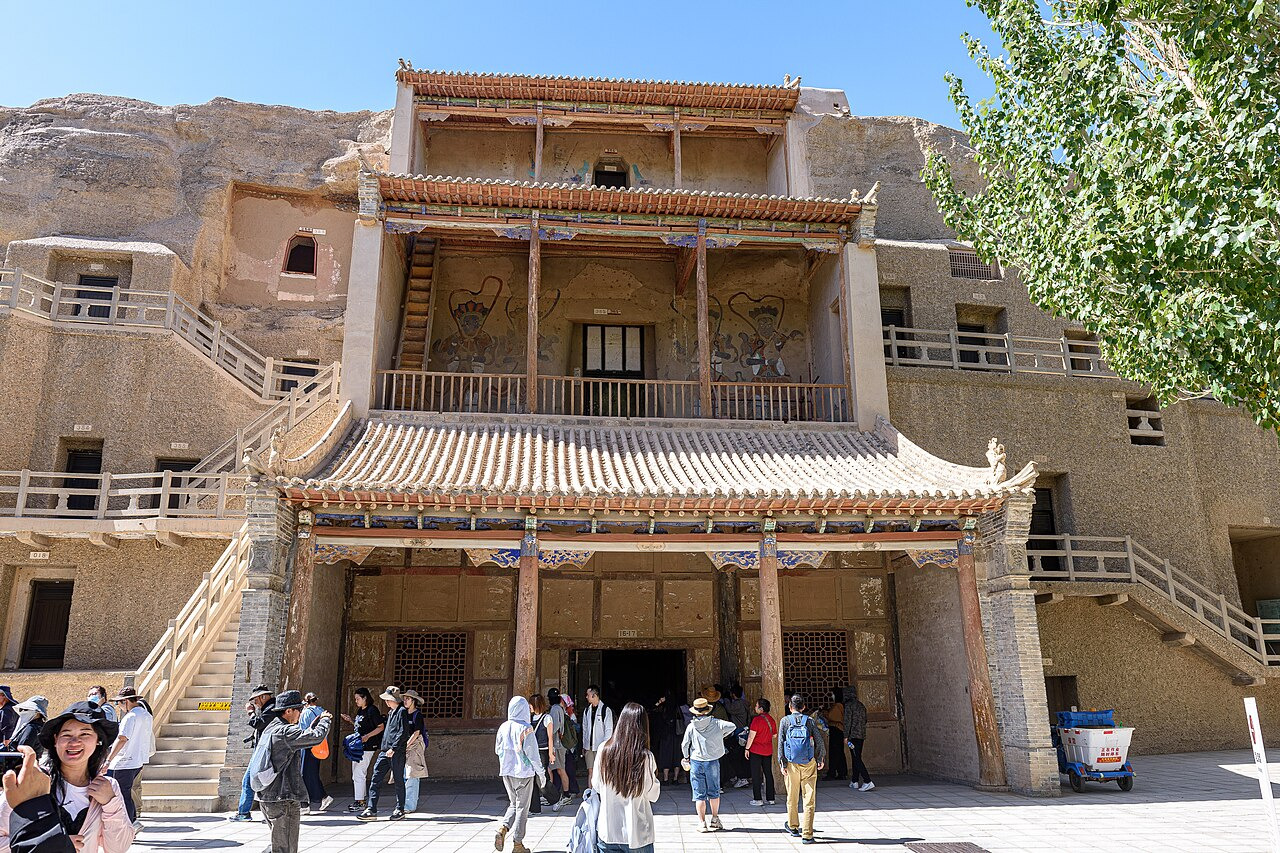
In June 1900, Wang Yuanlu uncovered the concealed chamber now called Cave 17. Mélodie Doumy’s IDP study documents his role as its keeper and in the transactions with Aurel Stein in 1907. He controlled access and handed over bundles for inspection. The history is more complicated than an explorer simply entering an untouched room and choosing its treasures.
KEEP THE DATES APART
Production, rediscovery and conservation
- 868 CE
A dated printing
The colophon gives the date corresponding to 11 May 868.
- 1900
The hidden chamber is opened
Wang Yuanlu discovers the Library Cave at Mogao.
- 1907
Stein acquires material
Transactions with Wang disperse a substantial part of the cave’s contents.
- 2010
Conservation work is completed
A long British Library project removes problematic linings and realigns damaged paper.
These dates describe different events in the object’s history.
Today the scroll is held by the British Library as Or.8210/P.2. Its appearance has its own history. Wood and Barnard describe how old repairs and multiple linings distorted the fragile sheets. Careful conservation exposed details that had been masked. What we see in a reproduction is an ancient print that has also passed through modern treatment.
What this printed book lets us understand
The opening image, printed writing and closing dedication answer different parts of the same question. The image frames a teaching; the blocks make its arrangement repeatable; the colophon gives a named sponsor’s purpose. Together they connect technical skill with religious generosity. This is a history of people choosing to multiply words, rather than machinery acting on its own.
THE THREAD TO KEEP
The scroll preserves both a way of making copies and a reason for wanting them.
The next question concerns what printers reused. A carved block keeps an arrangement together. Movable type separates it into characters that can be arranged again. That change deserves its own chapter. For now, Wang Jie’s scroll leaves a smaller, sharper insight: the value of a printed book depends on what people hope sharing it will achieve.
,_frontispiece_and_text_-_BL_Or._8210-P.2.jpg)
.jpg)