Wellcome Collection · CC BY 4.0 · fitted to canvas and converted to WebP
Industrial Lives · Chapter 3 of 8

Child Labour in Victorian Mills: The Hours Behind the Machines

An inspector’s report, a former worker’s testimony and an apprentice house tell different stories. Together they reveal what children’s work demanded—and why a law or a single witness cannot explain every mill.

WHEN?
c. 1830–1860 CE
WHERE?
British textile regions · Quarry Bank and Leeds
TODAY
Styal, Cheshire, and Leeds, West Yorkshire, England
THE BIG QUESTION
What can testimony and records tell us about children’s work, schooling and family pressures?

Friday morning, six o’clock. Saturday afternoon, four o’clock. In an 1836 factory inspector’s report, those times mark the beginning and end of a working period reported by boys at Taylor, Ibbotson & Co. There were breaks, but the account still crossed a night. It was written three years after Parliament had created a factory inspectorate.

This is an extraordinary reported case, not a timetable for every child in a Victorian mill. Its value lies in the questions it opens. What work did children do? Why did families depend on it? What could schooling rules change—and what happened when employers broke the law? Following testimony, records and buildings helps us answer without turning different childhoods into one story.

PLACE & TIME

Work, school and survival in textile regions

Quarry Bank · Leeds · textile investigations

British textile regions · Great Britain

c. 1830–1860 CE

The setting

A child’s job was part of the production system

Elizabeth Bentley was twenty-three when she gave evidence in 1832. She recalled starting at six in Mr Busk’s Leeds flax mill and working as a doffer. Her description explains the task: stop a full frame, remove full bobbins, carry them away, fit empty ones and restart. It was repeated work necessary to keep production moving, not simply a child watching an adult.

  • Doffing changed full bobbins for empty ones: Bentley described this in a flax mill.
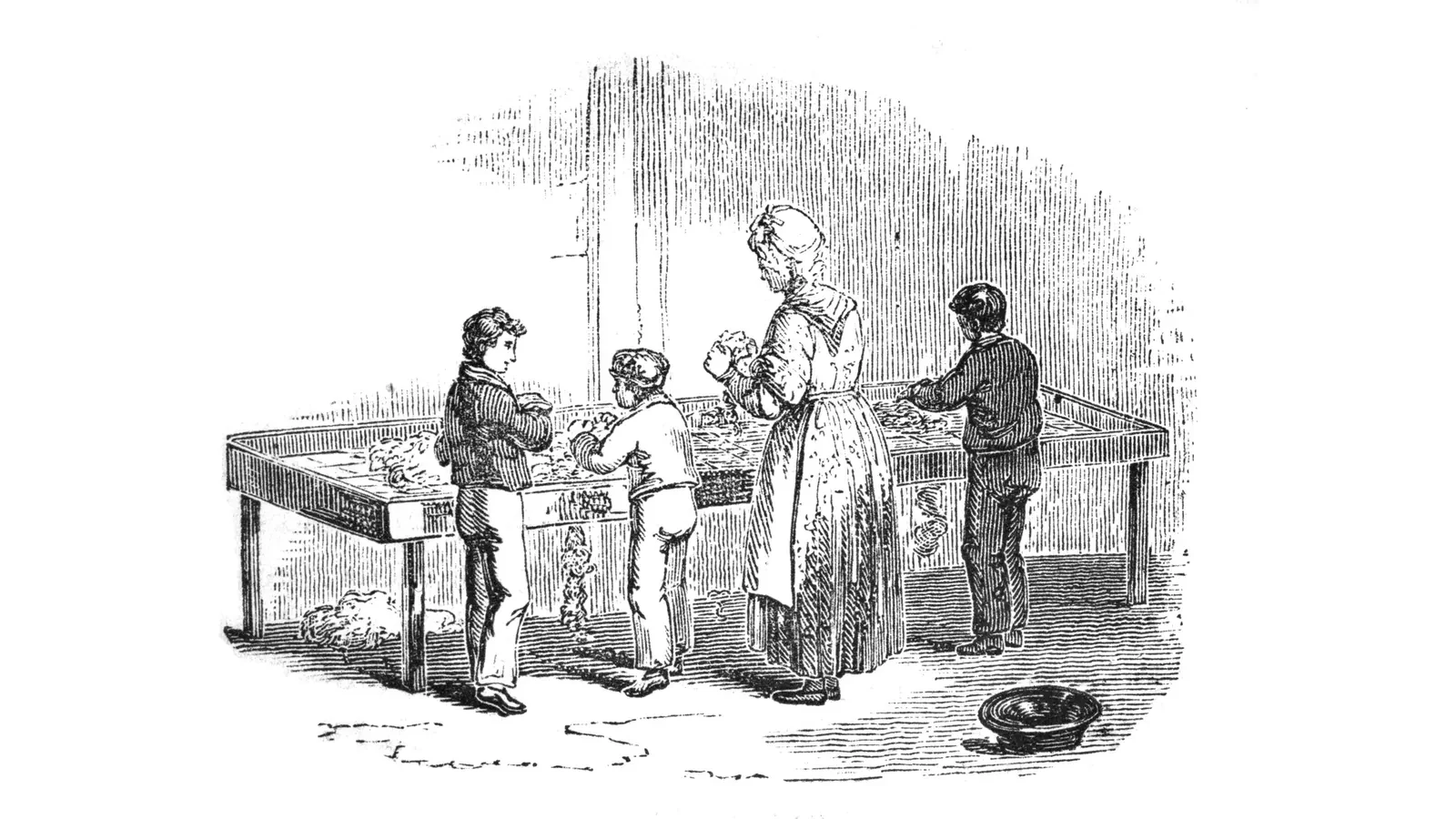
  • Preparing cotton was another stage: an 1844 illustration shows children handling fibre before spinning.
  • The job name alone cannot tell us a worker’s age, pay, hours or freedom to leave.

It matters that Bentley spoke about flax, not cotton. The familiar image of the Lancashire cotton mill does not cover every textile workplace. Nor should the sequence she described be transferred to every machine. Listening closely gives us a particular task, a particular witness and a particular industry; generalizing too quickly removes the very information that makes her account useful.

LOOK CLOSELY

Children preparing cotton, represented in 1844

  1. Read the work on the table

    Hands and loose fibre suggest preparation before spinning, rather than weaving finished cloth.

  2. Notice who shares the space

    Young figures appear alongside an adult. Their drawn size cannot supply precise ages.

  3. Keep representation separate from measurement

    This published engraving is not a photograph or a record of how many children every factory employed.
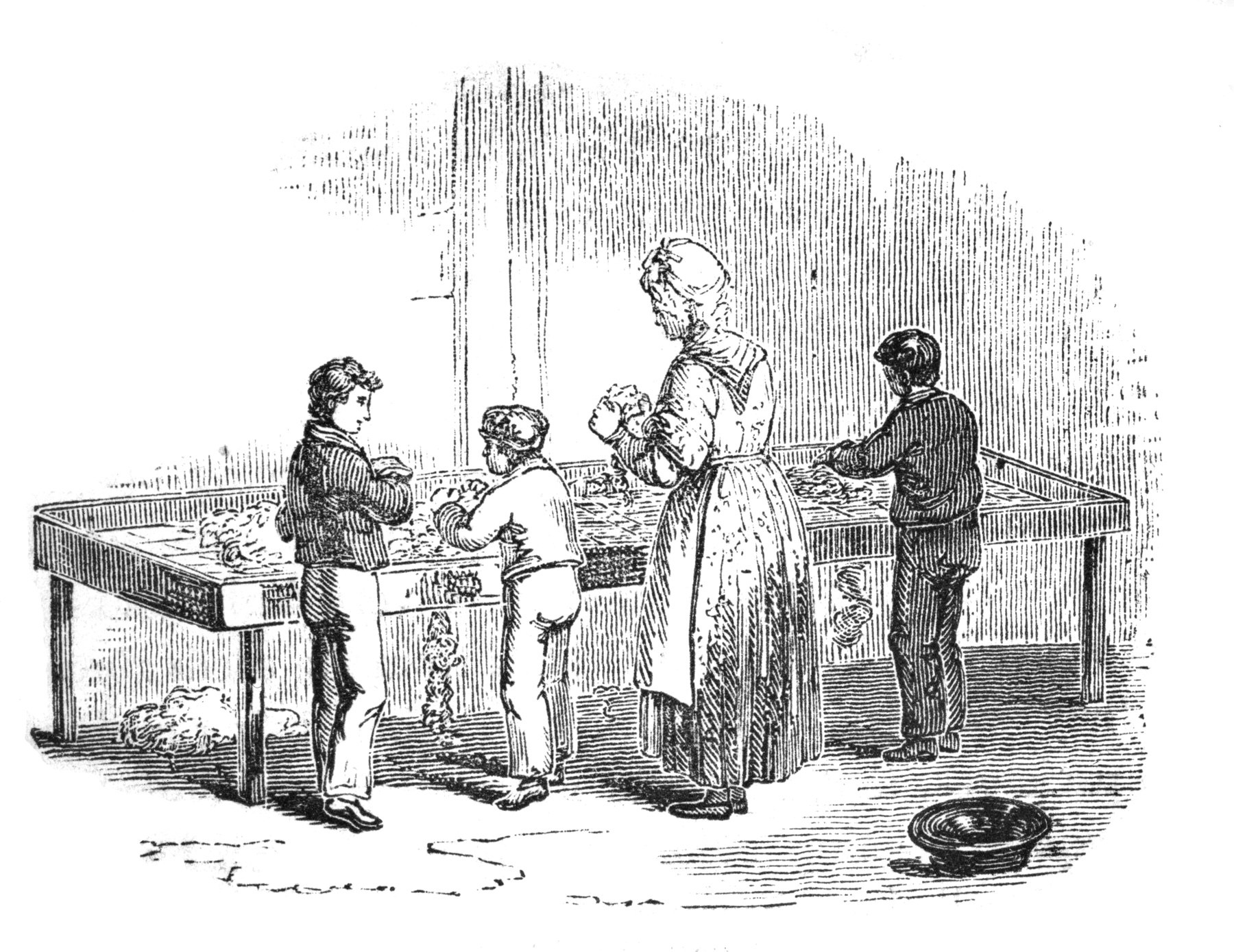
Young figures and an adult sort cotton at a table in an 1844 engraving.

Cotton preparation depicted in an 1844 publication. Wellcome records a later photographic reproduction of this engraving.

Mechanized production did not eliminate all the small tasks around it. In her introductory discussion of child labour, historian Jane Humphries emphasizes that children’s supporting work could be built into the labour process. An apparently subordinate task could therefore be essential. That helps explain why an engine, a spinning machine and the people attending it must be considered together.

Long hours meant more than time beside a machine

Bentley distinguished busier work from her usual schedule: five in the morning to nine at night in the former case, six to seven in the latter. She also described a meal allowance. These are recollected spans with qualifications, not an average shift length. Her evidence belongs to childhood before 1832, not to a factory day observed in 1850.

A working span and actual hours worked are different measurements. Time for meals has to be separated from labour, while travelling and waiting may consume a child’s day without appearing in a mill’s production hours. This is why a clock-based account should be read carefully before it becomes a headline number. The distinction makes severe demands more accurately visible, rather than less serious.

KEEP THE DISTINCTION

Three kinds of hours, three different questions

A witness’s remembered schedule

What the evidence tells us

Bentley differentiated ordinary and busier periods in her earlier work.

What it does not establish

The average hours of every British mill child.

An inspector’s exceptional case

What the evidence tells us

The 1836 account reported a working period crossing Friday night, with breaks.

What it does not establish

Continuous labour for every minute between the endpoints.

A statutory restriction

What the evidence tells us

A legal rule sets what covered employers were permitted to require.

What it does not establish

That every employer complied, or that all industries were covered.

Why would a family send a child to work?

Household need is part of the evidence, not an excuse supplied by the historian. Asked why children worked under harsh conditions, the witness Joshua Drake pointed to necessity. His answer should not be made into the motive of every parent. It does, however, challenge a simple explanation in which families freely choose between equally secure alternatives.

IN THE SOURCE

Necessity compels a man that has children to let them work.

Joshua Drake · Sadler Committee testimony · published transcription

Humphries’s research adds another source base: autobiographies describing working-class childhoods. The publisher’s account of her study identifies family vulnerability, including the loss of fathers, as one pressure on children’s work. Such evidence brings household circumstances into view. Memoirs still come from people who later survived and recorded a story, not from every child who entered a mill.
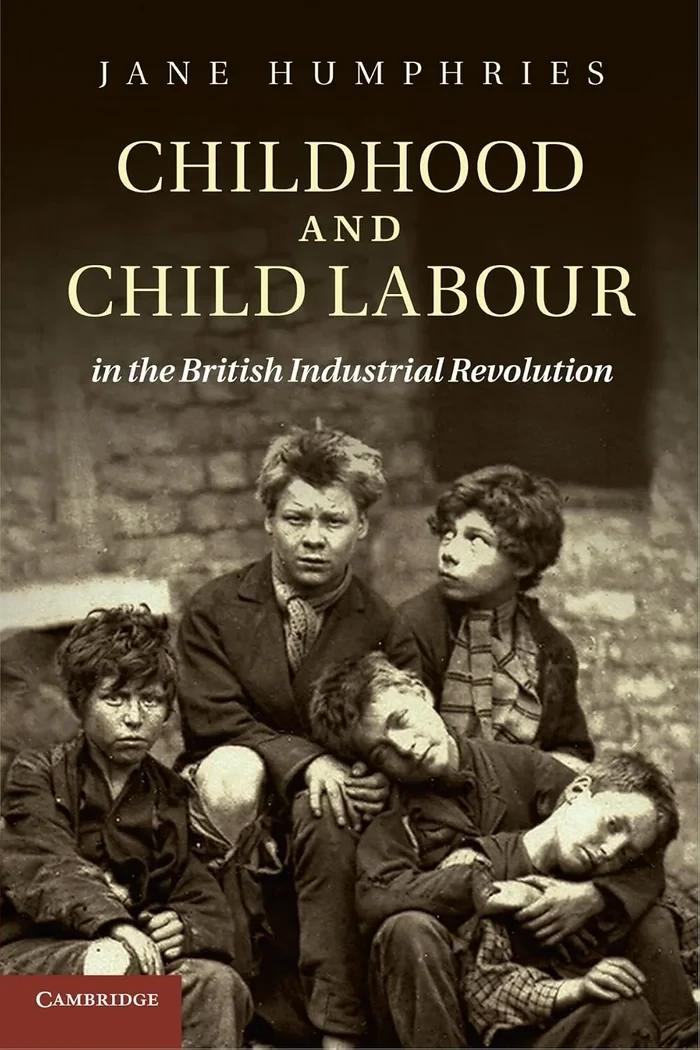
Childhood and Child Labour in the British Industrial Revolution · Paperback
LEARN

Childhood and Child Labour in the British Industrial Revolution · Paperback

Jane Humphries

Jane Humphries uses working-class life stories to examine work, family pressures and schooling. A deeper evidence-based reading of the questions raised here.

Find the book
Sponsored link

There is an important difference between explaining a constraint and accepting it as harmless. A family might need income while a child faced exhaustion or punishment. Those facts do not cancel each other. The historian’s task is to keep the household’s limited alternatives and the employer’s demands in the same frame, without deciding that one makes the other disappear.

An apprentice lived within a different arrangement

At Quarry Bank in Cheshire, the Apprentice House connected employment with lodging. The National Trust describes children receiving food and accommodation in exchange for work, with some arriving from workhouses and others from family homes. That arrangement differed from a child living with parents and contributing earnings to the household. Where a child slept was part of how the labour relationship worked.
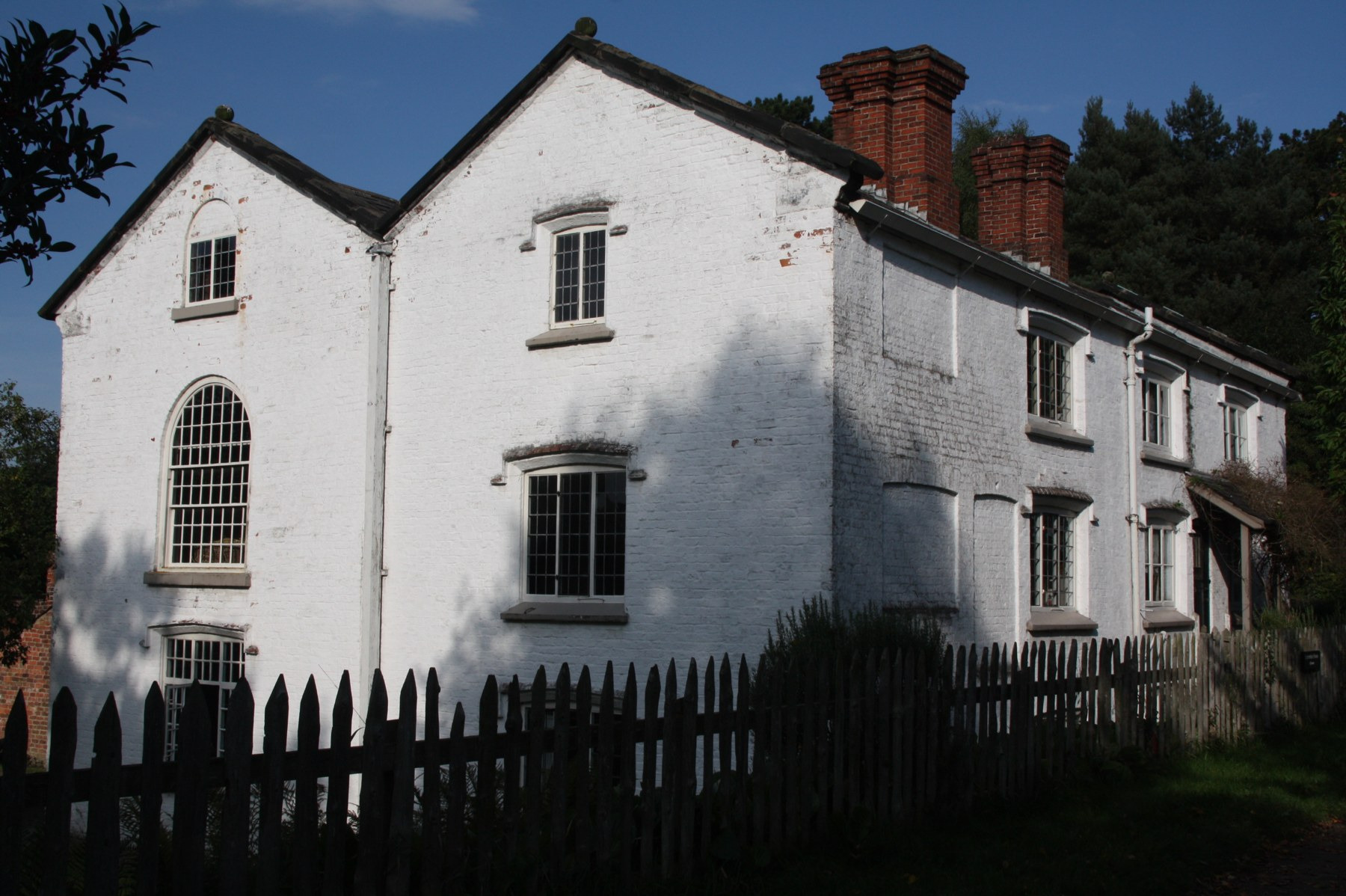
The red-brick Apprentice House and adjoining cottage at Quarry Bank, photographed in 2013.
Quarry Bank’s Apprentice House and cottage in 2013. Their fabric includes later extensions and alterations. Mike in Macc · CC BY-SA 3.0 · resized

The building survives, but it has not stood still. Historic England’s listing dates its first construction to 1790, records early nineteenth-century extensions and describes conversion in 1847. Today’s fabric helps locate a system of housed labour; it does not preserve every bed, lesson or conversation as it was. A restored room and a child’s original experience are different kinds of evidence.

CHANGE YOUR VIEW

The same apprentice, different questions

Housing and work were linked. Ask what support was provided, what obligations followed, and what evidence records the child’s own experience.

An employer could compare apprentices with other workers in costs and productive tasks. That calculation tells us about management, not the full experience of the person being valued.

A business record may preserve names and assignments while saying little about fatigue or attachment to family. Testimony and buildings can add evidence without automatically filling every gap.

A December 1837 list discussed by Quarry Bank’s archivists compared apprentices with other workers. It distinguished learners from more experienced workers and named Esther Price and Lucy Garner among the latter. The institutional account shows management measuring differences in work and cost. Its figures must not automatically be treated as spending money personally received by each apprentice.

The distinction matters because the surviving record answers its author’s question. A calculation of labour’s value is not the same document as a household budget or a worker’s receipt. Even when a child is named, the name does not turn the ledger into a diary. It makes further investigation possible; it does not supply the whole life.

Schooling needed more than a place on paper

The 1833 Factory Act required younger children in covered textile factories to receive two hours of schooling a day. It also created an inspectorate of four men. Parliament’s overview makes the enforcement problem clear: a very small body had to oversee thousands of mills. The reform changed what could be required and investigated, rather than instantly producing the same experience everywhere.

Time allocated to education is not identical to learning. Attendance, teaching and a child’s capacity to concentrate are separate questions. A rule could create space for schooling while work still occupied much of the day. To judge a particular child’s education, we would need evidence such as attendance or instructional records, not simply the date when Parliament passed an act.
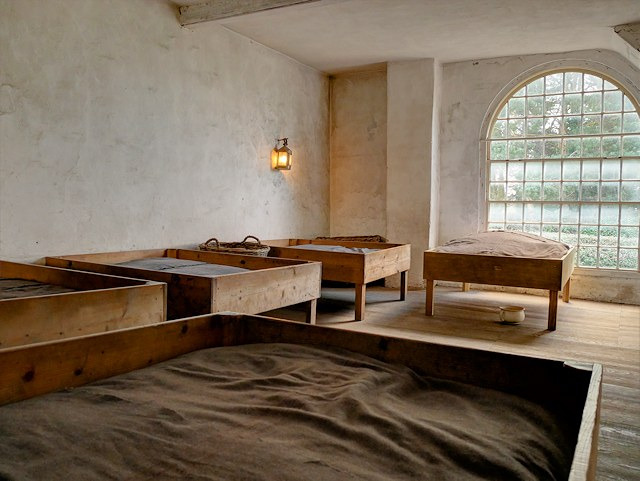
A modern museum display of the girls’ dormitory at Quarry Bank Apprentice House.
A modern dormitory display at Quarry Bank, not a photograph of children’s accommodation taken in the 1830s. David Dixon · CC BY-SA 2.0

LAYERS OF TIME

Keep testimony, rules and buildings in order

  1. 1832

    Earlier work recalled

    Bentley and other witnesses gave evidence to a parliamentary inquiry.

  2. 1833

    An inspectorate and schooling rules

    The Factory Act created a new means of supervising covered textile work.

  3. 1836

    A reported breach

    The Taylor, Ibbotson & Co. case recorded an exceptional overnight working period.

  4. 1837

    Work compared in a ledger

    Greg’s December list compared apprentices with other workers.

  5. 1847

    A building changes use

    The Apprentice House was converted after its earlier role housing apprentices.

These dates identify different kinds of evidence; they are not one child’s biography.

The Real Oliver Twist: Robert Blincoe — A Life That Illuminates an Age
VISIT

The Real Oliver Twist: Robert Blincoe — A Life That Illuminates an Age

John Waller

Follow Robert Blincoe’s life from workhouse childhood into the textile industry. A historical biography that adds an individual life to the chapter’s discussion of child labour and parish apprentices.

Find book on Amazon
Sponsored link

A reported breach is evidence, not a national verdict

Return to the inspector’s 1836 letter. The writer reported questioning the boys separately and receiving consistent answers, then consulting a time book. Those details matter: the account presents a process of checking, not merely an accusation. It also remains a selected published extract. We do not have every boy’s full interview or the complete record of what followed.
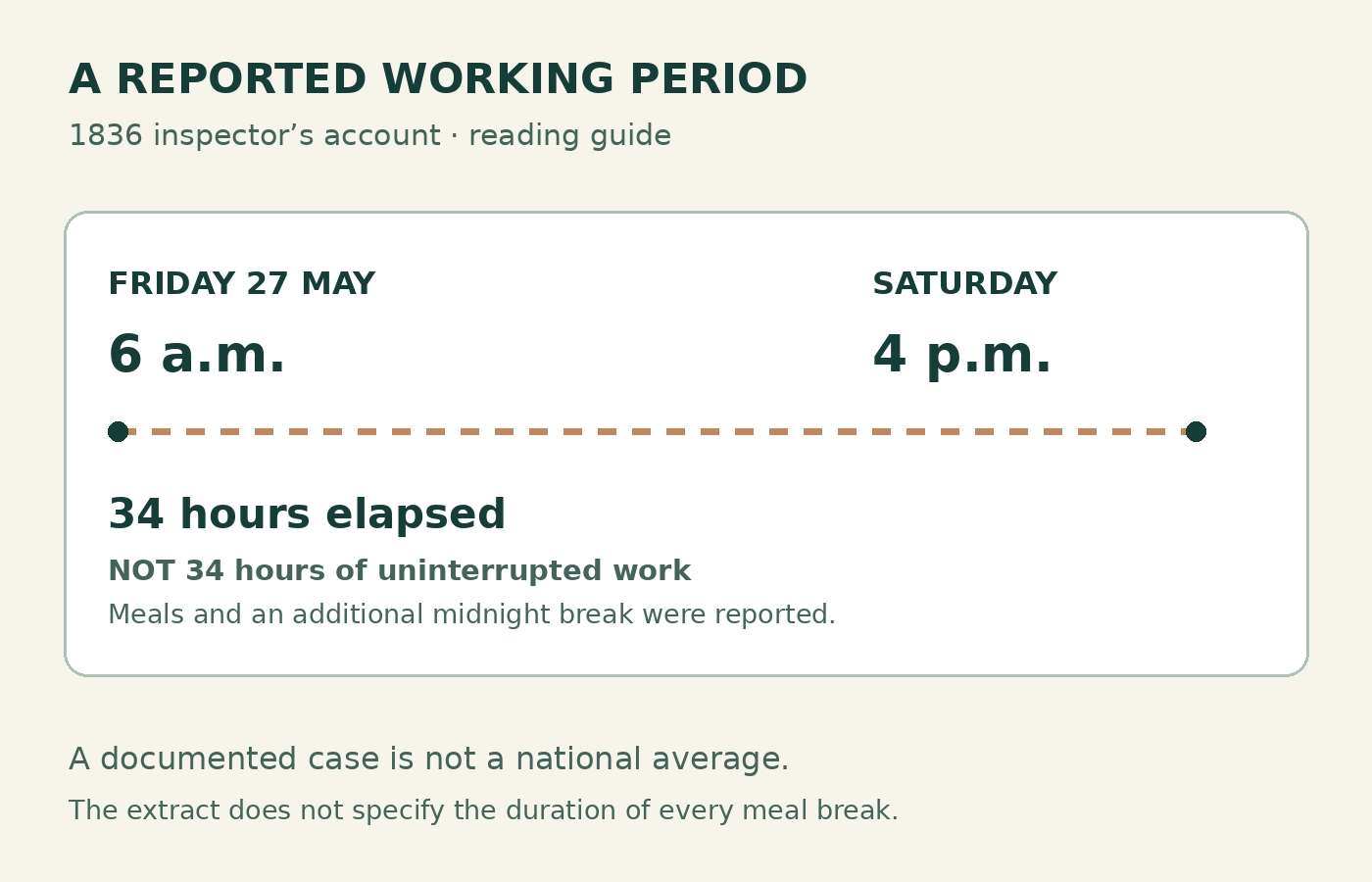
Friday 27 May at 6 a.m. to Saturday at 4 p.m.: 34 hours elapsed, with breaks; not a national average.
Modern reading guide based on the inspector’s 1836 account. Elapsed time includes breaks; exact net working hours are not calculated. Before Now · Editorial reading guide

TEST THE EVIDENCE

Does one case tell us how every mill worked?

All mill children worked continuously for 34 hours.

Friday 27 May at 6 a.m. to Saturday at 4 p.m.: 34 hours elapsed, with breaks; not a national average.
Reported endpoints and elapsed timeFriday 27 May to Saturday · 1836 report
REPORTS
Boys gave matching accounts; the inspector also checked a time book.
SUPPORTS
A serious reported breach meriting investigation in this workplace.
CANNOT ESTABLISH
Exact net hours without all breaks, conditions in every mill, or the final outcome of enforcement.

A better-supported statement

In this 1836 case, boys reported work across a 34-hour span, with breaks. The extract does not establish a national average.

Primary account: Factory Inspector’s Report, 1836 · National Archives · Before Now · editorial reading guide

Neither extreme follows from the letter. A documented breach does not mean that legislation achieved nothing; the existence of an investigation may itself reflect new powers to inspect. Conversely, a law on the statute book cannot be used to dismiss the reported labour. Regulation and evasion belong in the same history. Their relationship is a question for evidence, not a choice between a perfect reform and complete failure.

KEY IDEA

A child’s work can be essential to a mill while their own experience remains difficult to recover.

The records give us more than a picture of small bodies beside large machines. They reveal tasks that kept production moving, households under pressure, agreements joining labour to lodging, and rules that had to be enforced. None of these alone explains every working childhood. Together they make it possible to ask better questions about who depended on a child’s work—and what choices that child actually had.

The next chapter follows the cotton itself between plantation and mill. Those workplaces were connected, but their labour relationships cannot be collapsed into one. Here, even within British textile regions, family workers and housed apprentices occupied different positions. Keeping those differences visible is how a history of industrial production becomes a history of people.
A closer look

Frequently asked questions

Tasks varied by fibre, machine, age and workplace. Elizabeth Bentley recalled changing bobbins in a flax mill. Other evidence records children preparing cotton or attending spinning machinery. These examples do not establish one universal child’s job.

Hours depended on the period, mill and age. Bentley’s 1832 testimony recalled both ordinary and busier schedules from her earlier employment. An inspector’s 1836 case recorded an exceptional overnight working span. Neither is an average for all children or the whole Victorian period.

Employment arrangements differed. A child working while living with family was not in the same position as a housed apprentice supported through an agreement. A manufacturer’s calculation of an apprentice’s value is not automatically evidence of cash handed to that child.

No. It restricted employment in covered textile factories and created an inspectorate; it did not end children’s work throughout the economy. Evidence of later breaches shows the difference between a rule and its enforcement.

Some did. The 1833 Act required schooling for younger children in its covered factories. Time allocated by law was not the same as consistent attendance or effective instruction, and long work schedules could compete with learning.

Resources

Keep exploring.

Follow the evidence

Sources and evidence

A parliamentary testimony excerpt, an inspector’s report and institutional records reveal different aspects of children’s work. Dates and the limits of each source matter.

  1. The National Archives: Factory Inspector’s Report, 1836

    Published educational transcript of British Parliamentary Papers, 1836, No.353.

    Taylor, Ibbotson & Co.: Friday 27 May, 6 a.m., to Saturday 4 p.m.; meal breaks and an extra midnight hour are explicitly excluded. A reported case, not a national average.

  2. Evidence given before the Sadler Committee, 1832

    Elizabeth Bentley, Parliamentary Papers 1831–1832 XV, p.195; Joshua Drake p.44. Published transcription via Scott and Baltzly’s 1930 readings.

    Bentley, aged 23, recalled earlier employment at a Leeds flax mill. Questions and replies were read together. The modern anthology’s claim that the excerpts were statistically representative is not adopted.

  3. UK Parliament: The 1833 Factory Act

    Institutional overview: covered textile factories, schooling and four inspectors.

    Use for legal framework, not automatic compliance. Its eight-hour summary conflicts with the National Archives’ nine-hour summary; no daily-hour table based on these conflicting overviews is reproduced.

  4. The National Archives: 1833 Factory Act

    Educational overview and source context.

    Two daily hours of schooling, age certificates and inspectorate. Broad statements about no earlier laws and a malformed 1844-hours row are not adopted.

  5. National Trust: Visit the buildings at Quarry Bank

    Apprentice House and preserved industrial community.

    Food and lodging in exchange for work; child workers from workhouses or homes. Modern guided interpretation is distinct from an untouched historical interior.

  6. Historic England: Apprentice House and cottage

    List entry 1237685; 1790 construction, early nineteenth-century extensions and 1847 conversion.

    Building history and later alterations; the listing’s evaluative label for Greg is not treated as a verdict on every child’s experience.

  7. National Trust, Quarry Bank Revealed: Apprentices vs workers

    Laura, 24 January 2014; interpretation of Robert Hyde Greg’s December 1837 comparison list.

    Employer cost/value calculations, learners and experienced workers. No inflation conversion, universal cash-wage claim, or the blog’s mistaken 1844 Ten Hour Bill date adopted.

  8. Jane Humphries: Childhood and Child Labour, introductory excerpt

    Cambridge University Press authorised introduction to the 2010 book.

    Autobiographical evidence, built-in supporting work and limits of government inquiries. Only the accessible introductory excerpt and publisher description were consulted, not the whole book.

  9. Cambridge: Childhood and Child Labour in the British Industrial Revolution

    Jane Humphries; English paperback ISBN 9780521248969.

    Publisher confirms title, author and paperback ISBN. The displayed 2010 dates refer to initial publication/digital or hardback; no paperback publication year asserted.

  10. Wellcome Collection: M0013539

    WT/D/1/20/1/121/44; reproduction made July 1954 from George Dodd, 1844.

    1844 wood engraving, not an 1844 photograph of children. The Commons digital file is CC BY 4.0; the separately catalogued Wellcome reproduction is marked Public Domain.

  11. National Trust: Quarry Bank visitor information

    Admission and Apprentice House guided-tour conditions; checked 9 October 2026.

    Members’ entry included; house tours have limited tickets from reception. Membership does not guarantee a particular tour slot.

  12. National Trust: Membership

    Official membership benefits and options, checked 9 October 2026.

    Recommendation is a paid membership for broader visiting, not an invented affiliate Quarry Bank ticket. Compare the current cost with the visits you intend.

  13. Emma Griffin: Liberty’s Dawn: A People’s History of the Industrial Revolution

    Publisher metadata for specified edition.

    Amazon ISBN search is a discovery fallback, not verified stock. Full book not read. Yale paperback currently listed out of stock at publisher.

  14. Friedrich Engels: The Condition of the Working Class in England

    Publisher metadata for specified edition.

    Amazon ISBN search is a discovery fallback, not verified stock. Full book not read.

  15. Charles Dickens: Hard Times

    Publisher metadata for specified edition.

    Amazon ISBN search is a discovery fallback, not verified stock. Full book not read.

  16. Children preparing cotton in an 1844 engraving

    Cotton preparation depicted in an 1844 publication. Wellcome records a later photographic reproduction of this engraving.

    Original image and commercial-reuse licence checked.

    Image credit

    Wellcome Collection

    CC BY 4.0

  17. Quarry Bank Apprentice House and cottage

    Quarry Bank’s Apprentice House and cottage in 2013. Their fabric includes later extensions and alterations.

    Original image and commercial-reuse licence checked.

    Image credit

    Mike in Macc

    CC BY-SA 3.0

  18. Dormitory display in the Apprentice House

    A modern dormitory display at Quarry Bank, not a photograph of children’s accommodation taken in the 1830s.

    Original image and commercial-reuse licence checked.

    Image credit

    David Dixon

    CC BY-SA 2.0

  19. Reading the 1836 inspector’s reported times

    Modern reading guide based on the inspector’s 1836 account. Elapsed time includes breaks; exact net working hours are not calculated.

    Original editorial reading guide.

    Image credit

    Before Now

    Editorial reading guide

FOLLOW THE TRAIL

Continue Industrial Lives

Continue in sequence, or jump to another chapter in the path.

View full Story Path
Chapter1

NEXT CHAPTER

Manchester’s Cotton Mills: How Cotton Reshaped a City

Tall mills stood beside canals, with workers’ homes close behind. In Ancoats, Manchester’s industrial transformation can still be read through brick, water and the connections that reached across the Atlantic.

Chapter2

NEXT CHAPTER

Steam Power and the Factory: Why Water Didn’t Disappear

At one Birmingham works, steam kept a waterwheel turning. That surprising arrangement reveals what steam engines changed—and why factory power remained a choice rather than a single revolution.

Chapter4

NEXT CHAPTER

Cotton’s Divided World: From Enslaved Labour to Lancashire Mills

A bale could cross the Atlantic while the person who picked its cotton could not leave the plantation. Follow the trade, read the records and discover why one connected industry contained profoundly…

Chapter5

NEXT CHAPTER

Peterloo 1819: How a Crowd Demanding a Voice Met the Cavalry

A crowd gathered in Manchester to demand a political voice. Cavalry turned the meeting into violence. Follow the decisions, compare two eyewitness perspectives and see why the struggle over Peterloo’s meaning outlasted…

Chapter6

NEXT CHAPTER

A Shilling a Week: How Early Trade Unions Built Collective Power

A weekly subscription could support a sick worker, connect distant branches and sustain a dispute. Follow the machinery of early British trade unions—and the boundaries of the solidarity they built.

Chapter7

NEXT CHAPTER

A Shorter Working Day? What Factory Laws Changed for Children

A law could shorten a shift on paper. Changing a child’s day required inspectors, age certificates, school attendance and decisions inside the factory. Follow what changed—and what the rulebook could not settle.

Chapter8

NEXT CHAPTER

More Goods, Unequal Gains: Who Benefited from the Industrial Revolution?

Manchester’s smoky skyline promised a changed world. But more goods, better wages, freedom and a voice in public life did not arrive together. What counts as industrial progress depends on whose life…

Other chapters in this pathRead in any order
1Manchester’s Cotton Mills: How Cotton Reshaped a CityTechnology · Trade · Urbanism
2Steam Power and the Factory: Why Water Didn’t DisappearTechnology · Work and Labour
4Cotton’s Divided World: From Enslaved Labour to Lancashire MillsSlavery · Trade · Work and Labour
5Peterloo 1819: How a Crowd Demanding a Voice Met the CavalryPolitical reform · Work and Labour
6A Shilling a Week: How Early Trade Unions Built Collective PowerPolitical reform · Women and Gender · Work and Labour
7A Shorter Working Day? What Factory Laws Changed for ChildrenEveryday Life · Political reform · Work and Labour
8More Goods, Unequal Gains: Who Benefited from the Industrial Revolution?Social Status · Trade · Work and Labour