
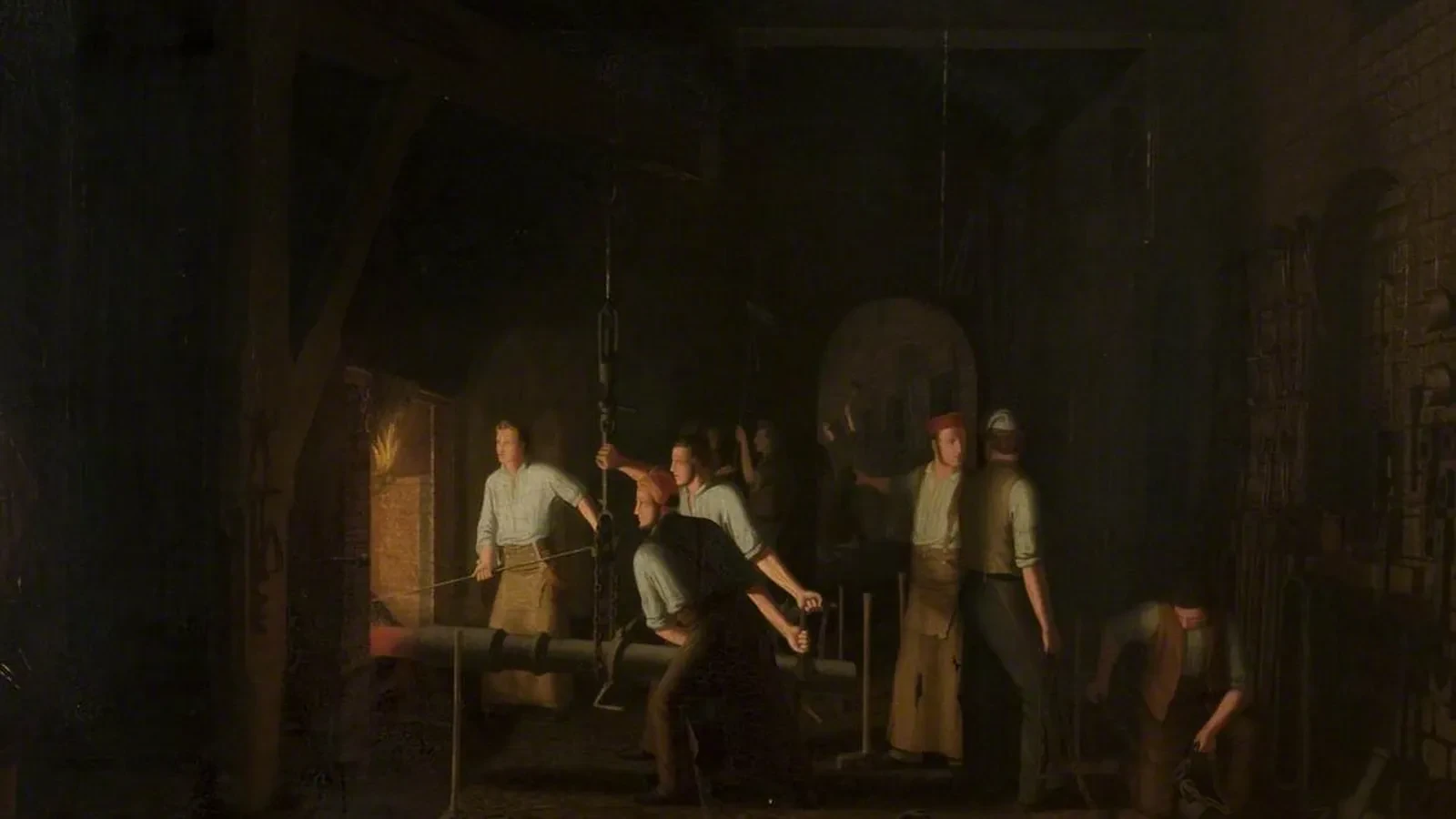
A shilling a week could look like a small payment beside a large industrial conflict. Yet in the Amalgamated Society of Engineers, that regular subscription helped turn individual earnings into shared resources. A member’s contribution when employed could support another member when work, health or earning power failed.
The important question was what happened after the money changed hands. Who recorded it? Who decided whether a claim qualified? How could people in different towns act together? Early British trade unions built power through these ordinary arrangements, as well as through public protest. Their rules also drew boundaries around the people entitled to help.
PLACE & TIME
Local branches, wider connections
Britain · Manchester, London and Tolpuddle
Great Britain · map anchor: Mechanics’ Institute, Manchester
c. 1824–1871 CE
Period covered in this article
A grievance needed an organisation that could last
A complaint about wages could be shared without producing sustained action. Workers needed ways to communicate, choose representatives and support people whose earnings stopped. The ASE, formed in 1851 from several engineering trade societies, offers one concrete example. It joined local knowledge to a wider organisation rather than gathering every worker into one meeting.
The legal setting remained uncertain. The repeal of the Combination Acts in 1824 did not establish unrestricted freedom to organise. Legislation in 1825 narrowed what combinations could lawfully do, while other laws could still reach their activities. The later parliamentary debate explains this uneven inheritance. Tolpuddle shows how an organisation could face punishment without union membership itself being the charge.
- Subscription: a regular contribution to an organisation’s funds.
- Branch: a local part of a wider union, with members and officers.
- Benefit: support provided under specified rules and conditions.
- Lockout: an employer’s refusal to provide work during a dispute.
Tolpuddle: solidarity could expose people to danger
In Dorset, agricultural labourers formed a friendly society amid pressure on wages. Their subscriptions and promises of loyalty helped bind the group. In 1834, six men were convicted over an unlawful oath and sentenced to seven years’ transportation. The prosecution was not a simple conviction for the act of joining a union, although it threatened workers’ attempts to organise.
A wider campaign carried their case beyond the village. Demonstrations and petitions challenged their punishment, and full pardons followed in March 1836. That mobilisation mattered: the society’s own resources could not simply overturn the verdict. Organisation could make people visible and vulnerable, while connections beyond the membership could bring support.
TEST THE EVIDENCE
Does the tree locate the oath?
This photograph proves that the Tolpuddle oath was sworn beneath the tree.

- PHOTO SHOWS
- A village tree, a bench and a setting of remembrance.
- RESEARCH PLACES
- The oath in Thomas Standfield’s house, drawing on accounts of the trial.
- CANNOT PROVE
- A photograph taken in 2009 cannot locate an action in 1833. This does not rule out other meetings beneath the tree.
A better-supported statement
The tree is a place of remembrance. Accounts discussed by researchers place the oath inside Standfield’s house.
Research: TUC Library · Tolpuddle and political folklore · Simon Palmer · CC BY-SA 2.0 · converted to JPEG
What a weekly shilling made possible
Writing in 1867, Thomas Wright described ASE members paying one shilling a week when employed. Twenty shillings made a pound: one hundred employed members each paying their subscription would contribute £5 in a week. This is an illustration of the arithmetic, not the surviving account of a particular branch. Regular payments made a fund possible; claims and expenses determined what it could sustain.
Wright’s account of the rules includes sickness, unemployment, old age and funeral support. Eligibility mattered. A new member did not immediately acquire every entitlement, and unemployment payments could decline as time without work continued. A benefit was a structured claim on shared resources, rather than a promise that every difficulty would be fully covered.
FOLLOW THE PROCESS
From a subscription to shared support
Collect and record
Branch officers entered contributions and maintained the local accounts.
Consider the claim
Rules and the member’s circumstances determined eligibility for support.
Report across branches
Regular reports connected local conditions to the wider organisation.
Check the accounts
Elected auditors examined branch books; central accounts also faced scrutiny.
Those procedures gave solidarity a practical form. An injured member needed a payment, but the society also needed to know who had contributed and what obligations remained. The Warwick archive catalogues an 1868 request for financial aid from the Drogheda branch. Its survival points to the work of making a local need legible to an executive committee; the catalogue alone does not tell us the applicant’s whole story.
Who could speak for the members?
The branch was more than a collection point. In the rules quoted by Wright, it appointed officers and conducted business within the society’s framework. This combined local participation with limits agreed beyond one town. A branch could know its members’ circumstances; a national body could connect resources and decisions across a much larger membership.
IN THE SOURCE
Every branch of this society shall appoint its own officers, and conduct its own business in the manner set forth in the following rules.
Communication also helped members look for work. Branches reported the state of their trade, including unemployment and prospective openings, and information circulated through central reports. A union could therefore connect a man without work to information from another district. The same network that supported a dispute could be useful during an ordinary search for wages.
The membership gate shaped the solidarity inside
Wright reported demanding ASE admission conditions: an age range, years of trade experience, and two members who would propose and second a candidate. They vouched for skill and conduct. Contributions and a qualifying period added further barriers. This was a craft society built around a defined membership, not an open assembly of everyone who earned a wage.
LOOK CLOSELY
A certificate presents the society it wants to be
Read the named trades
The full society title links engineers with machinists, millwrights, smiths and pattern makers. The claimed community has occupational boundaries.
Find the admission form
Spaces for a member, branch and admission date connect the grand imagery to an administrative act. This copy’s form is unfilled.
Read the motto as an ambition
“Be United and Industrious” presents solidarity and respectability. It does not prove that members always agreed or disputes succeeded.
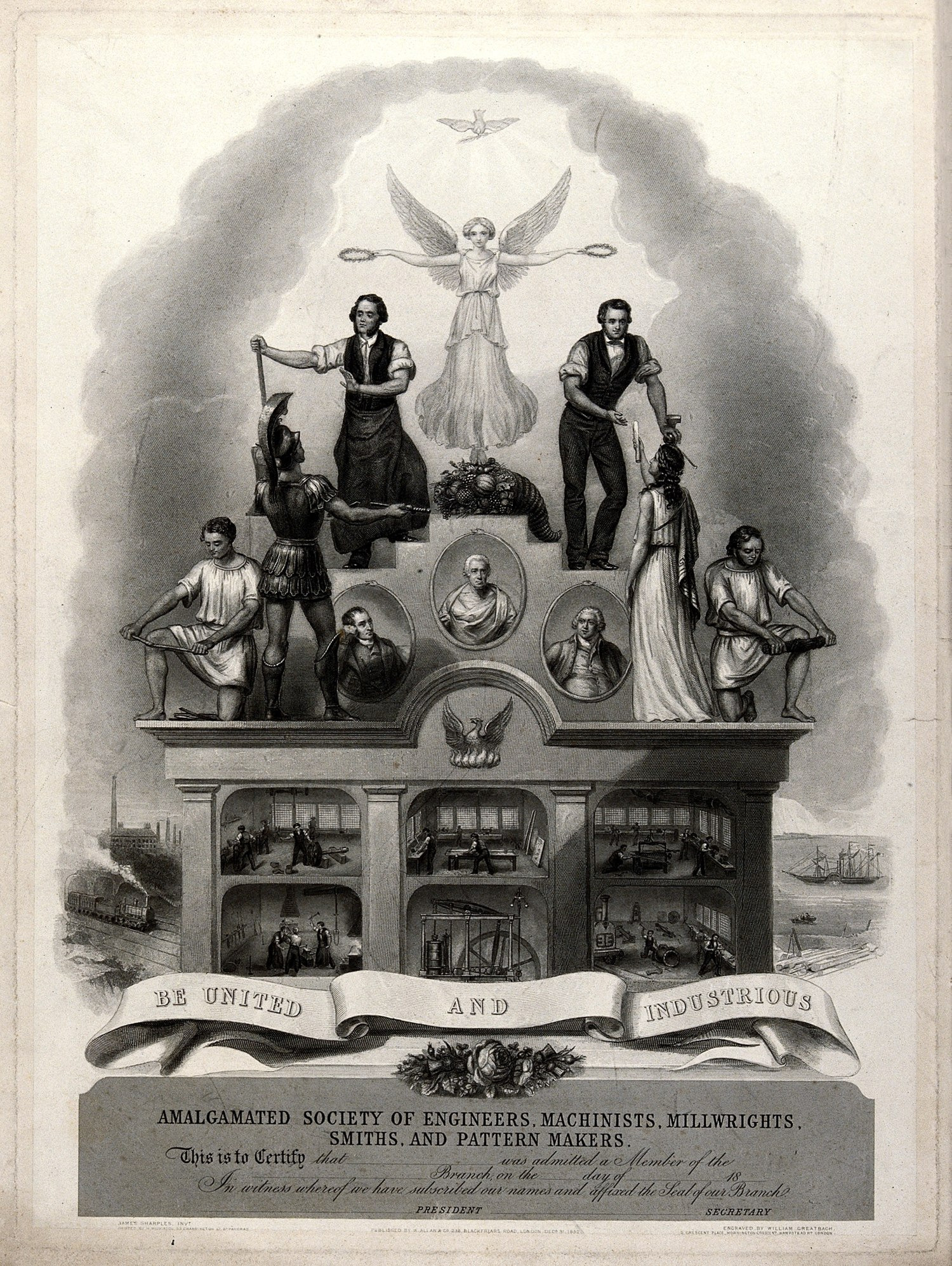
ASE membership certificate: allegorical figures above industrial scenes and an unfilled admission form. The imprint names James Sharples and engraver William Greatbach.
Such boundaries could strengthen members’ bargaining position while excluding other workers from the same protection. Skill was both useful knowledge and a claim to standing. To understand whose interests an organisation defended, look at the admission rule alongside its public language of unity. Neither a grand certificate nor a growing fund establishes that solidarity was universal.
Benefits and bargaining drew on the same organisation
Support outside a dispute could keep members attached to a society over many years. It also gave the organisation something to lose. Money promised for sickness or old age could not be treated as inexhaustible strike support. Decisions about collective action therefore involved both immediate grievances and responsibilities to members facing other needs.
KEEP THE DISTINCTION
Support and bargaining were connected, but different
Immediate purpose
Help eligible members when earnings or health failed.
Seek changes to wages or working arrangements.
What organisation supplied
Subscriptions, rules, claims and continuing administration.
Representatives, communication and resources for sustained action.
A practical limit
Funds and eligibility could not cover every worker or every need.
Employers could resist, and a dispute could end in defeat.
The ASE’s conflict with engineering employers in 1852 made that limit clear. Union demands concerned systematic overtime and piecework; employers responded with a lockout. Employers, too, could organise across firms. In the spring, workers returned on the employers’ conditions. The Webbs’ later account describes a serious defeat, followed by the society’s continued existence. A durable organisation did not guarantee victory in its first major confrontation.
Why bring different unions into one congress?
By 1868, unions had reasons to coordinate without surrendering their separate memberships. Delegates met at Manchester’s Mechanics’ Institute for the first Trades Union Congress. The TUC’s historical account describes an attempt to discuss common interests and public questions. A congress could connect organisations whose local funds and occupational concerns still differed.

The meeting did not turn all workers into members of one national union. Even established labour organisations were not uniformly involved: the London Trades Council stayed away. Coordination had to be built among bodies that could disagree about representation and priorities. “The unions” is a useful collective phrase only if it does not erase those differences.
LAYERS OF TIME
Organisation and recognition advanced unevenly
- 1824–1825
An uneven legal opening
Repeal of the Combination Acts was followed by narrower legislation.
- 1834–1836
Tolpuddle: punishment and pardon
An oath prosecution led to transportation; a wider campaign helped win full pardons.
- 1851–1852
A new society, a major defeat
The ASE formed, then faced an employers’ lockout and an unsuccessful dispute.
- 1868
A congress in Manchester
Delegates sought coordination among separate unions.
- 1871
Legal status and protected funds
The Trade Union Act improved recognition and provisions for registered societies.
These are selected turning points, not the beginning of all worker organisation or a steady sequence of victories.
The Trade Union Act 1871 improved unions’ legal standing and gave registered societies provisions for holding property and protecting funds. Accounts, officers and returns mattered in law as well as within the branch. Recognition nevertheless had limits: the Act did not make every union agreement enforceable in court, or place every form of collective action beyond legal challenge.
Whose collective power remained difficult to build?
The male skilled engineer is a revealing case, but not a representative of the whole workforce. Women worked and organised, and opportunities differed across trades. As a short epilogue beyond this chapter’s main period, Emma Paterson’s work with the Women’s Protective and Provident League from 1874 points towards efforts to extend organisation among women. It was a response to uneven access, not the invention of women’s collective activity.
KEY IDEA
A union turned contributions into shared capacity—and rules decided who could draw on it.
Early unions made grievances harder to isolate by connecting people, payments and decisions over time. That capacity could survive a defeat, but it could also leave many workers outside its boundaries. The next chapter turns to factory laws: how workplace conditions became a matter for legislation, and why passing a rule was only the beginning of changing working life.
_-_The_Forge_-_601_-_Blackburn_Museum_and_Art_Gallery.jpg)


