
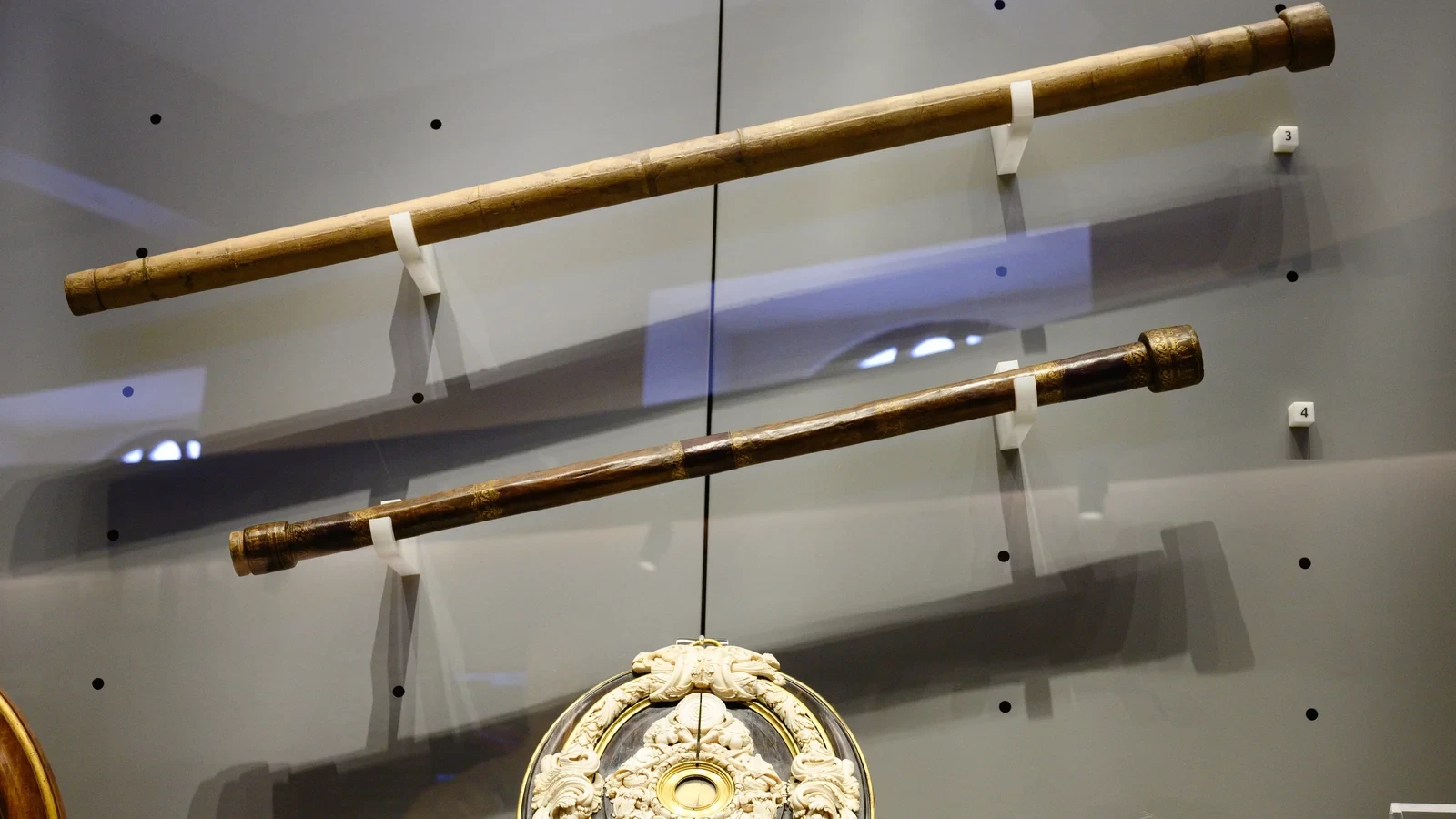
On 7 January 1610, Galileo noticed three small points of light close to Jupiter. At first he took them for fixed stars. The next night their arrangement was different. More nights brought more changes, and eventually a fourth point appeared. The important observation was not a single dazzling view. It was a pattern that emerged by returning to the same planet and recording what had changed. His published account preserves that sequence.
Galileo was then a mathematics professor in Padua, in the Venetian Republic. The instrument he used had a short history as a device for bringing distant things closer. Turning it towards the sky raised a new question: when an unfamiliar tube showed something unexpected, how could an observer distinguish a celestial feature from a fault in the glass? The telescope changed astronomy through the work needed to answer that question.
PLACE & TIME
Padua and Venice · 1608–1611 CE
Padua and Venice
Northern Italy; connections to Dutch instrument making
1608–1611 CE
Padua is a reference point for Galileo’s early work, not the birthplace of every part of the telescope.
The telescope arrived before Galileo’s discoveries
In 1608, telescopes appeared in the Netherlands. Hans Lipperhey, a spectacle maker, is closely associated with their early development. Galileo heard about the device in 1609 and built instruments of his own. Museo Galileo separates that Dutch beginning from his improvements. Calling him the inventor of the telescope collapses two different achievements into one famous name.
A spectacle maker’s experience mattered because useful magnification depended on shaped glass, not simply on a clever idea. Lenses had to be selected and combined; their separation had to work for the person looking through them. A tube held the arrangement together. Each of these practical choices affected what could be seen. A telescope was an artefact made to perform, and early examples did not all perform equally well.
FOLLOW THE PROCESS
From a distant rumour to a usable instrument
Combine the lenses
An early Galilean arrangement used a convex objective at the far end and a concave eyepiece near the eye.
Adjust the instrument
Lens quality, spacing and alignment affected the image. Greater enlargement did not automatically produce a clearer view.
Learn the view
The field was narrow, so locating a target and following it required practice. The instrument showed a selected view, not the whole sky at once.
The surviving instruments make those limits tangible. Galileo’s best examples magnified more than twenty times, but image defects and a restricted field of view remained. The museum’s original telescopes are therefore more useful evidence than a modern photograph of the Moon presented as though it were his view. They show the material conditions under which those early observations were possible.
A useful tube could win attention on Earth
A distant ship was an easier selling point than an unfamiliar satellite. In the opening of Sidereus Nuncius, Galileo describes testing his instruments on terrestrial objects before turning to celestial observations. An observer could compare an enlarged distant object with something already known to exist. That did not settle every astronomical problem, but it offered a way to establish that the tube could do useful work.
Venice gave this usefulness a political setting. Galileo demonstrated his instrument there in 1609, and the technology promised advantages to a maritime state. A device could attract support before anyone agreed about what its celestial discoveries meant. Technical improvement, patronage and astronomical investigation developed together; they were not neatly separated stages on a road towards a modern research laboratory. The 1880 edition’s introduction describes this Venetian episode, while Galileo’s own text explains the optical work.
Light and shadow made the Moon readable
The Moon offered a conspicuous target. Galileo paid attention to the boundary between its illuminated and dark parts: the line was uneven, and bright points sometimes appeared within the darkness. He interpreted these effects using an analogy with sunlight reaching elevated ground on Earth. The claim was about relief—mountains and depressions—rather than an entirely smooth celestial surface. The drawings and accompanying discussion make that reasoning visible.
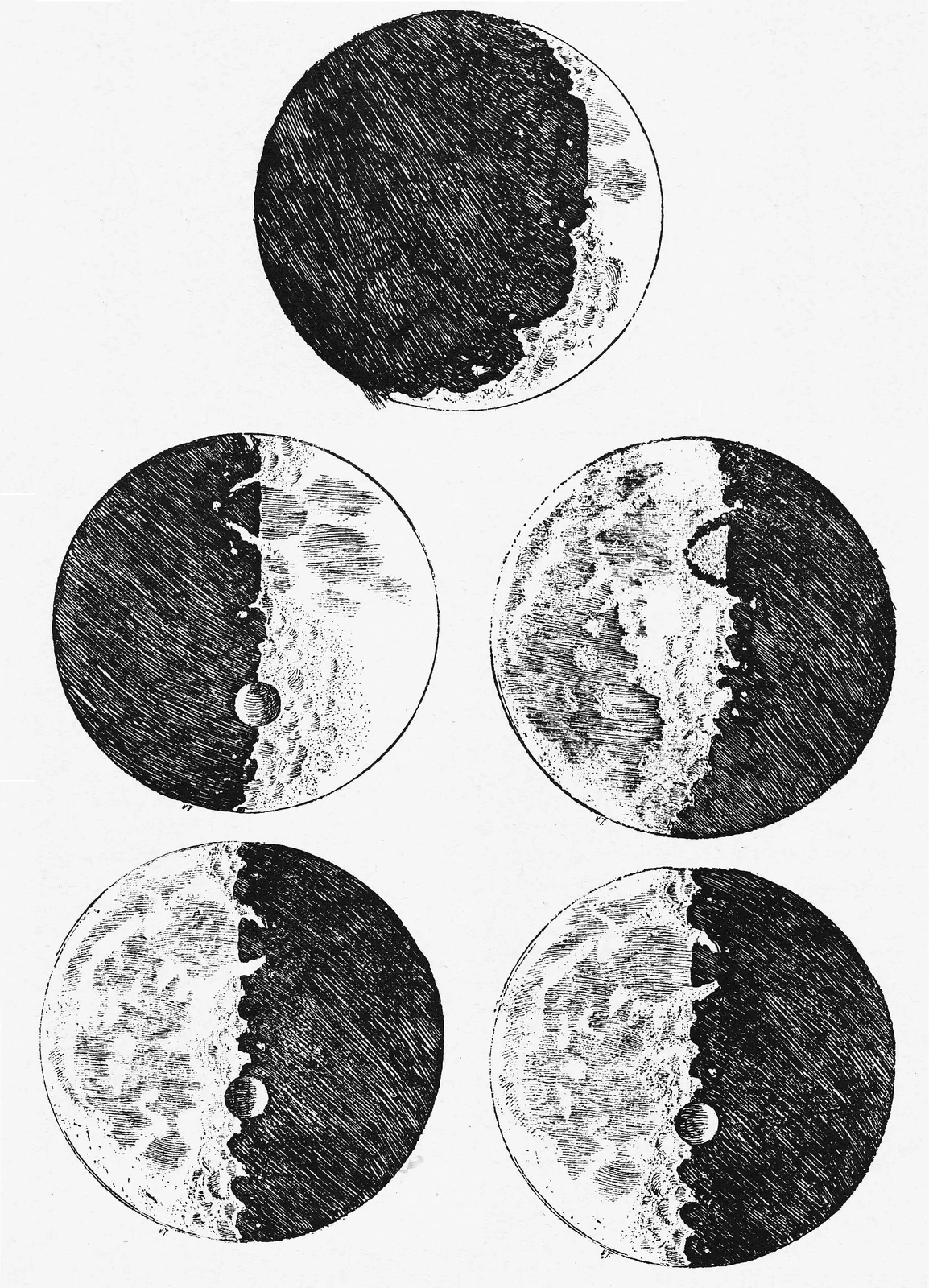
Notice how much work the comparison performs. A bright patch is an observation; identifying it as a mountain requires an explanation of how light falls on a surface. The printed illustrations select features that help readers follow that explanation. They are not photographs, and their persuasive force does not depend on pretending otherwise. They allow people away from the instrument to examine a reasoned representation of what Galileo thought he had seen.
KEEP THE DISTINCTION
An enlarged image still needs an argument
Uneven lunar light and shadow
A case for an irregular surface, interpreted through the behaviour of light.
Whether particular shapes are consistent across observations and how the instrument affects their appearance.
Small points beside Jupiter
A reason to keep watching the planet and compare positions over time.
Whether the points are ordinary background stars or bodies associated with Jupiter.
More stars in a familiar region
Evidence that unaided vision misses celestial detail.
How to identify, record and communicate the new detail reliably.
This is why the familiar instruction to “look for yourself” was more demanding than it sounds. Someone needed access to a serviceable telescope, a suitable target and enough experience to interpret the image. A disappointing attempt could expose a poor instrument or an inexperienced observer; it did not automatically refute every reported discovery. Equally, a successful terrestrial demonstration did not guarantee that every strange celestial appearance had been correctly understood.
Jupiter became a problem of repeated positions
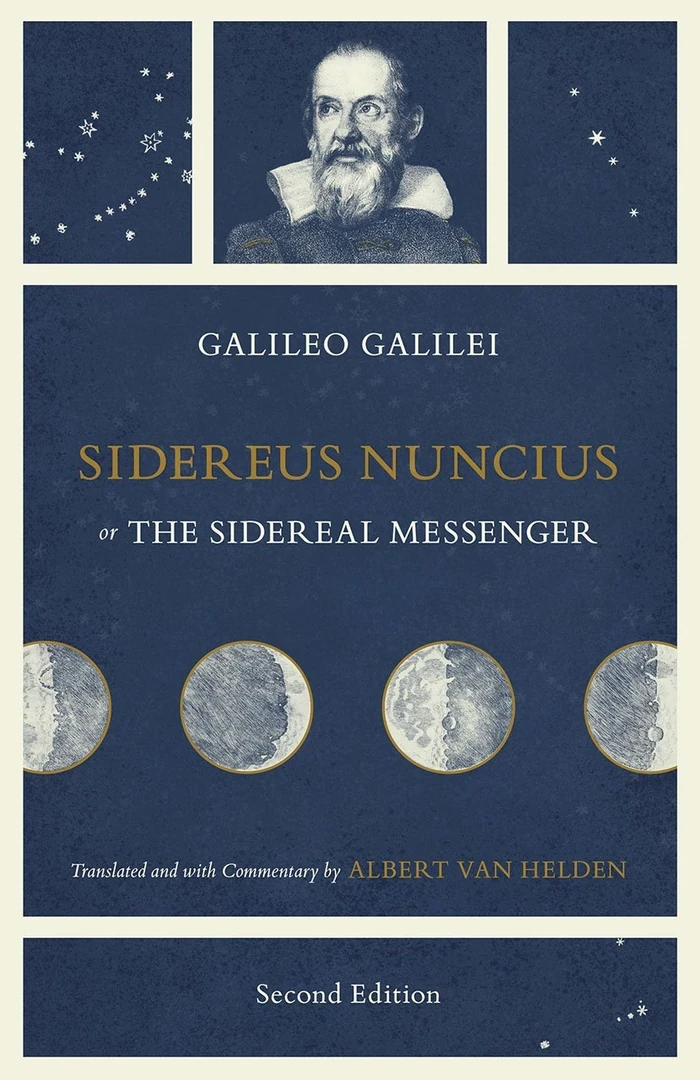
The points near Jupiter changed the scale of the investigation. In Sidereus Nuncius, Galileo printed dated diagrams showing their positions on either side of the planet. The rows are a record across time, not a picture of stars scattered across one piece of sky. Their value lies in the comparison: the points remained associated with Jupiter while changing their arrangement around it. That pattern supported the conclusion that they revolved around the planet.
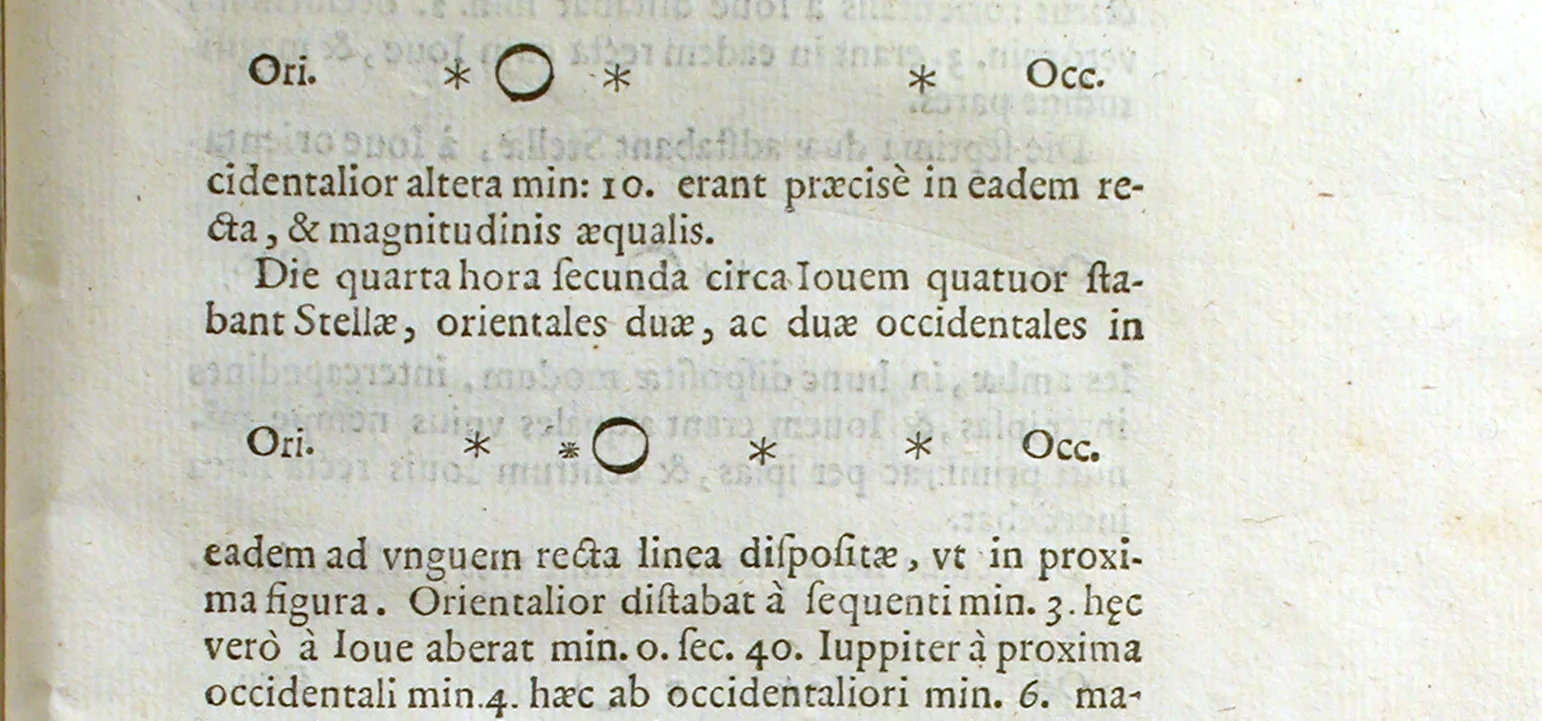
The account also contains interruptions. Clouds prevented an observation; a point could be hidden or too close to another body to distinguish. Galileo did not immediately begin with a complete, stable set of four. His report moved from an initial identification to a revised explanation. Reading that sequence preserves something a list of discoveries loses: a result was assembled from imperfect opportunities to observe, not delivered whole in the first glance.
IN THE SOURCE
Jan. 14.—The weather was cloudy.
The observation had an important consequence. Here were bodies apparently circling something other than Earth. That challenged the assumption that every celestial motion had to share the same centre. It also answered an objection to a moving Earth: a body might have its own companion and still belong to a larger system. But neither inference made Jupiter’s moons, by themselves, a complete demonstration of Earth’s motion.
A discovery travelled through diagrams and names
Published in Venice in 1610, Sidereus Nuncius carried the observations beyond the people who could stand beside Galileo’s instrument. Its diagrams, explanations and dedication worked together. Galileo named the satellites the Medicean Stars in honour of his patrons. The dedication shows that an astronomical claim could also be a bid for recognition and support. Patronage does not make the moons unreal; it helps explain how the discovery was presented and circulated.
Other observers had to engage with the claims. Carlos’s edition includes discussion of Kepler’s response and subsequent observations with a telescope. Agreement involved access to instruments and repeated examination, not simply admiration for a famous observer. A printed report could invite that work and provide a comparison, but it could not place the same glass, sky or skill in every reader’s hands. The journey from local sight to shared knowledge remained uneven.
The telescope also left unresolved questions. Venus’s phases, observed later in 1610, undermined the usual Ptolemaic arrangement, but they fitted Tycho Brahe’s system as well as Copernicus’s. Museo Galileo explicitly makes that distinction. A stronger case against one arrangement was not yet an exclusive proof of another. What the instrument changed was the available evidence and the arguments astronomers now had to address.
What changed was the work of establishing a view
The early telescope joined workshop skills to astronomical reasoning. It enlarged distant objects, but its historical importance depended on adjustment, repeated observation and communication. Galileo’s Jupiter diagrams are especially revealing: each small mark belongs to an effort to compare views across time. The instrument made a new kind of evidence possible; observers still had to decide what that evidence meant.
TAKE THIS WITH YOU
A new view was the beginning of an investigation
Separate invention from use
Dutch development, Galileo’s improvements and astronomical interpretation were related achievements with different histories.
Follow the sequence
Dated observations mattered more than one spectacular view; uncertainty and missed nights belong inside the record.
Keep the inference precise
Jupiter’s satellites and Venus’s phases changed the debate without independently proving every part of a moving-Earth system.
The next chapter turns from a tube to a page. Vesalius’s anatomy book posed a related problem: how could an image allow a distant reader to examine a claim about something they had not personally seen? The materials and subject were different. The need to make observation inspectable was just as concrete.



.jpg)