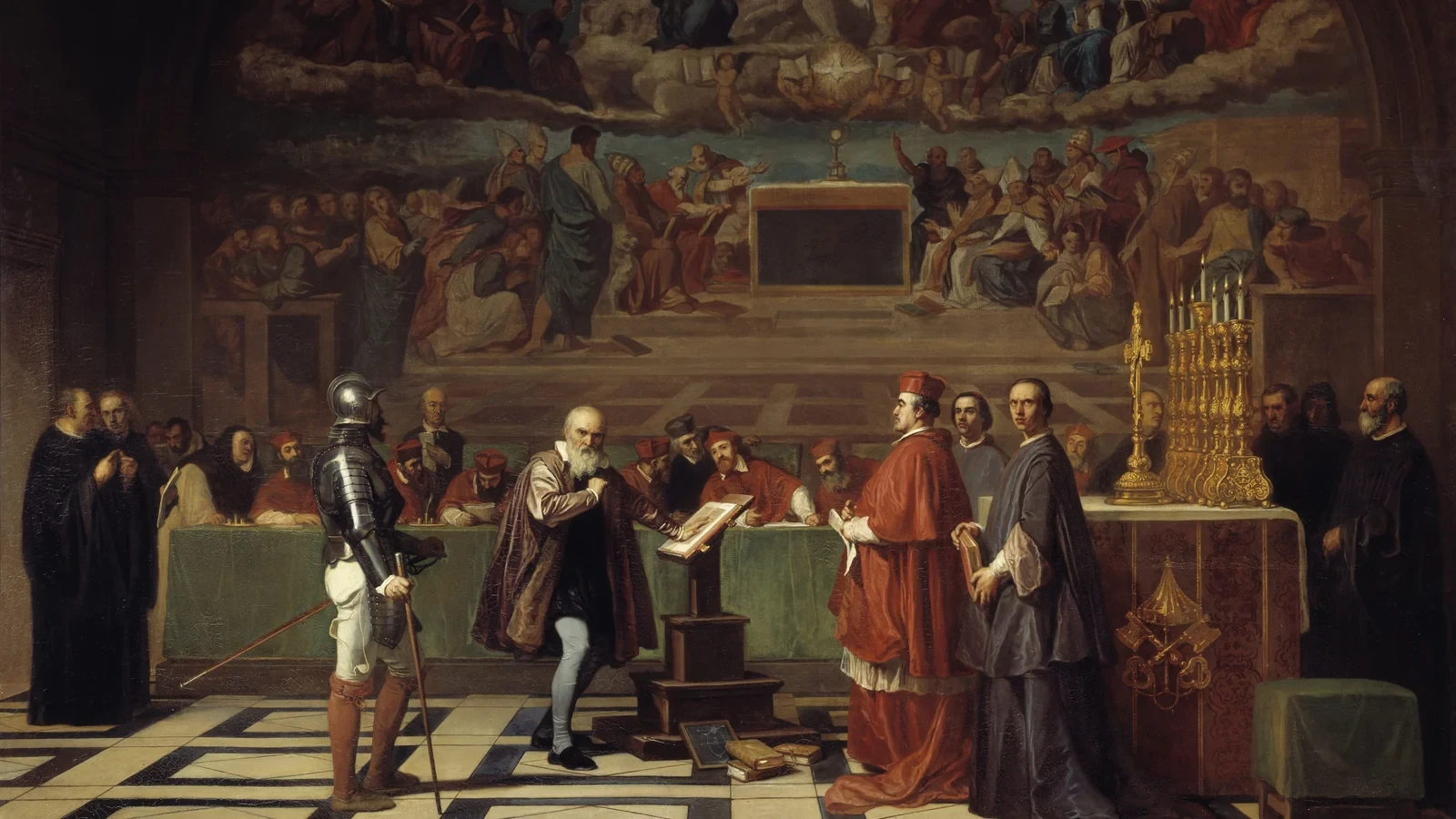
On 12 April 1633, Galileo was shown a copy of a book printed in Florence the previous year. He identified it as his own Dialogue concerning the Two Chief World Systems. That recognition was an early step in his interrogation by the Roman Inquisition. The book had already passed through a process of approval for printing. Now its author had to answer questions about what he had been forbidden to do and what the printed argument actually did. The recorded questions expose the problem.
It is tempting to replace this procedure with a single scene: a scientist describes reality and a religious court refuses to look. The surviving documents show something more specific and more troubling. An institution with coercive power judged the permissible defence of an astronomical position. Scientific arguments mattered, but so did the interpretation of instructions, the authority to interpret scripture and the conditions under which a book could circulate.
PLACE & TIME
Rome · 1633 CE
Rome
The Holy Office; Galileo’s Florentine and Tuscan connections
1633 CE
Rome is the tribunal’s city. The later house arrest in Arcetri was a different place and stage of the story.
The disagreement concerned a moving Earth
The Copernican arrangement placed Earth among the planets moving around the Sun and gave it a daily rotation. This was not an argument about whether Earth was flat. It challenged an established account of celestial motion and raised difficulties for the interpretation of biblical passages understood to describe a stationary Earth. Mathematical models, physical explanations and scriptural authority met in the same controversy.
Galileo’s telescopic work had changed the available evidence. Jupiter had companions, and Venus displayed phases incompatible with the usual Ptolemaic arrangement. Yet the phases also fitted Tycho Brahe’s system, which retained a stationary Earth. That surviving alternative matters: a historian should not make the prosecution easier to explain by pretending that one observation had already settled every physical and cosmological question.
KEEP THE DISTINCTION
Keep three questions separate
Astronomical arrangement
Which system could account for the observations?
Evidence against the usual Ptolemaic account did not automatically eliminate every stationary-Earth alternative.
Physical explanation
What made Earth move, and what would count as a demonstration?
Galileo’s preferred explanation of the tides was not a successful physical proof of Earth’s motion.
Institutional authority
What could an author hold, defend or teach?
The court could enforce restrictions on an argument without supplying a correct account of the heavens.
Earlier instructions became part of the case
In 1616, church authorities acted against the Copernican position, and Cardinal Robert Bellarmine warned Galileo about its defence. The later trial turned partly on the precise force of what he had been told. Galileo produced a certificate from Bellarmine dated 26 May 1616 and relied on its wording in his defence. The interrogators also referred to a stronger injunction, including restrictions on teaching the position. Those differences appear directly in the first deposition.
The distinction was consequential. Discussing a mathematical supposition was different from defending a physical account as true; an instruction against holding or defending a position could be read differently from an absolute prohibition on teaching it. This does not require us to solve every historical dispute about the documents’ interpretation. It does require us to keep Galileo’s recollection, the certificate he presented and the court’s account of the injunction distinct.
TURNING POINTS
The documents connect two confrontations
- 1616
Restriction and warning
Authorities act against Copernican claims; Bellarmine’s subsequent certificate becomes important to Galileo’s later defence.
- 1632
The Dialogue appears
A book comparing world systems is published in Florence after negotiations over permission and presentation.
- April–May 1633
Interrogations and defence
The Holy Office examines the book, the earlier instructions and Galileo’s account of his intentions.
- 22 June 1633
Sentence and abjuration
The tribunal condemns him and requires a formal renunciation; restrictions continue afterwards.
The 1633 proceedings cannot be understood as the immediate response to the first telescopic observation in 1610.
This is also why the official record cannot simply be read as an unrestricted conversation. Its questions were asked within a prosecution, under oath and under institutional pressure. Galileo’s answers were part of a defence. They are evidence of the positions he advanced before the court, not effortless access to everything he privately believed. Treating them with care makes the coercion more visible, rather than making it disappear.
Permission to print did not make the book safe
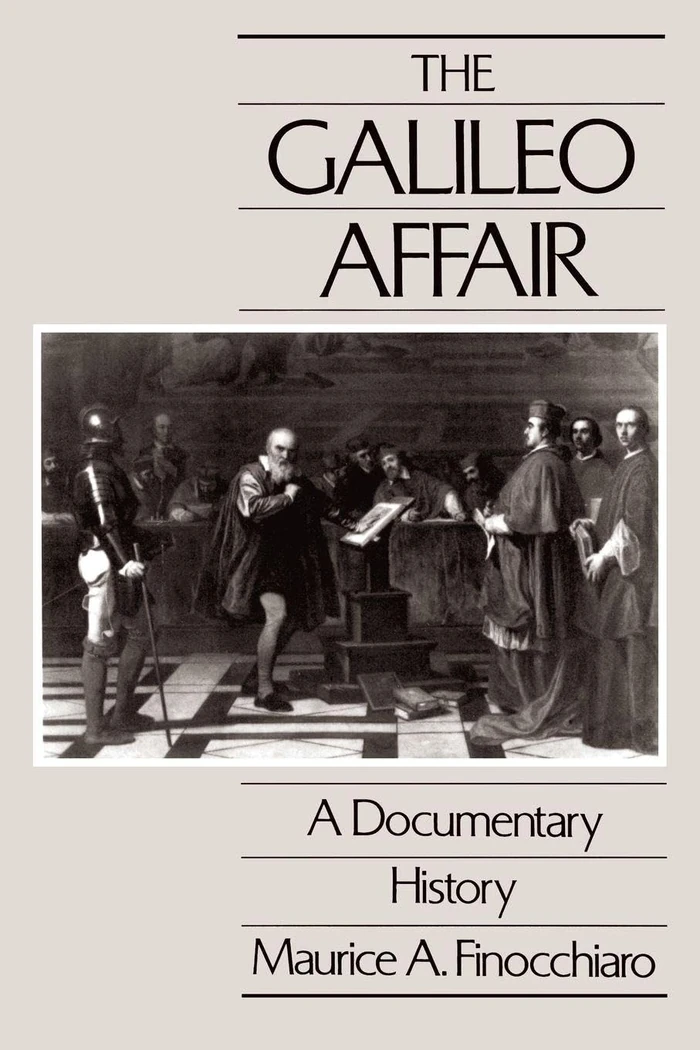
The Dialogue presented discussion across four days between named speakers. Its form allowed arguments for competing arrangements to be developed rather than merely listed. The book’s handling of the Copernican position and its framing as a permissible discussion became central to the controversy. Museo Galileo’s study of the work traces the negotiations over its hypothetical presentation.
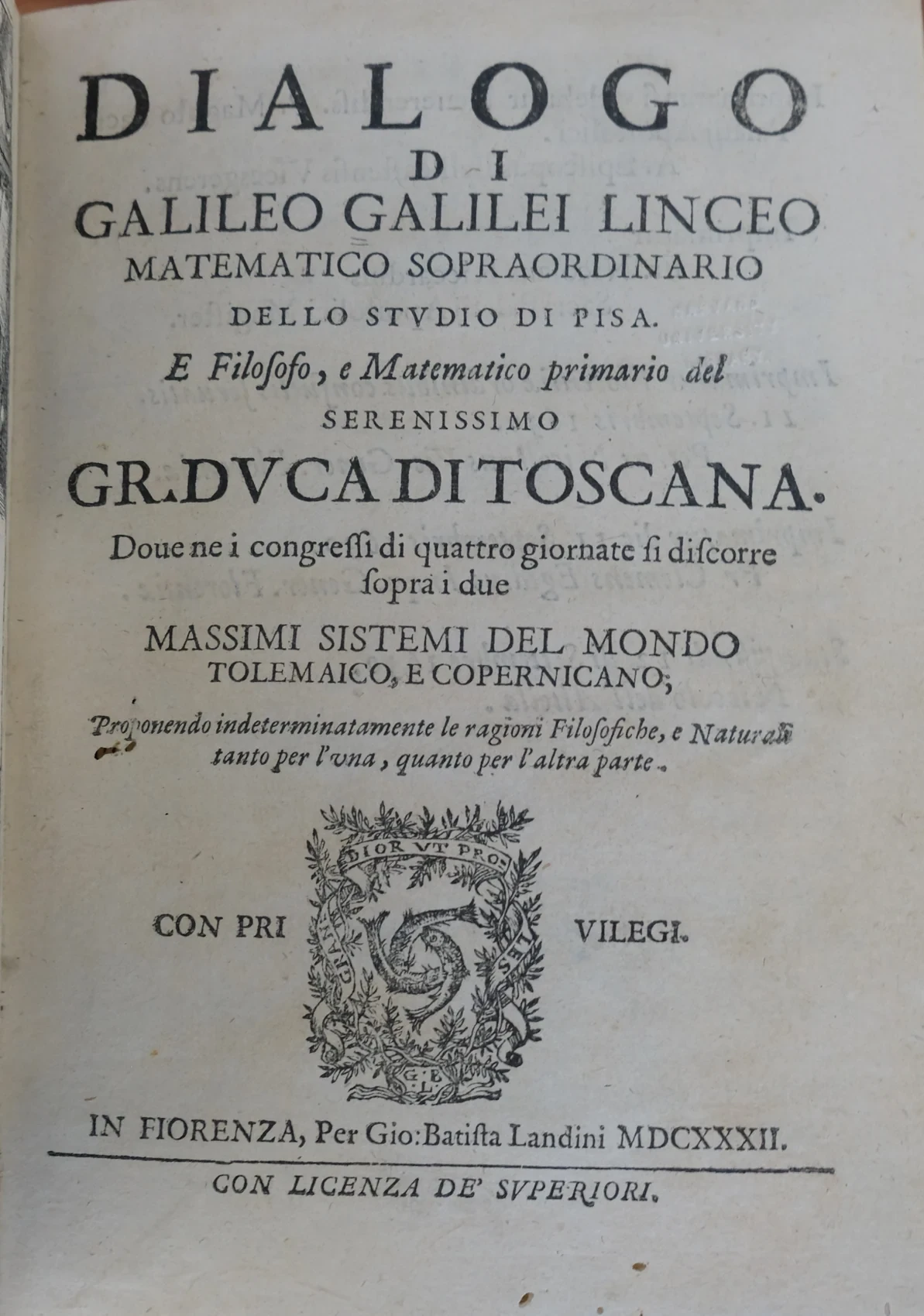
In his testimony, Galileo described seeking approval, submitting the manuscript to scrutiny and arranging printing in Florence when circumstances prevented his return to Rome. Permission was therefore not incidental paperwork. It belonged to the route by which the book became public. But obtaining a licence did not prevent the authorities from later judging that the book, or the circumstances of its approval, conflicted with prior restrictions.
Galileo’s defence emphasised that he had not intended to violate the prohibition. In his written statement of 10 May, he relied again on Bellarmine’s certificate. The document presents his attempt to show why he considered his conduct permissible. A historian can follow that reasoning without accepting every defensive claim as an adequate description of the book’s persuasive effect.
KEY IDEA
Approval to print did not remove the possibility of a prosecution over what the book was understood to defend.
Religious authority was exercised through particular institutions
The election of Urban VIII in 1623 had encouraged Galileo’s hopes of a more favourable setting. By 1632–1633 that relationship no longer protected the Dialogue. Papal authority, censorship and the Holy Office were connected, but they were not interchangeable names for one undifferentiated opinion. The book passed through readers and permissions before a tribunal judged its author. That sequence makes individual decisions and institutional responsibilities identifiable.
The book also advanced a physical argument from the tides. Galileo connected their movement with Earth’s motion; the explanation was unsuccessful. The institutional account of the Dialogue discusses the argument’s intended role. Recognising a weakness in his reasoning does not justify censorship or coercion. It prevents a different distortion: turning a historically constrained investigator into someone whose every scientific argument must be correct because his punishment was wrong.
LOOK FROM HERE
Read the case through its different kinds of evidence
Its structure and unequal persuasive force matter alongside its declarations about hypothetical discussion.
Galileo invoked an earlier certificate and argued that he had complied with the restrictions as he understood them.
It tells us what the institution declared and imposed. It is not a neutral verdict on the truth of astronomy.
The judgement imposed a renunciation and a warning
On 22 June 1633, the tribunal declared Galileo “vehemently suspected of heresy”. It prohibited the Dialogue, imposed confinement subject to its authority and required an abjuration. The wording matters. “He was proved wrong about astronomy” does not describe this judgement. Neither does a vague story in which nothing happened beyond a polite disagreement over interpretations.
IN THE SOURCE
vehemently suspected of heresy
The proceedings included the threat of torture. The chronology should not be embellished into an invented torture scene. Museo Galileo records both the threat and Galileo’s subsequent confinement. He eventually returned to the villa Il Gioiello at Arcetri, near Florence, under restrictions. Later work continued, including the publication of Two New Sciences in Leiden in 1638; that continuation does not make the penalties or censorship inconsequential.
What was at stake was who could make an argument public
The trial exposed a conflict over the defence of a physical account of the world within a system of doctrinal supervision. Galileo’s science, his religious setting and his search for permission cannot be detached from one another. Nor should their entanglement obscure the imbalance of power. A tribunal could compel an abjuration and restrict a book. The person before it could not negotiate on equal terms.
TAKE THIS WITH YOU
Follow the documents, not a simplified courtroom legend
Read the sequence
The instructions of 1616, the book of 1632 and the proceedings of 1633 belong to the same case, but are different kinds of evidence.
Name the coercion precisely
The sentence, abjuration, censorship and confinement were real; invented spectacle does not make them clearer.
Separate truth from permission
A weakness in Galileo’s tidal theory did not vindicate the court’s power to silence his defence of Earth’s motion.
The next chapter moves to another setting in which claims were judged: the meetings and correspondence of the Royal Society. Its members developed ways of presenting investigations to one another and to distant readers. The question changes from the permission to defend a world system to the practical work of making an experiment public.