On the eastern side of Pompeii’s Forum, a woman put her name into the fabric of the town. The inscription did more than identify a generous donor. It named Eumachia as a public priestess, named her son beside her, and recorded that she had paid for building work herself. A passer-by could encounter her position, family and expenditure in one statement carved in stone.
Pompeii was a Roman town in Campania, in present-day southern Italy. Vesuvius buried it in 79 CE, but Eumachia’s story belongs to its earlier imperial life. We cannot follow her through a diary or a complete biography. Instead, three kinds of monument bring her into view: a building dedication, a portrait honoured by the fullers, and a tomb prepared for her family. Together they reveal a woman making her standing publicly legible.
PLACE & TIME
A name at the centre of the town
Pompeii’s Forum
Campania · present-day Italy
Early 1st century CE · approximate focus
The setting
Begin with what the inscription actually says
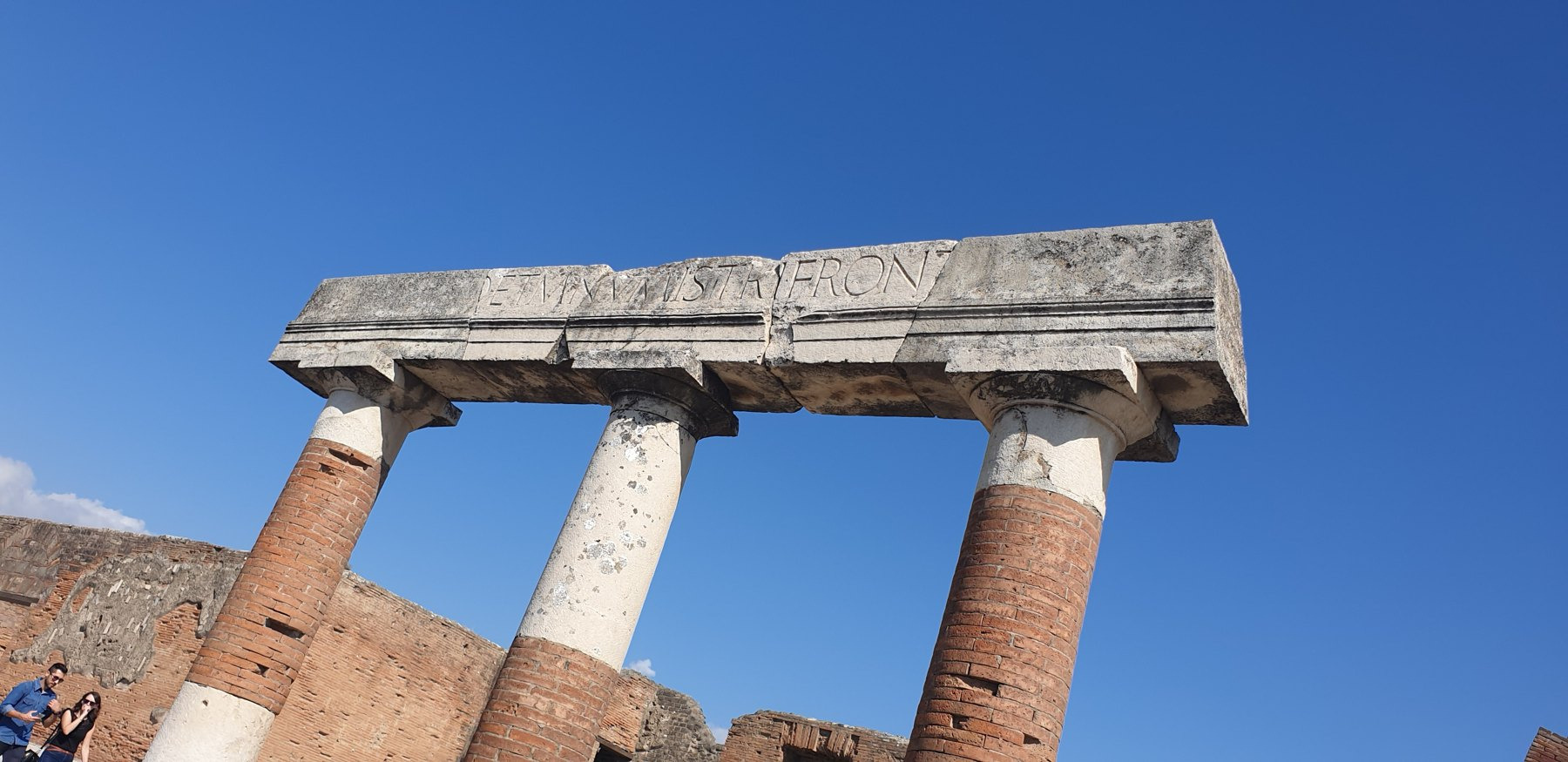
The dedication at the rear entrance identifies Eumachia as the daughter of Lucius. It calls her sacerdos publica: public priestess. It places the project in her own name and that of her son, Marcus Numistrius Fronto. Then it names three architectural elements—the chalcidicum, crypta and porticoes—and connects them with Concordia Augusta and Pietas, personifications of concord and dutiful conduct in an imperial setting.
These are carefully chosen public facts. The text does not tell us what she ate, which room she preferred at home or what she privately thought of the emperor. It tells its audience who should receive credit for a visible contribution. That makes it an unusually direct starting point for a portrait: the woman is named as the person who built and dedicated, rather than appearing only as someone’s unnamed relative.
IN THE SOURCE
sua pequnia fecit eademque dedicavit
“At her own expense” is a compact claim with large consequences. The dedication presents resources under Eumachia’s control being turned into a civic monument. It gives us no accounts ledger, total cost or breakdown of payments. Nor does it explain the origin of every coin. What survives is the public attribution of expenditure and responsibility. We can recognise that action without inventing the financial history behind it.
Her son’s name belongs in the same picture. A project credited to mother and son could advertise a family’s presence as well as an individual’s generosity. But the wording does not reduce Eumachia to a messenger for a man: her name comes first, her priesthood is specified, and her expenditure is recorded. Family prominence and a woman’s own public standing could be expressed together.
TERMS TO KEEP
Three short labels, three different jobs
Public priestess
The civic religious title given to Eumachia in the inscriptions. It identifies a public role, not a surviving description of her daily duties.
Benefaction
A contribution made for a community or public setting. Here the dedication attributes construction and expenditure to Eumachia.
Fullones
Fullers: workers associated with cleaning and finishing textiles. Their name appears as the group honouring Eumachia on her statue base.
A building could make a benefactor difficult to overlook
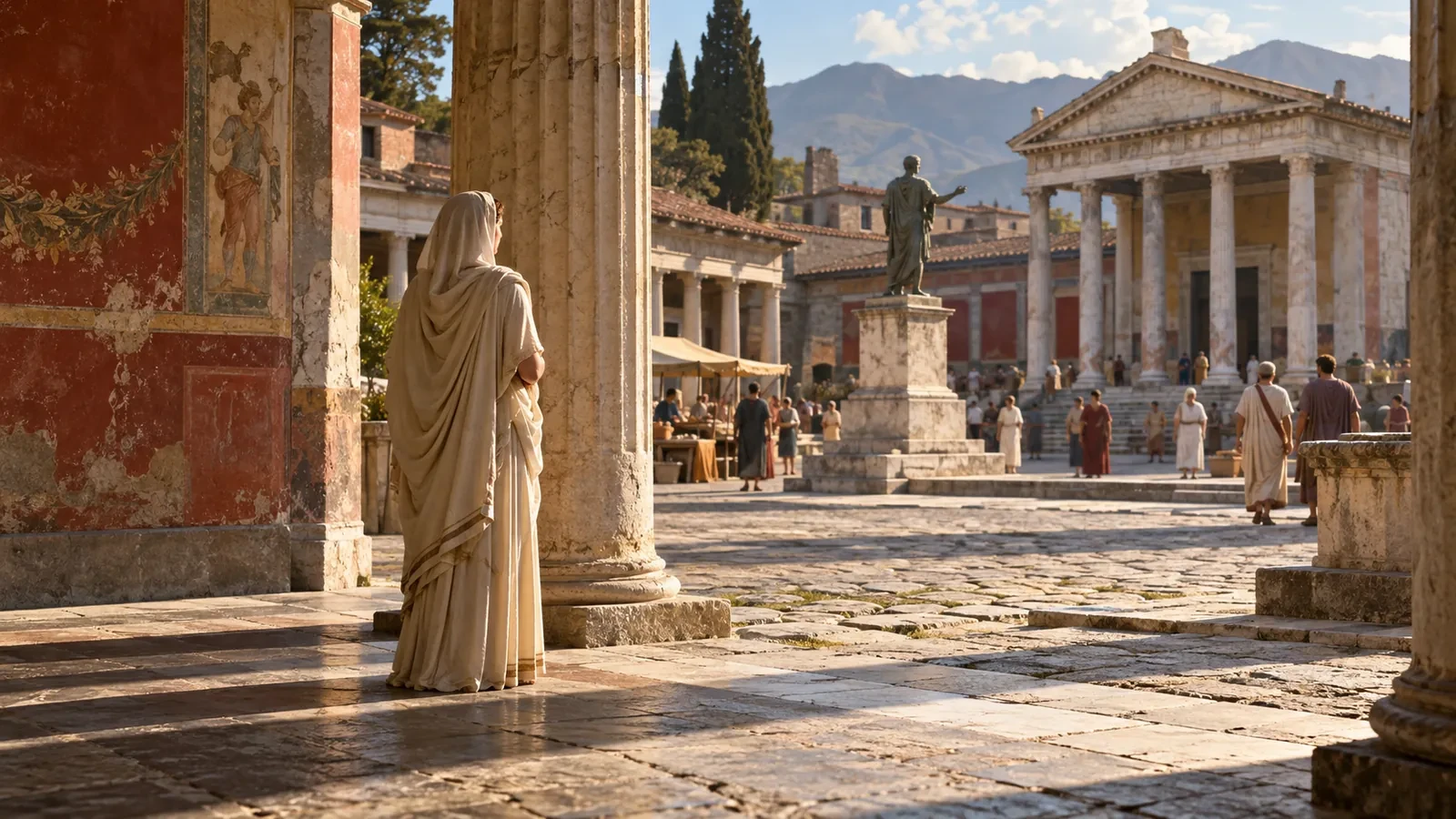
Location gave the dedication an audience. A monument facing the Forum participated in the town’s public setting rather than remaining behind a household door. Names and honours could meet people moving through the same central space. Eumachia’s expenditure thus had a continuing physical presence: the building remained available to be encountered after the act of giving was over.
The Park’s excavation guide describes colonnaded space and a covered passage behind it, where Eumachia’s statue stood. Today the structure has lost much of its rich marble decoration. The stripped remains should not be mistaken for the visual experience of the completed ancient monument. Its appearance, like its donor’s public reputation, was something people had deliberately constructed.
Exactly how all those spaces were used is less secure. The statue’s connection with the fullers has encouraged the familiar description of a guild headquarters or wool market. Yet scholarly discussion still treats the building’s function as unresolved. A commercial association with Eumachia does not, by itself, identify every activity that happened inside her complex. Its dedication gives us a firmer statement than a convenient modern label.
The fullers answered with an honour of their own
The building dedication records an action attributed to Eumachia. The statue base records an action towards her: the fullers dedicated her portrait. Its short text repeats her name, her father’s name and her public priesthood, then identifies the honouring group. The two inscriptions therefore show different sides of public reputation—credit claimed for a contribution, and recognition offered by others.
That recognition is important even without a complete explanation of its cause. It establishes that the fullers publicly associated themselves with Eumachia. It does not supply the agreement behind the statue, list a subsidy she paid them or state that she employed every person in their trade. The durable result of a relationship survives; its full terms do not.
KEEP THE DISTINCTION
An honour is not a complete business record
The statue
The fullers honoured Eumachia and identified her as a public priestess.
The inscription does not explicitly appoint her patrona of their association.
The building
Her dedication names constructed spaces, religious values and personal expenditure.
A statue from the fullers does not prove that the whole complex was their headquarters.
Her wealth
The dedication credits her with paying for a substantial public project.
Its text does not document a textile business, company structure or source of every payment.
Eumachia is often called the patroness of the fullers. Historian Emily Hemelrijk draws attention to the missing formal title: the statue inscription does not actually call her patrona. That does not erase the relationship. It asks us to describe it at the right level of certainty. “A woman honoured by the fullers” is directly supported; a formally appointed office needs evidence of that appointment.
Her portrait shows a public image, not a private moment
The surviving statue gives the named woman a bodily presence. Her head is covered, and cloth is gathered across her body. The photograph below shows the ancient object during its loan to a London exhibition in 2013; the original belongs to the National Archaeological Museum in Naples. The figure displayed at Pompeii is a copy, a distinction that matters when a modern visit becomes part of the story.
LOOK CLOSELY
A face framed for public recognition
Covered head
The mantle frames the face. Read it beside the inscription’s priestly title, rather than inventing a specific ceremony.
Gathered cloth
The sculpted folds and controlled gesture form a composed public image. They do not reveal her everyday wardrobe.
Idealised features
The portrait uses a polished visual language. Its smooth face cannot establish her age or give us a photographic likeness.

Eumachia’s ancient statue, belonging to MANN in Naples, photographed during a temporary British Museum exhibition in 2013.
A statue is easy to treat as a preserved encounter: here she is, just as someone saw her. But Sheard’s study examines the idealising conventions of this portrait. Face, dress and pose communicated a socially recognisable image. Looking closely means noticing what the sculpture was made to express, while resisting the temptation to turn its composed appearance into a personality test.
That restraint makes the monument more interesting. Public recognition had a visual vocabulary as well as an inscriptional one. The named woman could be represented as dignified and appropriate to her position. Such qualities were displayed, not discovered by looking into stone eyes. We have an image made for an audience; we do not have access to the feelings of the person it commemorated.
Religion and family were part of public standing
Her public priesthood is a repeated title, not an incidental decoration in the text. Research on female civic priesthoods places such religious roles within the life of Roman communities, alongside public honours and benefaction. A priestess was visible through religion, even though the title alone cannot reconstruct her precise duties, appointment or term of service.
The dedication’s Concordia Augusta and Pietas also locate the project in an imperial language of public values. Eumachia’s name stood beside ideas larger than her own family. It is reasonable to read that juxtaposition as a way of presenting her contribution within a recognised civic and imperial setting. It is less reasonable to supply a private conversation in which she decided on her motives.
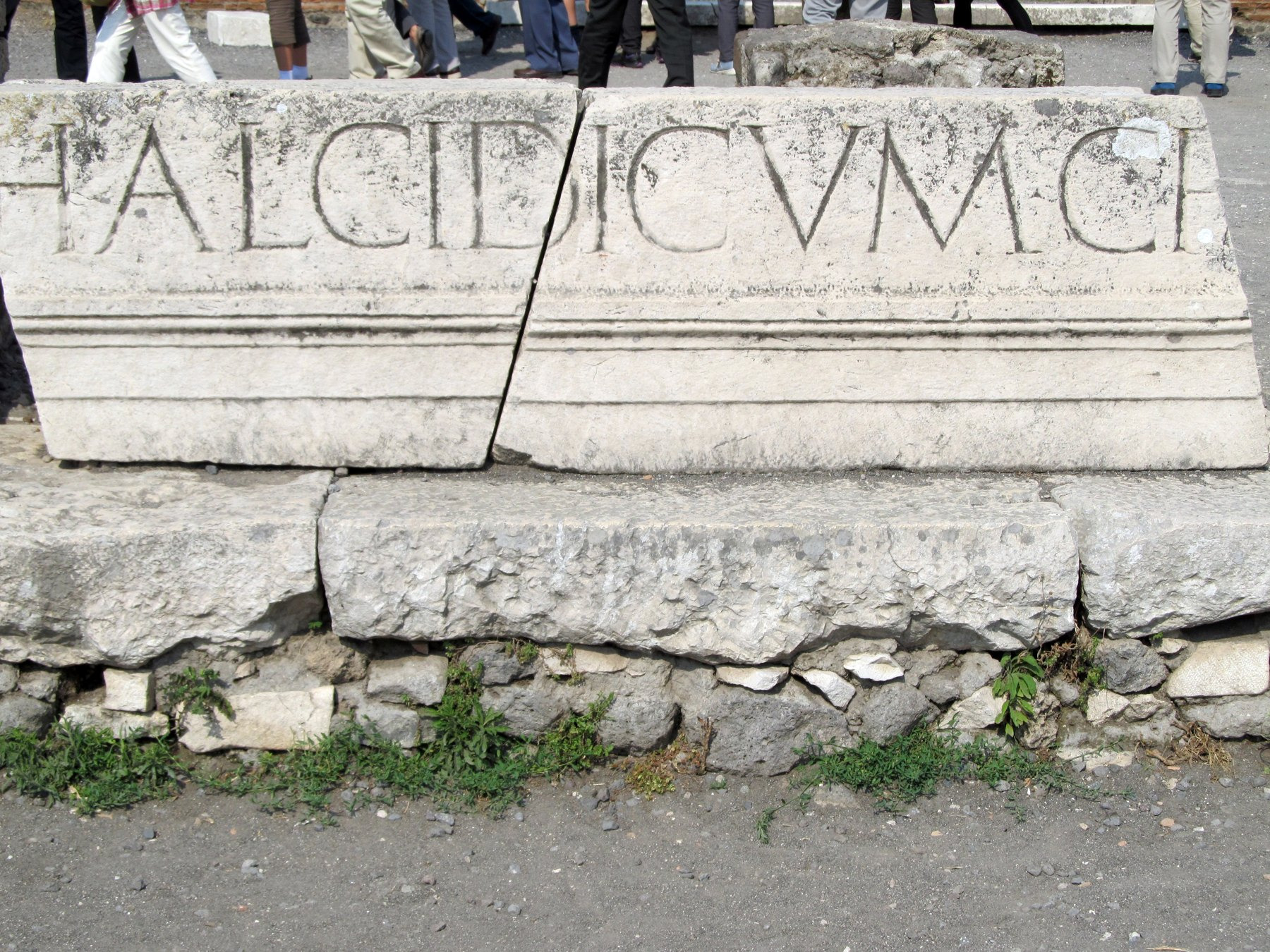
The fragment above preserves part of the architectural wording, not a complete explanation of the project. It is a useful reminder of how the portrait works: separate pieces must be read together. A damaged inscription can preserve a building term; a fuller transcription preserves the dedication; a statue base identifies who offered an honour. No single object carries all the answers.
KEY IDEA
Eumachia made her name part of a place other people used.
Her family’s memory extended beyond the Forum
Outside the town, another monument continued the work of remembrance. The tomb associated with Eumachia at Porta Nocera used a monumental semicircular design. Its inscription identifies her and presents the provision as being for herself and her own people. The public building and the funerary monument belong to different settings, but both gave her name a lasting physical location.
The tomb does not tell us the date of every death or exactly who was eventually buried there. What it does preserve is a claim about belonging and provision. At the Forum, her family appeared through a project naming mother and son. Beyond the city, the funerary monument made family memory visible. These are distinct actions, linked by the recurring importance of a named woman.
What changes when we follow her name?
Eumachia’s monuments let us ask more precise questions than whether Roman women were simply “powerful” or “powerless”. This particular woman could be named as a public priestess, credited with expenditure, honoured by a working group and associated with a monumental family tomb. Those opportunities do not describe the circumstances of every woman in Pompeii. Wealth and standing are part of the explanation, not details to leave out.
- Read the action: who built, paid, dedicated or honoured?
- Read the relationship: whose names and titles appear together?
- Read the limit: what would require another inscription, object or record?
The earlier chapters followed food, houses and the machinery of bathing. Here, a name leads through another part of everyday life: how a community displayed importance and remembered contributions. Eumachia comes into focus because those acts were made durable. The next step is to follow the people named as her honourers—and the less celebrated work behind the town’s shops and workshops.