
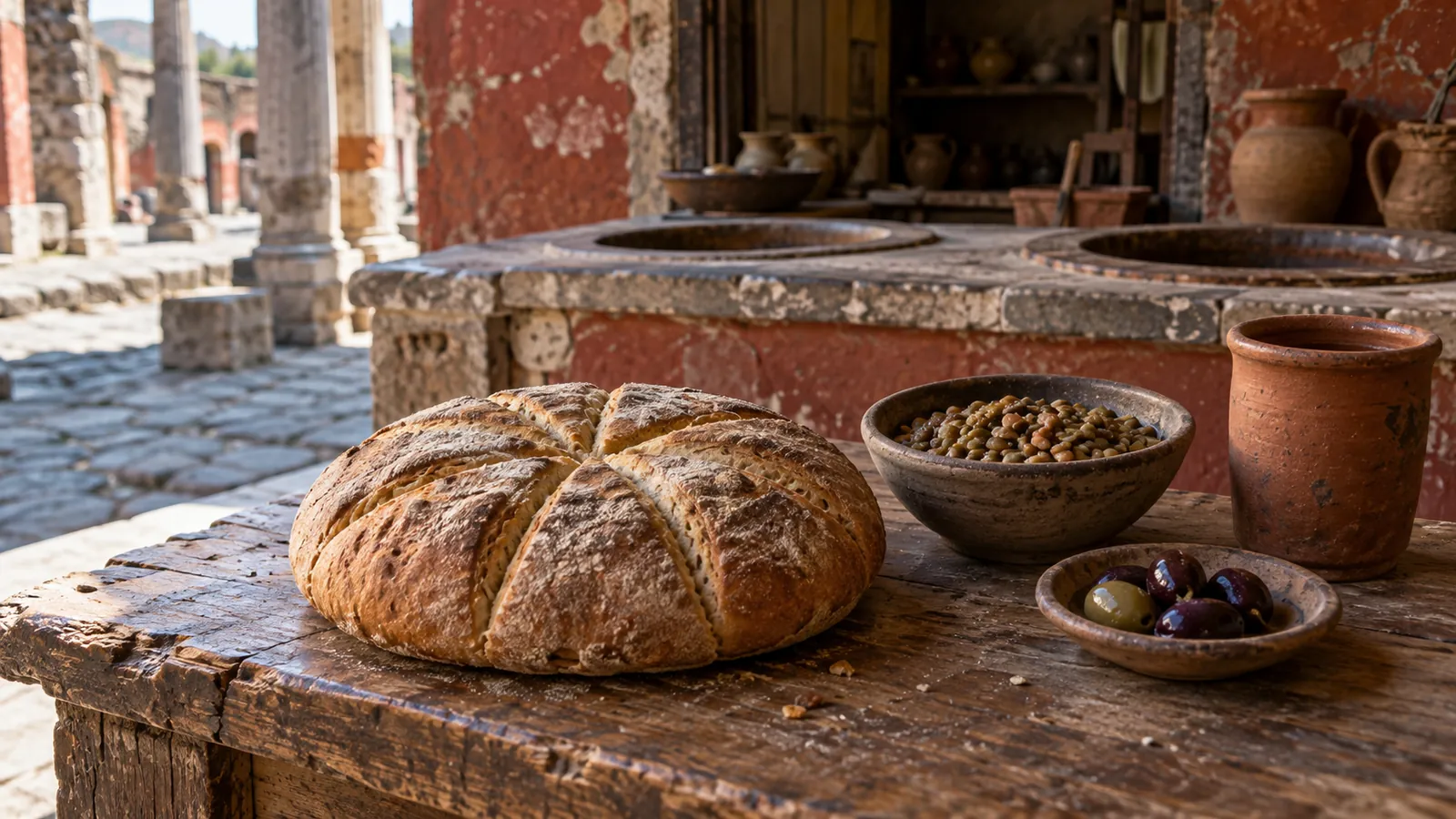
A meal in Pompeii could begin at a street-facing counter, pass through a household kitchen or arrive in a room arranged for guests to recline. These are different ways of eating, even when some ingredients overlap. The useful question is not simply whether Romans liked bread or fish. It is how food reached people—and how much choice they had about where, when and with whom they ate.
This first chapter of Everyday Lives: Pompeii starts with that ordinary need. The town lay in Roman Campania, in present-day southern Italy, and was buried by the eruption of Vesuvius in 79 CE. Its surviving buildings and food remains let us follow daily life through several places. They also remind us that the person enjoying a meal and the person making it possible might occupy very different positions.
PLACE & TIME
A Roman town before the eruption
Pompeii
Campania · present-day Italy
1st century CE, before the eruption of 79
The setting
Start with bread—and the work before it
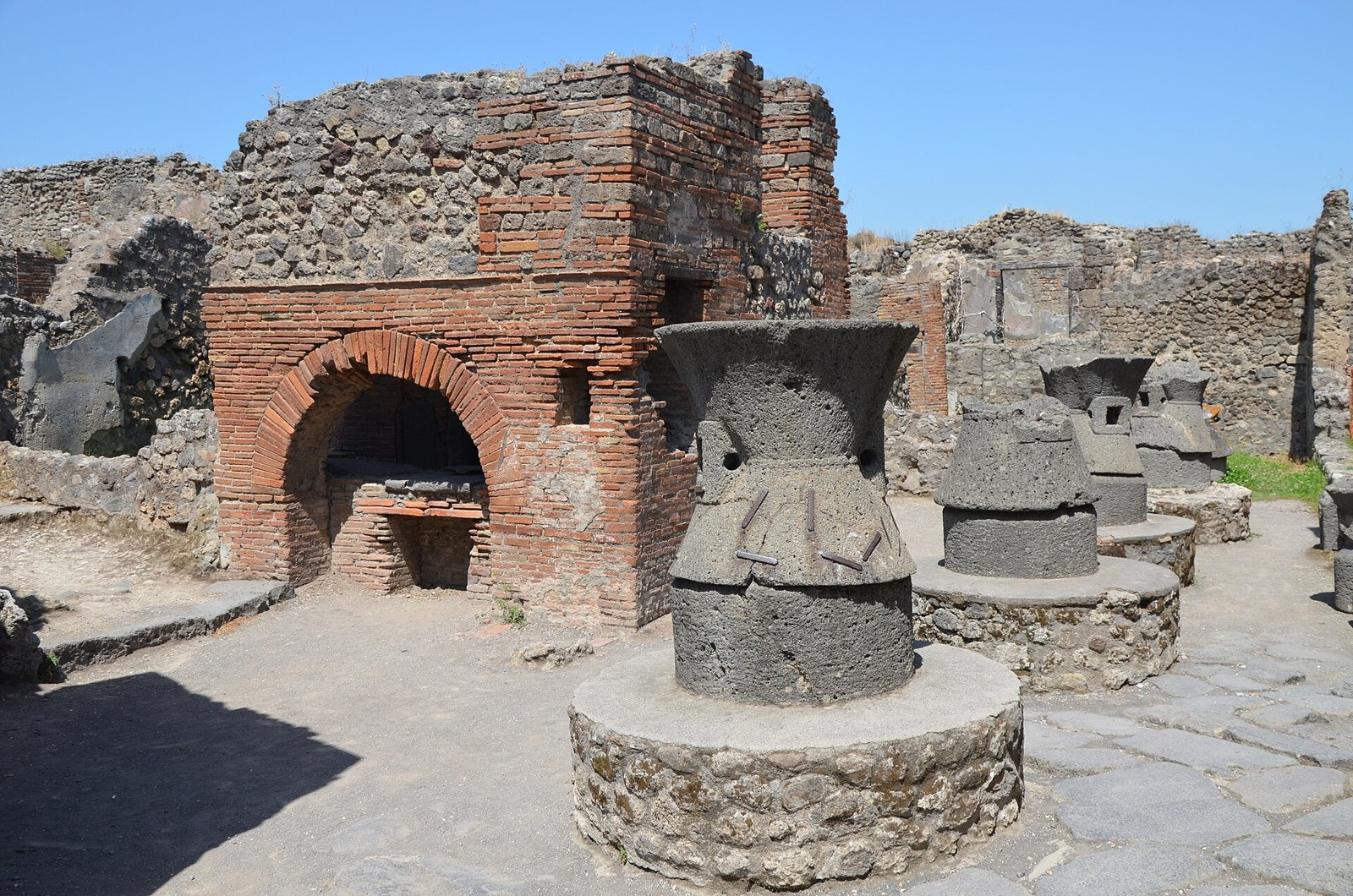
The bakery of Popidius Priscus brings milling and baking into one premises. Its large volcanic-stone mills had a fixed lower part and a rotating upper section: grain entered above, and flour emerged below. Nearby, the oven completed another stage of the work. A loaf was therefore the end of a sequence, not something that appeared at the selling point already made.
That distinction changes what we notice. The mills are impressive objects, but their importance lies in repeated effort. Someone had to keep grain moving through the process; the equipment required power, handling and attention. Buying bread connected a consumer to work they might never see. The bakery’s remains let us take that connection seriously without inventing the voice or morning routine of a particular baker.
FOLLOW THE PROCESS
A loaf connects several kinds of work
Obtain grain
Food production and movement bring a raw ingredient within reach.
Make flour
Milling changes grain into material that can be worked.
Prepare and bake
Water, skilled handling, fuel and heat turn ingredients into bread.
Reach the eater
The finished loaf must be distributed before it can become a meal.
Production and selling need not occupy the same spot. The park’s guide notes the absence of a sales counter at this bakery and proposes orders, wholesale distribution or street sellers as possibilities. What matters here is the separation: a place that made food was not necessarily the place where every customer obtained it. The street belonged to the supply chain too.
A surviving loaf provides a different view. The carbonised bread displayed at Boscoreale comes from Pompeii. Its rounded form and divided surface make breadmaking tangible in a way that walls and machinery cannot. It is tempting to reach immediately for a recipe, but the object answers a narrower question first: what did one finished food look like?
LOOK CLOSELY
A loaf’s shape survives better than its recipe
A rounded loaf
The surviving outline records a deliberately formed food, rather than unprocessed grain.
A divided surface
Grooves make wedge-shaped portions visible. Their appearance alone does not establish how the loaf was shared.
A changed material
Carbonisation preserved the bread while transforming it. Colour and texture today cannot tell us exactly how it tasted.

Carbonised bread from Pompeii, photographed in the Antiquarium at Boscoreale. Its visible shape survives; the photograph cannot supply the baker’s exact recipe.
A counter makes the street part of the meal
Food-selling counters offered another route to a meal. A thermopolium is the familiar archaeological term for a place selling prepared food and drink. Its built counter, with vessels sunk into it, put stored contents within the seller’s reach. The decorated example in Regio V is one especially vivid survival among the town’s food businesses, rather than an isolated invention.
Calling such a place “Roman fast food” offers a quick point of recognition: a customer could obtain something prepared outside their own home. But the comparison works best when it leads us back to the counter. It does not provide a modern franchise, identical portions or a standard menu. The stonework marks a transaction space; the details of any particular transaction need their own evidence.
At the Regio V establishment, the best-known clue lies in the relationship between decoration and food remains. The counter carries images including hanging ducks. The initial laboratory report also identifies a duck-bone fragment, alongside remains of pig, sheep or goat, fish and land snails. That combination gives the food world more variety than a simple picture of people living on bread alone.
The evidence becomes less useful if we turn it into one extravagant stew. Several animal species in a context are not automatically ingredients cooked together in a single pot. Nor does an animal pictured on a counter have to be a dish. The duck offers a connection between image and material evidence; the whole decoration is not a menu whose every entry can be ordered with confidence.
KEEP THE DISTINCTION
A food counter is not a complete menu
Painted animals
Images chosen for the counter’s presentation.
A fixed list of every dish sold there.
Animal fragments
Several species identified in a particular excavated context.
Proof that all those ingredients formed one recipe.
A serving counter
A place arranged for selling food and drink.
The identity, income or order of every customer.
Buying a meal outside the home could solve a practical problem. Cooking requires space, equipment, fuel, ingredients and time. A household with little room for preparation had different options from one able to sustain a substantial kitchen. The Ashmolean’s account of Pompeian food places emphasises their usefulness for modest homes, while recognising customers across social levels. Convenience does not belong to only one class.
For the same reason, “ate at a counter” and “ate at home” should not become two permanent categories of people. They describe ways of obtaining a meal. A resident could purchase prepared food on one occasion and eat in a household on another. Where the evidence does not identify an individual pattern, it is better to leave room for that variation than to assign every doorway a rigid menu.
What belonged beside the bread?
Pompeii’s food world extended beyond its built streets. The Boscoreale museum catalogue connects fishing with the coast and river mouth, cultivation with the Sarno plain, and vines and olives with the surrounding slopes. It also records food and transport vessels. These traces make a town’s meals part of a wider working landscape: the counter was a destination, not the beginning of the story.
Near the Forum, the Macellum provided a market setting associated with fish selling. Food shopping therefore extended from small premises along the streets to a more concentrated commercial space beside the civic centre. The town’s public heart was also a place where provisions could be obtained. These different locations help explain why a meal belongs on a map of Pompeii, not just in a list of ingredients.
- Bread and other grain foods required processing before they reached the eater.
- Fruit, olives and pulses broadened the plant-food world.
- Fish and animal foods left different kinds of remains.
- Oil, wine and fish sauce connected ingredients with storage, seasoning and trade.
One seasoning brings that last connection into focus: garum, a fish-based sauce widely used in Roman cooking. A Pompeian amphora fragment in the Boscoreale collection retains fish scales, bones and residue. The evidence is more specific than a literary description of something pungent. It puts a product into a vessel, and a vessel into the material world through which food moved.
The mosaics associated with Aulus Umbricius Scaurus go further, showing labelled fish-sauce containers in the setting of his house. A food product could therefore do two jobs: season meals and help display the prosperity connected with its sale. The pictured bottle is small; the relationship between commerce and domestic presentation is much larger.
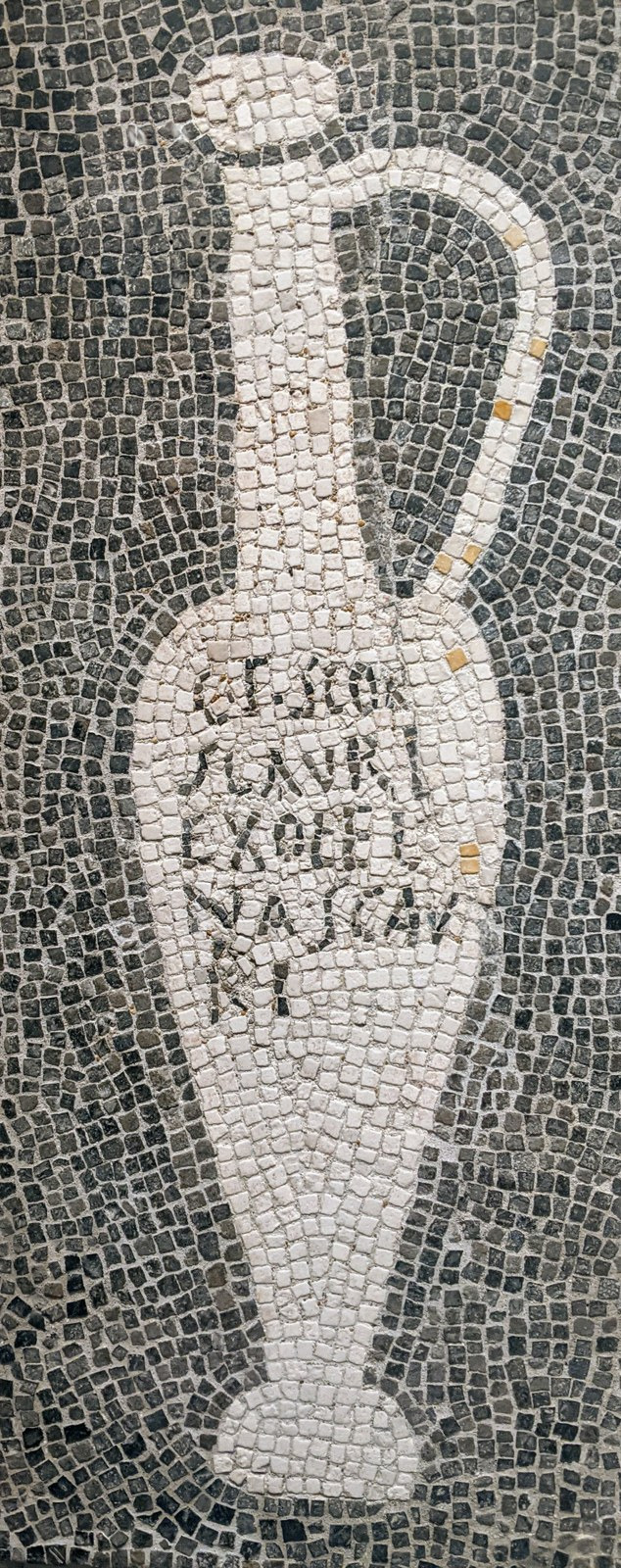
Think of the contrast with a plain loaf. Both belong to eating, but one surviving image foregrounds a named product. A consumer’s need, a merchant’s reputation and a household’s self-presentation meet in the same food economy. We do not have to know what every guest said about the mosaic to see that the choice to display it made business visible inside a home.
Taste is a further question. A sauce name, an ingredient or a recipe heading does not reproduce the sensation of a finished meal. Anyone cooking from an ancient recipe today has to make decisions about quantities and technique. That can be an engaging way to learn, provided the result is understood as an interpretation rather than a recovered lunch from one specific Pompeian counter.
A dining room offered more than food
A meal served to reclining guests arranged bodies and attention as well as ingredients. The Roman term triclinium refers to a dining setting organised around three couches. The Ashmolean’s discussion of Pompeian dining links these rooms with furnishings, decorated surroundings and serving equipment. Hosting involved preparing a setting in which the meal could be seen and enjoyed.
The summer dining setting in the Praedia of Julia Felix provides a surviving example of that investment in place. Its grotto-like form, water features and opening towards the garden frame the couches. The surroundings are not incidental packaging for the meal. They are part of what a host could offer: room, a view and an arrangement that makes eating an occasion.
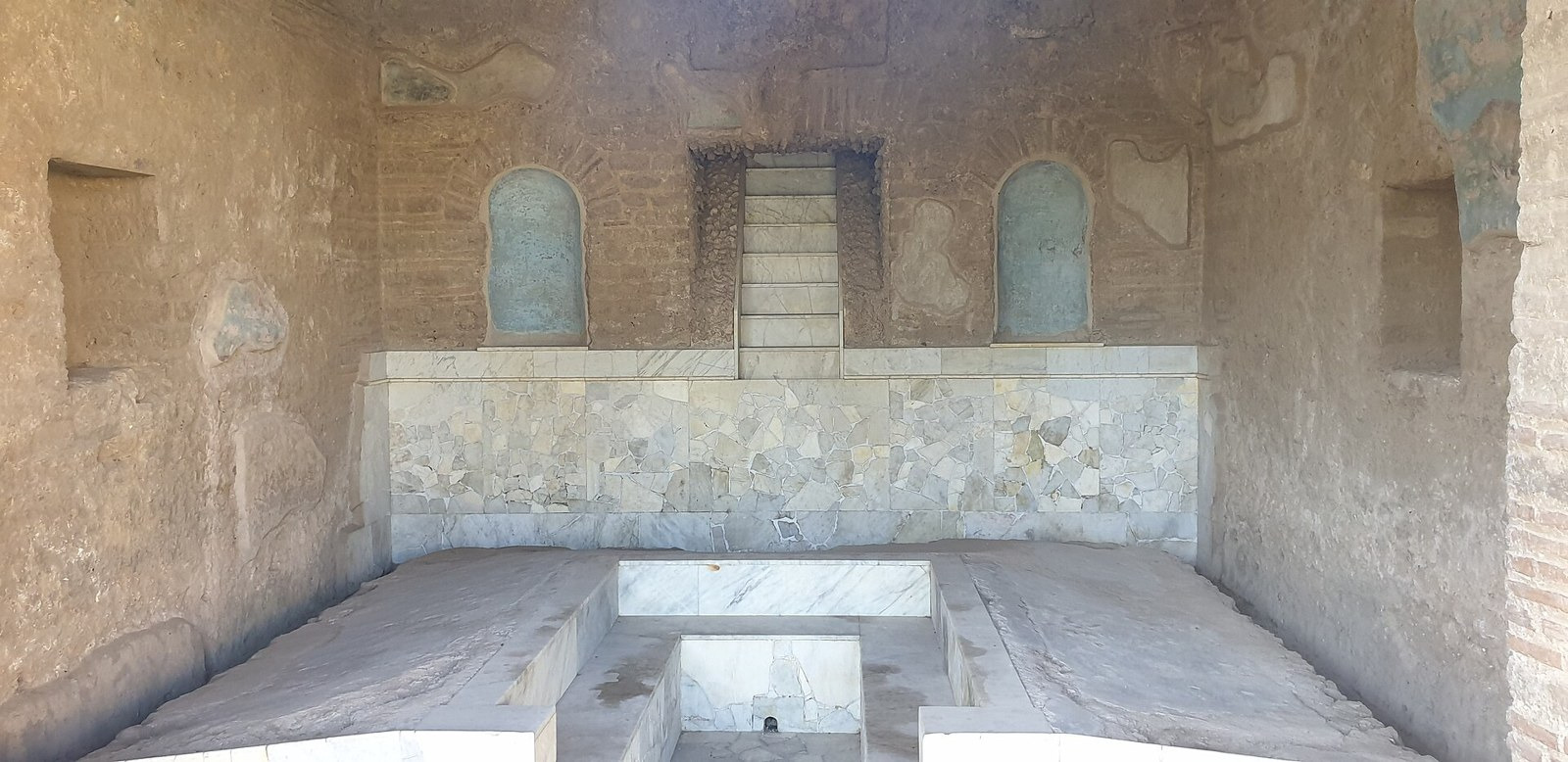
Compare that setting with the food counter at the beginning. Both accommodate eating, but they distribute space differently. The seller’s working surface keeps vessels close at hand; the dining couches give selected guests somewhere to settle. A meal bought from a counter and a meal offered by a host could overlap in ingredients while differing in time, setting and social meaning. The physical arrangement matters as much as the names of the foods.
Those relationships also reached beyond the guests. The food had to be prepared, carried, served and cleared. Kitchens and utensils are therefore part of the same story as fine furnishings. In wealthy households, enslaved people’s cooking and service work supported the diners’ experience. Looking only at the couches would leave that dependency outside the picture, just as looking only at the loaf would hide the mill.
CHANGE YOUR VIEW
One meal, different positions
Consider access to ingredients, prepared food, cooking space and invitations. A list of foods in the town cannot establish that everyone could obtain them equally.
A counter organised exchange; a dining arrangement organised hospitality. Presenting food also meant presenting a business or a household.
Processing, cooking and serving required effort. Comfort at the point of consumption cannot be used as evidence of comfort for the people producing it.
The same food economy could restrict freedom
A recently excavated bakery-house in Regio IX sharpens the labour question. The 2023 excavation report for IX.10.1 describes restricted communication between productive and residential spaces, no direct street exit from the production area, and barred openings. The excavators interpret these arrangements as controlling the movement of enslaved people. This is a different bakery from Popidius Priscus’s premises pictured earlier.
The building was under renovation and the bakery partly out of use at the eruption. It cannot supply a scene of flour being ground on the final morning. What it supplies is a disturbing spatial relationship: food production placed close to a decorated residence, with freedom of movement unevenly distributed between its parts. Everyday life could be ordinary for the consumer and coercive for someone behind the supply.
KEY IDEA
Sharing a city’s food world did not mean sharing its choices.
That is why an attractive ancient object should not stand in for the whole life around it. A jar, cup or decorated panel can bring us close to the material setting. Its survival does not preserve all the labour, constraints and decisions that surrounded its use. Holding on to both sides—the appealing object and the people’s unequal circumstances—makes the everyday world more legible.
Variety survives; a daily menu does not
Painted foods create another kind of temptation. A still life discovered in 2023 was widely compared with pizza. The excavation discussion places it among hospitality images and treats the brown element carrying some of the food as uncertain: perhaps a basket, perhaps a flatbread. Its interest is the presentation of food and drink, not the discovery of a modern recipe with a secure name.
Scientific analysis broadens the picture in a different direction. A 2025 study of Pompeian plant and animal remains examined stable carbon and nitrogen isotope signals. It identified varied cultivation and animal-management practices, while showing how overlapping signals make human dietary reconstruction difficult. More data can reveal variety without dividing every person’s diet into tidy percentages.
- A preserved food can tell us about one item, without giving a person’s whole diet.
- A room can show arrangements for eating, without identifying every diner.
- An image can communicate hospitality or a product, without being a literal meal record.
These limits do not leave us with nothing. They help us keep different questions apart. “Was this ingredient present?” is not the same as “Who ate it regularly?” “Could food be bought here?” is not the same as “What did this customer order?” A useful account of everyday eating can be specific about places and materials while remaining open about individual habits.
Follow the meal into the rest of the town
People in Pompeii ate within a food world that included bread, plant foods, animal foods, drinks and seasonings. They obtained and consumed those foods through different settings: production premises, selling places and households. The strongest answer to our opening question joins the contents of a meal to its circumstances. Space and resources shaped opportunities; other people’s work made those opportunities possible.
This is where our new path begins. Follow food and the boundary between street and home becomes harder to draw: a household could contain a business, a purchased meal could become part of home life, and a fine dining setting could depend on work nearby. In the next chapter, we will look more closely at the front doors themselves—and at the living, trading and working spaces behind them.

_on_Vicolo_Storto_(Reg_VII,_Ins_2,_22)_belonging_to_N._Popidius_Priscus,_Pompeii_(14856682197).jpg)

.jpg)
_Roman,_Pompeii,_House_of_Aulus_Umbricius_Scaurus_(51358292490).jpg)
.jpg)
