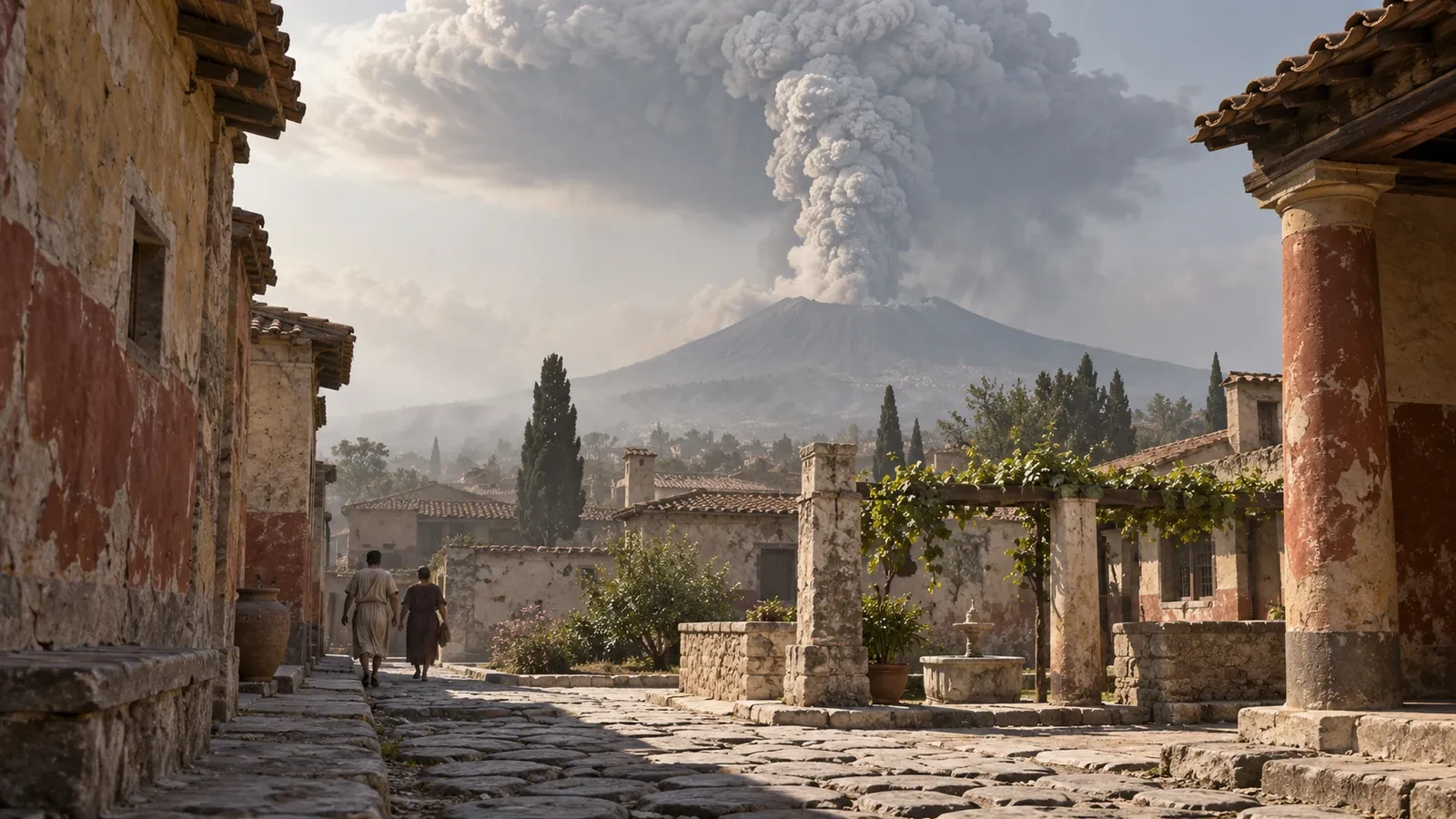
The danger did not stay the same. At Pompeii, falling pumice could turn a roof into a weight-bearing problem and a street into difficult ground. Later, ash-rich currents brought a different threat. The eruption of Vesuvius in 79 CE was a sequence of changing conditions, not one instant that caught an entire town in a single pose.
Two kinds of evidence help us follow it: the letters of a survivor across the Bay of Naples, and the material left around buildings and people. Neither supplies a complete account on its own. Read together, they show why shelter, movement and timing mattered—and why the famous remains cannot tell us every victim’s last decision.
PLACE & TIME
One eruption, different experiences around the bay
Pompeii
Bay of Naples · present-day Italy
79 CE · exact day disputed
The setting
The cloud that caught an observer’s attention
Pliny the Younger’s first eruption letter begins with his uncle at Misenum, where the elder Pliny commanded the fleet. His mother drew attention to an unusual cloud in the early afternoon. The younger Pliny describes a tall rising form spreading at its top, comparing it with a pine tree. From their distant viewpoint, he says, the mountain beneath it was not initially clear.
His uncle first intended to investigate. A request for help from Rectina redirected that curiosity towards rescue: he took ships towards the endangered coast. The nephew stayed behind. That separation matters throughout the account. The younger Pliny could report what he saw at Misenum, but the later events around his uncle depended on information brought back by others.
FOLLOW THE PHASES
How the danger changed at Pompeii
- First day · early afternoon
The eruption column rises
Pliny reports the conspicuous cloud. Pumice fallout begins to affect Pompeii.
- Following hours and night
Deposits accumulate
White and then grey pumice build up. Roof loading, falling fragments and difficult movement create dangers.
- Transition towards the next morning
Buildings can fail in more than one way
A 2024 study links specific collapses to earthquake shaking after pumice fallout and before later currents.
- Later destructive phase
Ash-rich currents reach the town
Ground-hugging mixtures of gas and particles change the hazard again and add deposits over the earlier fall layers.
A simplified relative sequence, not a minute-by-minute timetable. Processes overlapped around the bay; exact calendar date and some timings remain debated.
Pumice fell from above; its weight stayed behind
The deposits preserve a distinction that the word “ash” can hide. Pumice is a porous volcanic rock, and the eruption produced large quantities of it. At Pompeii, the recognised succession includes pale and later darker pumice. These falling fragments accumulated before later deposits from pyroclastic currents. That order is a physical part of the reconstruction, not simply a dramatic arrangement of scenes.
A light fragment does not make a light roof load when many fragments collect. Accumulation changed buildings as well as the ground outside them. In a house, shelter from falling material could come with growing danger overhead. Outside, the surface on which someone tried to move was being altered. The important question is what conditions had become, not what the street normally offered.
TERMS TO KEEP
Three words for different parts of the eruption
Pumice
Porous volcanic rock formed from gas-rich magma. Many light fragments can accumulate into a heavy load.
Lapilli
Volcanic fragments 2–64 mm across: a size category, not a synonym for every kind of ash.
Pyroclastic density current
A ground-hugging mixture of volcanic gas and particles moving away from the volcano. It is different from fallout descending through the air.
The samples below make the rock’s texture visible. They do not tell us how deep a deposit became in a particular room, or exactly when its roof failed. For those questions, the position of material in an excavated sequence matters more than a specimen removed from it. An object’s appearance and its original context answer different questions.
LOOK CLOSELY
The texture of the falling material
A porous surface
Cavities reveal a gas-rich volcanic material. This is rock, not an image of a lava stream.
A sense of scale
The photo record reports the centre sample at about 3 cm across. Do not assume every fragment had that size.
A missing relationship
Collected specimens show texture. An undisturbed layer would additionally show position relative to other deposits and remains.

Pumice samples attributed in the photo record to Pompeii’s 79 CE eruption. The centre sample is reported as about 3 cm across. These are collected specimens, not an undisturbed deposit.
A roof load was not the only reason a building could collapse
Earthquake shaking accompanied the eruption. A 2024 multidisciplinary study in the Insula dei Casti Amanti examined two people killed beneath collapsed masonry. By combining wall movements, construction, injuries and the deposit sequence, the authors argued that shaking triggered these failures. They placed them after pumice fallout and before the later currents affecting that setting.
This adds a cause of destruction without replacing every earlier explanation. Roofs could fail under accumulated material; particular walls could fail under shaking. A broken building needs its own investigation. The study gives a reason to ask which mechanism operated at a specific location, rather than treating every collapse as interchangeable evidence of “the volcano”.
Choices made sense only within the danger people could perceive
Pliny’s account of his uncle at Stabiae preserves a discussion about whether to stay inside or go out. The buildings shook, while falling material threatened people in the open. The party chose to leave, tying pillows to their heads for protection. That detail makes their predicament concrete: protection against one danger did not remove the others.
We cannot transfer their choice into every Pompeian house. Different buildings, routes, bodies and companions would make different demands. But the episode helps us resist judging everyone with knowledge of what came next. The people facing a changing eruption did not have our reconstructed phase sequence in front of them. Waiting and moving each carried risks that could change.
- What was threatening the person at that stage: falling material, collapse or an approaching current?
- What route or shelter was actually available at that place?
- What evidence records a decision, rather than merely where a person was found?

Pliny and the Eruption of Vesuvius: The Boy Who Watched the End of the World
Pedar W. Foss’s Pliny and the Eruption of Vesuvius examines the two letters, their manuscript history and their archaeological setting. A deeper study for readers interested in how the disaster is reconstructed.
When ash began moving along the ground
The later currents were not lava rivers. A pyroclastic density current carries volcanic gas and particles close to the ground. Its danger involves the moving mixture itself: temperature, force, particle concentration and exposure can all matter. Nor should Pompeii and Herculaneum be assigned identical conditions just because the same eruption affected both.
Dellino and colleagues’ 2021 model emphasises the duration of exposure to suspended ash at Pompeii, contrasting it with more destructive conditions near Herculaneum. This is a scientific interpretation tied to a studied deposit and model. It is not a stopwatch for each person. The continuing debate over death mechanisms is a reason to explain the hazards carefully, rather than give every victim one identical medical story.
KEEP THE DISTINCTION
Fallout and a moving current
How material arrives
Fragments fall through the air from the eruption column.
A gas-and-particle mixture moves along the ground.
How danger develops
Repeated accumulation can burden roofs and obstruct movement.
The arriving mixture can expose people to heat, force and inhaled particles.
What remains
Fall deposits can lie below later eruption layers.
Current deposits add a different part of the sequence; context is essential.
Darkness on the other side of the bay
The younger Pliny’s own escape belongs to Misenum. In his second letter, he recalls stronger tremors, leaving the town with his mother, crowds and diminishing visibility. When she urged him to leave her behind, he refused. He describes trying to avoid being trampled in the road and shaking off accumulating ash. Eventually daylight returned; they survived.
IN THE SOURCE
that of a room when it is shut up, and all the lights put out
This is valuable testimony, but it was written afterwards for Tacitus, not recorded live in a Pompeian street. Pliny shapes an account around observation, conduct and memory. His survival gives us a voice that the town’s victims cannot supply. We can use his description to understand an experience at Misenum without putting his words or emotions into someone else’s mouth.
The calendar day is less secure than many timelines suggest
The familiar 24 August comes from the textual tradition of Pliny’s letter. Archaeological arguments have favoured an autumn eruption, including a charcoal note dated 17 October. But that note has no year. Its relevance depends on how long it could have survived and what its building context tells us, not on the written day alone.
A December 2024 study published by the Archaeological Park challenges treating 24 October as settled and re-examines the charcoal argument. The responsible distinction is between the firm year, 79 CE, and a disputed month and day. We can explain the order of hazards without pretending to resolve that debate. The phase labels here therefore use relative timing.
The casts preserve forms, not complete biographies
The victims’ casts are often called petrified bodies, but their manufacture tells a different story. As buried soft tissues decayed, cavities remained in consolidated deposits. Excavators filled such spaces to recover their forms; original bones can remain inside. Fiorelli’s method, used from 1863, turned hidden traces into visible figures. The plaster belongs to the history of excavation.
Pose and proximity can invite a family story that the remains do not independently establish. A 2024 DNA study challenged familiar identifications: an adult wearing a gold bracelet, long described as a mother with a child, was genetically male and not biologically related to that child. This does not recover their emotional relationship. It shows why appearance alone was insufficient.
What the layers let us say
A sequence emerges when different evidence stays connected to its place. Falling pumice altered the town; buildings could fail under loading or shaking; later currents added another deadly hazard. Pliny’s letters reveal observation, attempted rescue and escape elsewhere around the bay. Human remains require the same attention to context as a wall or a deposit.
KEY IDEA
The eruption changed the danger faster than the ruins can show at a glance.
The earlier chapters followed meals, homes, bathing, work and public recommendations. Those lives were larger than the disaster that preserved their traces. The eruption belongs within their history, but it does not replace it. The final chapter will return to that wider question: what can one town reveal about everyday Roman life, and what would we lose by making it stand for everything?