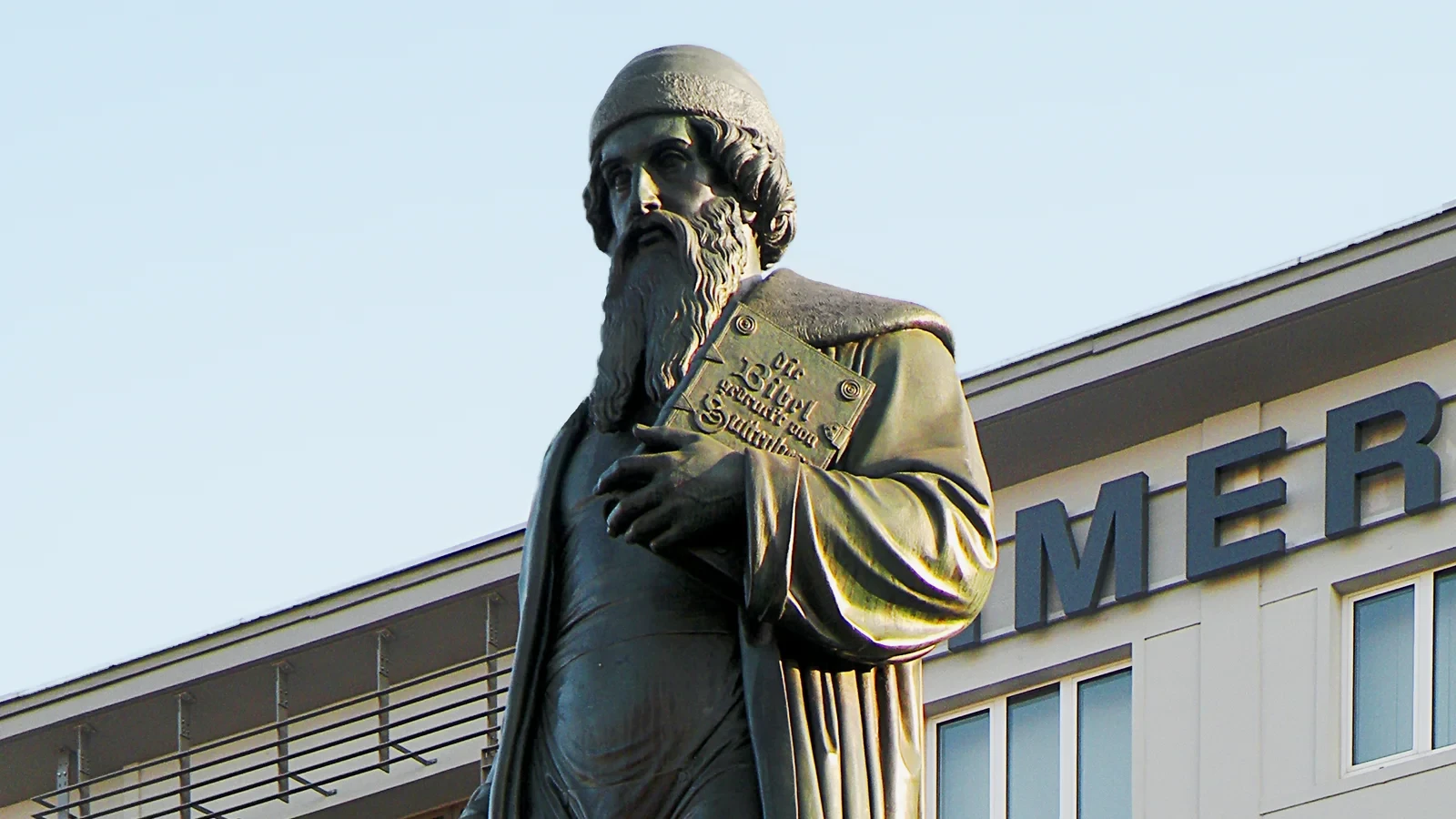
On 6 November 1455, three men attended a proceeding in Mainz on Johannes Gutenberg’s behalf. Gutenberg himself was absent. His business partner, Johannes Fust, was there to swear an oath about money advanced to their enterprise. A legal ruling, including the parties’ claims and Gutenberg’s response, was read aloud. The surviving record preserves this encounter—a printing pioneer seen through a dispute over an account.
That is an unexpectedly useful place to begin a Johannes Gutenberg biography. The familiar inventor’s story follows a brilliant idea towards a finished Bible. The business record asks what made that work possible: equipment, people, materials and money, with agreements that the partners understood differently. It brings Gutenberg down from the pedestal and into an enterprise that could produce remarkable books while remaining financially contentious.
PLACE & TIME
A Mainz dispute within a wider working life
Mainz · Strasbourg
The Rhineland and Alsace
15th century CE
The historical settings
The man is harder to see than the monument
Gutenberg was born in Mainz around 1400, into the Gensfleisch family. The city’s historical account connects the name Gutenberg with the family’s houses, rather than a modern fixed surname. His father belonged to Mainz’s patrician society: the established families involved in the city’s wealth and government. Johannes did not emerge from a social vacuum, even if the details of his childhood remain obscure.
His schooling and training are less securely known. It is tempting to give him the complete apprenticeship that his later achievement seems to demand. But a plausible route into skilled work is not a documented life story. Nor does the familiar beard supply a missing fact: the Gutenberg Society notes that no contemporary likeness is known. The face you meet in later portraits belongs to Gutenberg’s reputation, not a verified eyewitness image.
TEST THE EVIDENCE
Does the monument show Gutenberg’s face?
This image tells us what Johannes Gutenberg looked like.

- SHOWS
- A bronze figure carrying a book, presented as Gutenberg.
- SUGGESTS
- The monument gives the printing pioneer a recognisable, dignified public identity.
- CANNOT PROVE
- A sculpture erected in 1837 cannot establish the appearance of a man who died in 1468.
A better-supported statement
It shows how a later generation chose to commemorate him.
Dating and context: Mainz University · the Gutenberg monuments ·
Vitold Muratov · CC BY-SA 3.0 · original upload version; resized.
Before the Bible, there were partners and pilgrims
By 1434, Gutenberg can be placed in Strasbourg, another important trading city in the Rhine region. His activities brought him into contact with craftsmen and investors. One venture concerned mirrors for pilgrims travelling to Aachen. These devotional objects were meant to capture the blessing associated with displayed relics. The pilgrimage took place in 1440, later than the venture’s partners had expected—a reminder that making a product and meeting its market were separate problems.
When Andreas Dritzehn, one of the partners, died, his brothers brought a case in 1439 seeking repayment or entry into the partnership. The Gutenberg Society describes the testimony’s references to a press, lead and moulds. The record points towards technical activity, but it does not identify a surviving Strasbourg book printed by Gutenberg. It is evidence for the work and its business relationships, not a finished scene of the first successful printing.
WORDS BEHIND THE DISPUTE
Money, security and a written record
Gulden or guilder
A monetary unit used in the records. The sums here are historical figures, not converted into a supposed exact modern price.
Pledge
Property offered as security for an obligation; the partners’ equipment mattered financially as well as technically.
Notarial instrument
An authenticated written record made by a notary. It records a particular legal act, not necessarily an entire court case.
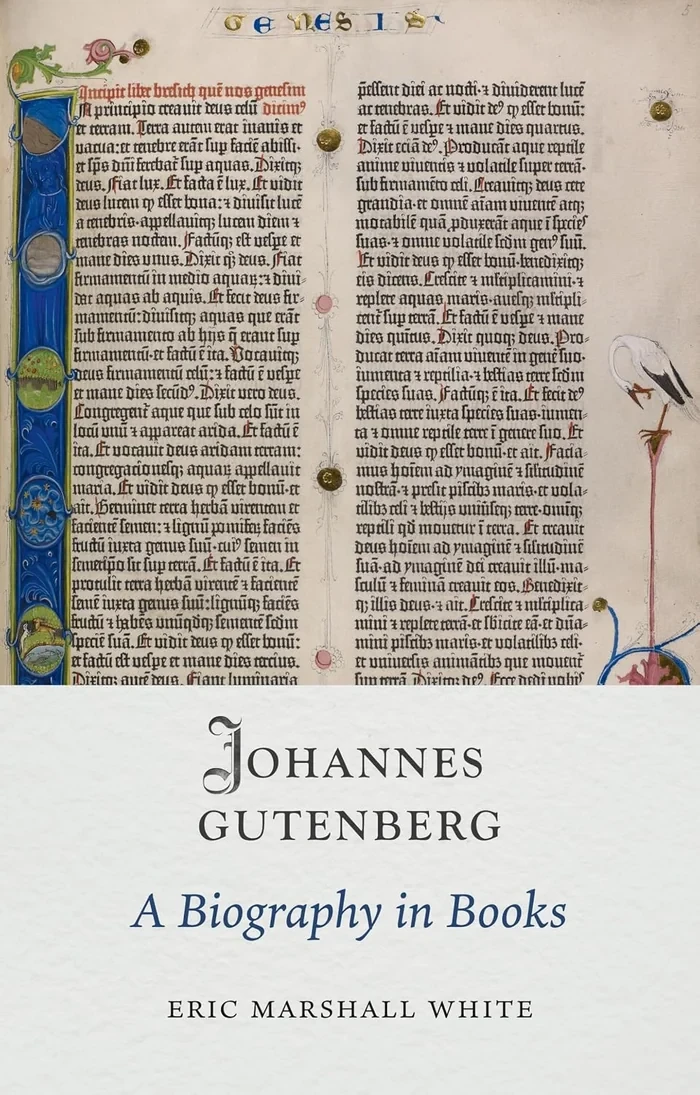
Antonio Zugaldia · CC BY 2.0 · wikimedia resized reproduction; no further pixel edit.
In Mainz, the equipment needed a backer
A loan document securely places Gutenberg back in Mainz in October 1448. The next venture acquired a crucial backer in Johannes Fust. The Gutenberg Society’s account describes two advances of 800 gulden, first for the developing enterprise and later for the shared work of producing books. The details of these arrangements became central to the disagreement. Money did not simply arrive behind the invention; it came with expectations about its use and return.
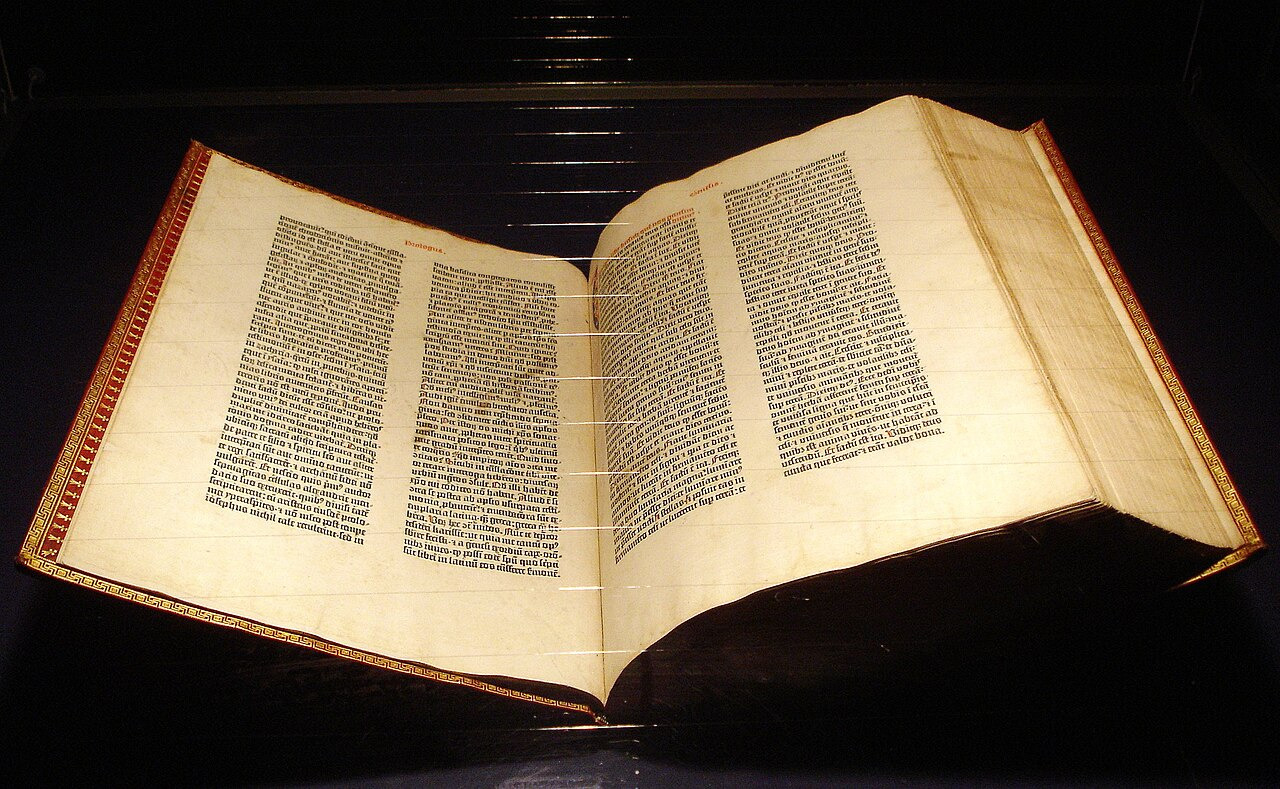
The printed Bible makes those requirements tangible. A repeatable page still needed type, a working printing arrangement and a supply of sheets. People needed paying while the book was being made. In the surviving legal record, Gutenberg’s response names wages, rent, parchment, paper and ink among the costs Fust was to meet. These are the ordinary obligations beneath an extraordinary surviving object.
IN THE SOURCE
werck der bucher
The wording matters. The legal instrument speaks of a common undertaking, while later scholarship connects it with the Bible’s production. In an interview introducing his critical biography, Eric Marshall White stresses how few documents directly connect Gutenberg with books. Printed survivals and business records have to be read together. Neither gives us permission to invent the workshop’s conversations or Gutenberg’s private ambitions.
Fust and Gutenberg disagreed about what the money meant
Fust’s claim concerned advances and unpaid interest. Gutenberg’s recorded answer distinguished making equipment from spending on the shared book project. He also maintained that Fust had said he would not require interest on the initial advance. These were positions argued in a dispute, not two transparent explanations that can be accepted together without question. The instrument preserves the competing accounts and a ruling requiring an accounting.
The disagreement exposes a problem that technical success alone could not settle. Which expenses belonged to the common work? Which money created equipment, and which supported ongoing production? What should be repaid? The court’s recorded ruling tied repayment to the accounting and, for interest, to evidence about Fust’s own borrowing. It did not provide a neat final statement of everything Gutenberg subsequently surrendered.
READ THE ARGUMENT
An account can look different to each partner
The initial advance
Money had been advanced and interest remained unpaid.
The advance was connected with making equipment, which stood as security.
Interest
Fust had himself incurred borrowing costs.
Fust had said he would not demand interest on the initial sum.
Further money
Additional advances formed part of the demand for repayment.
Gutenberg offered an accounting for the shared undertaking.
There was a serious dispute, and the partners separated. That does not establish the popular ending in which a grasping financier left the inventor penniless. The Library of Congress’s research guide rejects that financial-ruin story and points to evidence of Gutenberg’s continuing property and financial activity. A break in a partnership is not the same event as the disappearance of a working life.

Johann Fust and Peter Schöffer · Royal Collection reproduction · Public Domain Mark 1.0 · jpeg re-encoded; no crop.
The enterprise continued under other names
Fust’s subsequent partnership with Peter Schöffer is visible in the books themselves. Schöffer had been a scribe before his printing career, bringing experience of written forms into the new trade. In 1457 they produced the Mainz Psalter, a book of psalms for religious use. The Royal Collection identifies the two makers; its printed colophon advertised the workshop, date and method. Their names need not be reduced to supporting characters in someone else’s legend.
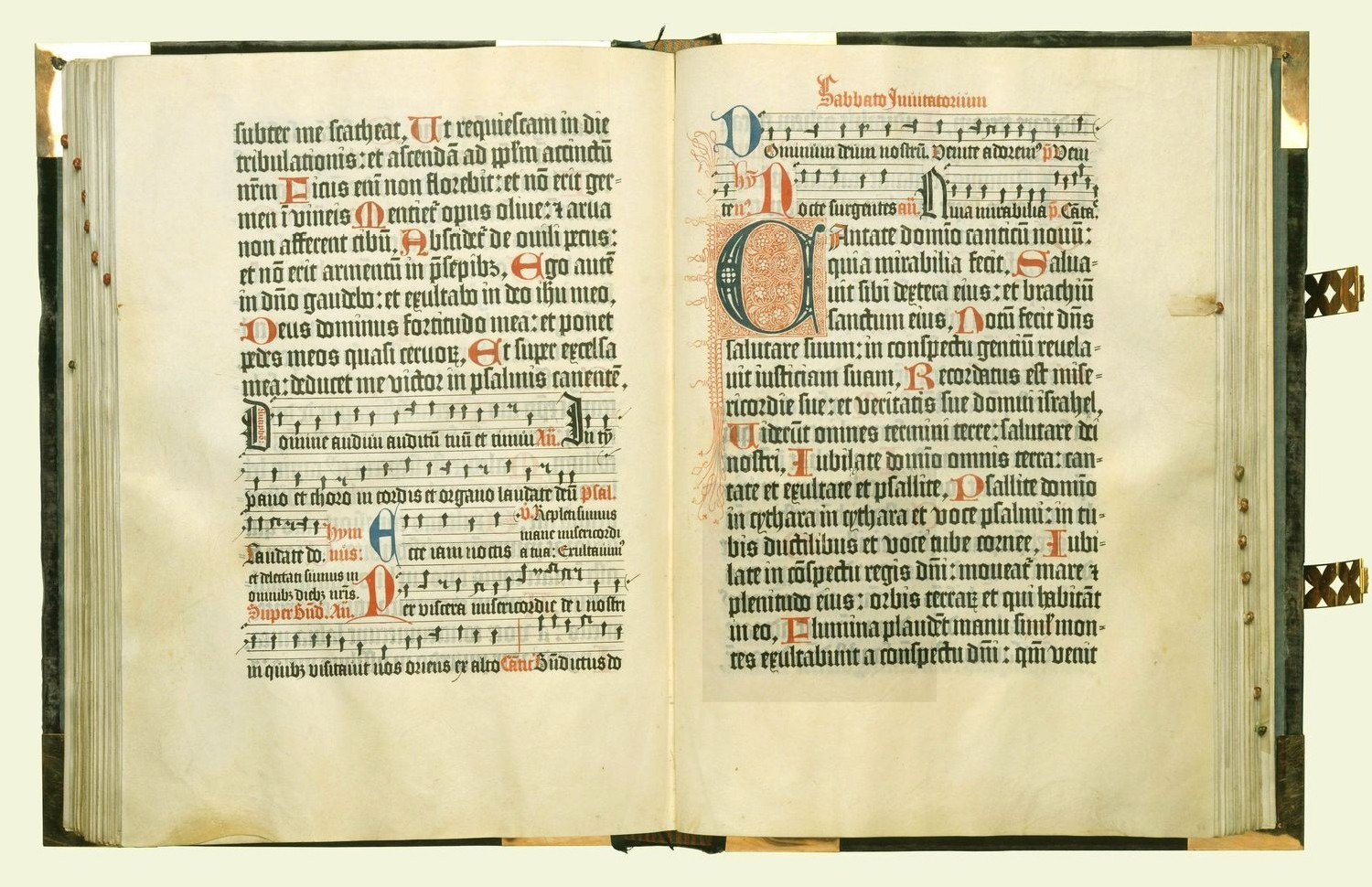
The red-and-blue initials in this spread also make a point about continuity. Book production did not stop with the Bible or with the end of Gutenberg’s partnership. Skills, equipment and commercial relationships could form another working combination. That is different from assigning every feature of a later book to Gutenberg personally. The printed object has its own makers and history.
DOCUMENTED LANDMARKS
A working life, with gaps left visible
- 1434–1444 CE
Strasbourg records
Legal and other records place Gutenberg in the city; the 1439 case illuminates partnerships and technical work.
- 1448 CE
Back in Mainz
An October loan document securely places him in Mainz again.
- 1455 CE
A disputed undertaking
The instrument of 6 November records Fust’s oath and the parties’ financial arguments.
- 1465–1468 CE
Recognition and an estate
Court appointment in 1465; a February 1468 document records printing materials after Gutenberg’s death.
Selected dated evidence, not a complete itinerary. The record does not explain all his activities between Strasbourg in 1444 and Mainz in 1448.
The last records do not describe a forgotten man
In 1465, Archbishop Adolf of Nassau made Gutenberg a member of his court household. The appointment brought clothing, grain and wine, as well as exemptions from duties and taxes. Gutenberg’s life still depended on material support, but this was public recognition rather than the ending of an unnoticed pauper. The sources do not establish every circumstance behind the honour.
He died in early 1468. The Gutenberg Society cautions that the often-repeated exact death date is not securely known. A document of 26 February records Konrad Humery receiving printing equipment from his estate. This keeps Gutenberg connected with the tools of printing to the end, without identifying every late publication as his. An estate record is evidence of materials and obligations; it is not a diary of his final years.
THE PERSON IN THE RECORDS
Gutenberg’s achievement becomes more intelligible when you keep its people, equipment and financial agreements in view.
The monument offers a single, settled figure holding a book. The surviving records offer something more interesting: a technically ambitious man making partnerships, securing resources and disputing an account. You can follow his documented actions without pretending to know his face or thoughts. The next chapter moves into the printing shop itself, where making an edition depended on many hands repeating exacting work.