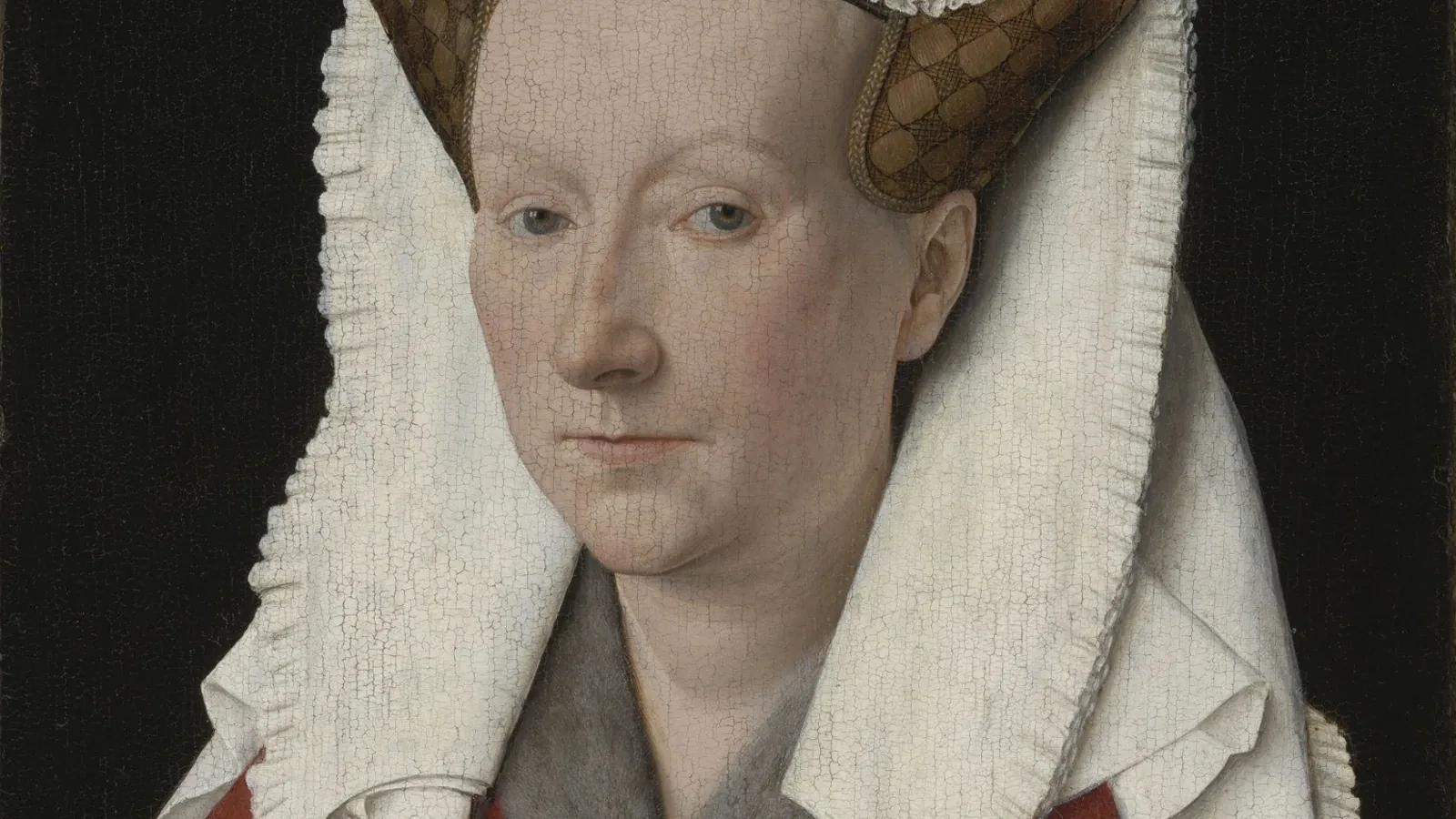
Margaret van Eyck looks out from a small painted panel with a directness that can make six centuries seem briefly unimportant. The face, head covering and red clothing hold the viewer’s attention. Yet familiarity is deceptive. The painting brings one person vividly before us without giving us her full biography or the life of the household around her.
Jan van Eyck painted his wife’s portrait in 1439, near the end of his documented career. His work had already connected him with princely service, travel and the people who commissioned paintings. Following those connections gives us a different view of Bruges’ wealth: the resources and relationships that could be turned into an exceptionally skilled image.
PLACE & TIME
A career with several centres
Bruges and its connected settings
Historical County of Flanders · present-day Belgium
1422–1441 CE
Period and setting
Begin with what the records actually date
Van Eyck’s birth date is uncertain. That uncertainty should not be replaced with a convenient exact year. Lorne Campbell’s National Gallery account begins the secure career record in 1422, when the painter was serving John of Bavaria. In 1425 he entered the service of Philip the Good, Duke of Burgundy.
Court service placed painting within a wider set of responsibilities. Van Eyck travelled to Portugal in 1428–1429 in connection with negotiations for Philip’s marriage to Isabella of Portugal. The painter’s ability to represent a person could be useful where dynastic decisions involved someone a prospective spouse had not met.
IN TIME
A short documented framework
- 1422
Service to John of Bavaria
The documentary record identifies work for a princely employer.
- 1425
Philip the Good’s service
Van Eyck entered the Burgundian duke’s employment.
- 1428–1429
A journey to Portugal
Painting formed part of a mission connected with a dynastic marriage.
- By 1431
A Bruges base
The painter was established in Bruges.
- 1441
The end of the career
Van Eyck died in June.
These dates establish recorded activities; they do not reconstruct every year of Van Eyck’s life.
The combination complicates the idea of a painter confined to a single urban workshop. Bruges mattered to Van Eyck, but it was not the geographical limit of his work. A career could connect a city’s skilled production with political relationships that crossed several territories.
A workshop made the celebrated individual’s work possible
Accounts record assistants in Van Eyck’s employment at different points. The evidence does not allow every hand in every surviving picture to be identified, but it does prevent a simple equation between a named master and a person doing absolutely everything alone. The workshop belongs in the history of the painter’s achievement.
This is a useful connection with the earlier cloth chapter. In both cases, naming the producer or organiser is only a starting point for understanding the work. Painting required materials, preparation and skill; attributing a masterpiece does not automatically describe how all of those tasks were distributed.
KEY IDEA
An artist’s identity and the organisation of a workshop are related questions.
The comparison has limits. A panel painting and a length of cloth involved different techniques and buyers. What they share is a need to ask how skilled work was supported. Who provided the opportunity? Who could pay? What relationships made the finished object desirable? Those questions link art to the commercial city without reducing it to a financial transaction.
Jan van Eyck · Public domain · resized jpeg reproduction.
Look closely at Margaret’s portrait
LOOK CLOSELY
A vivid likeness, a limited biography
A carefully bounded view
The panel concentrates on Margaret’s head and upper body. It gives the viewer a closely framed encounter rather than a broad account of domestic life.
Clothing made visible
The head covering, red clothing and fur are important visible features. Describing them is firmer ground than inventing the occasion on which she wore them.
Information beyond the face
The museum records a date of 15 June 1439 and an inscription giving her age as thirty-three. These are documented features, distinct from a viewer’s impression of her character.

Jan van Eyck, Portrait of Margaret van Eyck, 1439. The reproduction shows the likeness; the museum record supplies the date, inscription and wider object context.
Musea Brugge’s collection record provides the portrait’s date and inscription. It also explains the painted imitation of marble on the frame and reverse. The surviving object was more than a face on a neutral support. Its different surfaces were deliberately worked, even though a reproduction usually draws our eyes towards the sitter.
What the picture does not supply is equally relevant. It cannot tell us all the work Margaret performed, her role in household decisions or the whole relationship between husband and wife. The vividness of the likeness is an achievement of painting, not permission to invent an intimate conversation between its subjects.
The Arnolfini Portrait asks a different set of questions
Van Eyck’s Arnolfini Portrait, dated 1434, places two richly dressed people in a carefully furnished interior. The National Gallery identifies the male sitter as probably Giovanni di Nicolao Arnolfini. Both the identities and the event represented have been debated. Calling it a straightforward photograph of a wedding would turn an interpretation into a settled fact.
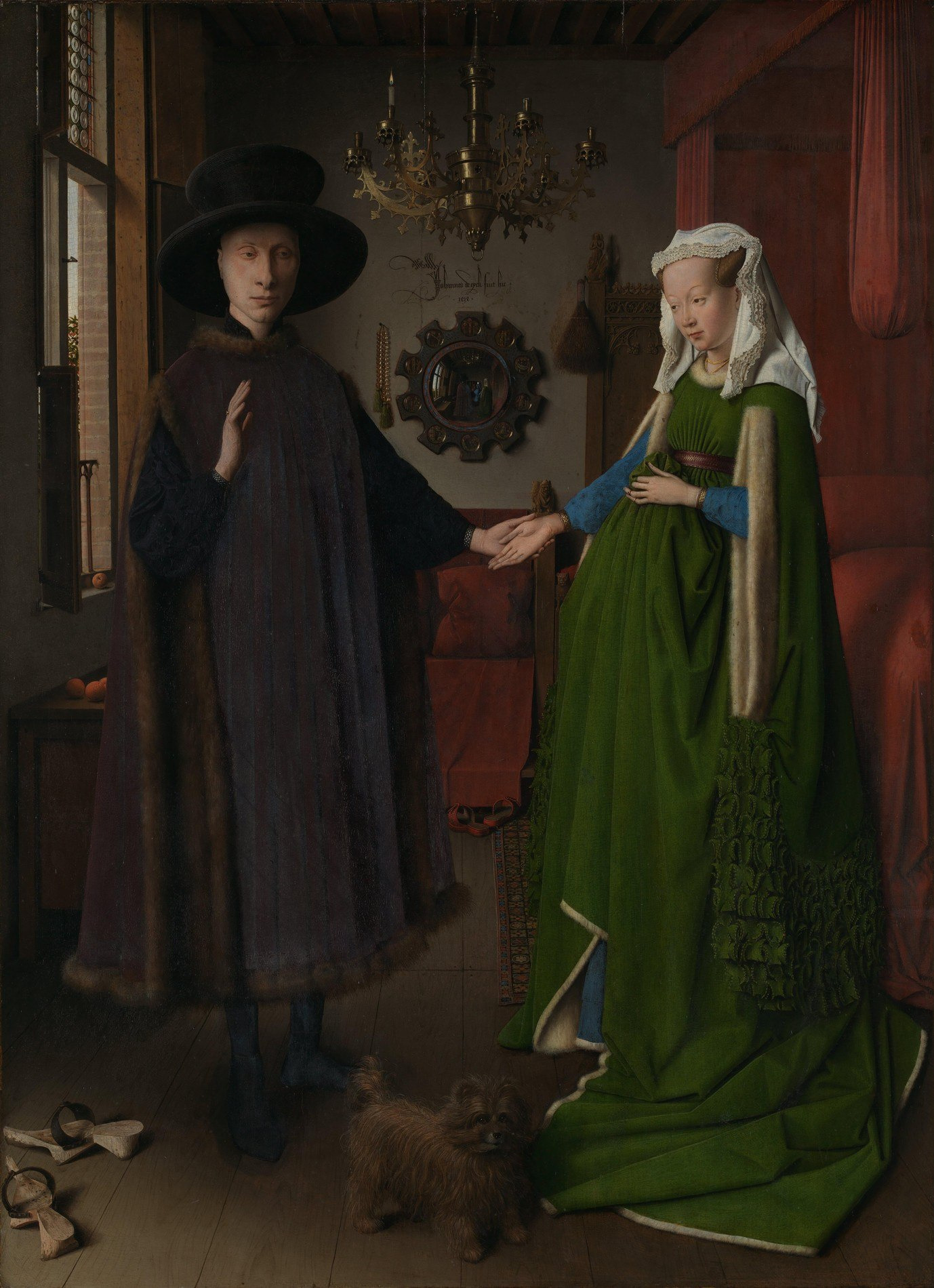
The mirror, dog, furnishings and clothing invite close looking. They are also elements selected for a painting. Some may carry meanings beyond their practical uses, and scholars disagree about how far those meanings can be specified. The safe starting point is to distinguish a visible detail from a proposed explanation of it.
COMPARE
Read what is visible before assigning a story
The room
The picture includes a bed, mirror and other furnishings.
These establish the exact contents of a particular household at one moment.
The clothing
The figures wear elaborate garments.
The woman’s gathered gown proves pregnancy.
The arrangement
Two people stand in a deliberately composed interior.
The painting records a legally identifiable marriage ceremony.
The woman’s silhouette is not reliable evidence of pregnancy. The gathered fabric belongs to the clothing represented. That example matters because a familiar interpretation can become self-reinforcing: viewers who are told to see one event may stop examining whether the visible details actually establish it.
Jan van Eyck · Public domain · resized jpeg reproduction.
A foreign merchant’s portrait belonged to an urban network
The Arnolfini name also connects the painting with Bruges’ Italian commercial world. Research on Lucchese residences examines a specific merchant community around 1390–1430. It locates properties and relationships rather than treating international trade as an abstract source of wealth. The portrait and the property records remain different kinds of evidence.
A portrait could make a person’s presence and status visible in ways an account book did not. It was commissioned, composed and made to be viewed. That gives it value for understanding the presentation of a prosperous life, while also warning against using it as the typical interior of everyone in Bruges.
- Ask whose resources made the work possible.
- Distinguish the represented setting from a household inventory.
- Keep uncertainty about identities and occasions visible.
The same city contained workers with much smaller means. An expensive painted likeness does not contradict that inequality; it is one of the forms through which differences in resources could become conspicuous. The ability to commission such work was itself an opportunity distributed unevenly.
Oil painting was a developed technique, not a lone invention
Van Eyck’s reputation sometimes comes with the claim that he invented oil painting. The Metropolitan Museum’s history of early Netherlandish painting instead places the medium within a longer technical development. Oil was already used in painting. Van Eyck’s importance lies in the sophisticated results he achieved, not in a securely documented moment when he created the medium from nothing.
That distinction gives the work back to its materials and decisions. The portraits’ precision and effects of light invite admiration without requiring an invention myth. A technique can be transformed by exceptional practice even when it has a history before the practitioner who becomes most famous for it.
WORDS TO KEEP APART
Three terms for looking carefully
Patron
A person or institution that commissions or supports a work.
Attribution
An evidence-based assignment of a work to an artist or workshop.
Iconography
The study of subjects and meanings represented in images; interpretations require context.
The painter connects different kinds of power
Van Eyck’s documented career joins court service, an urban workshop and commissioned images. These connections explain something about the opportunities available to a highly skilled painter. They do not make him representative of every craft worker, or his patrons representative of every inhabitant of Bruges.
His work asks us to look closely at both a surface and the relationships behind it. A compelling portrait can preserve a particular presentation of wealth; a career record can show how princely employment supported skilled work. The next chapter turns from those connections to a more openly contested question: who could make decisions for the city itself?