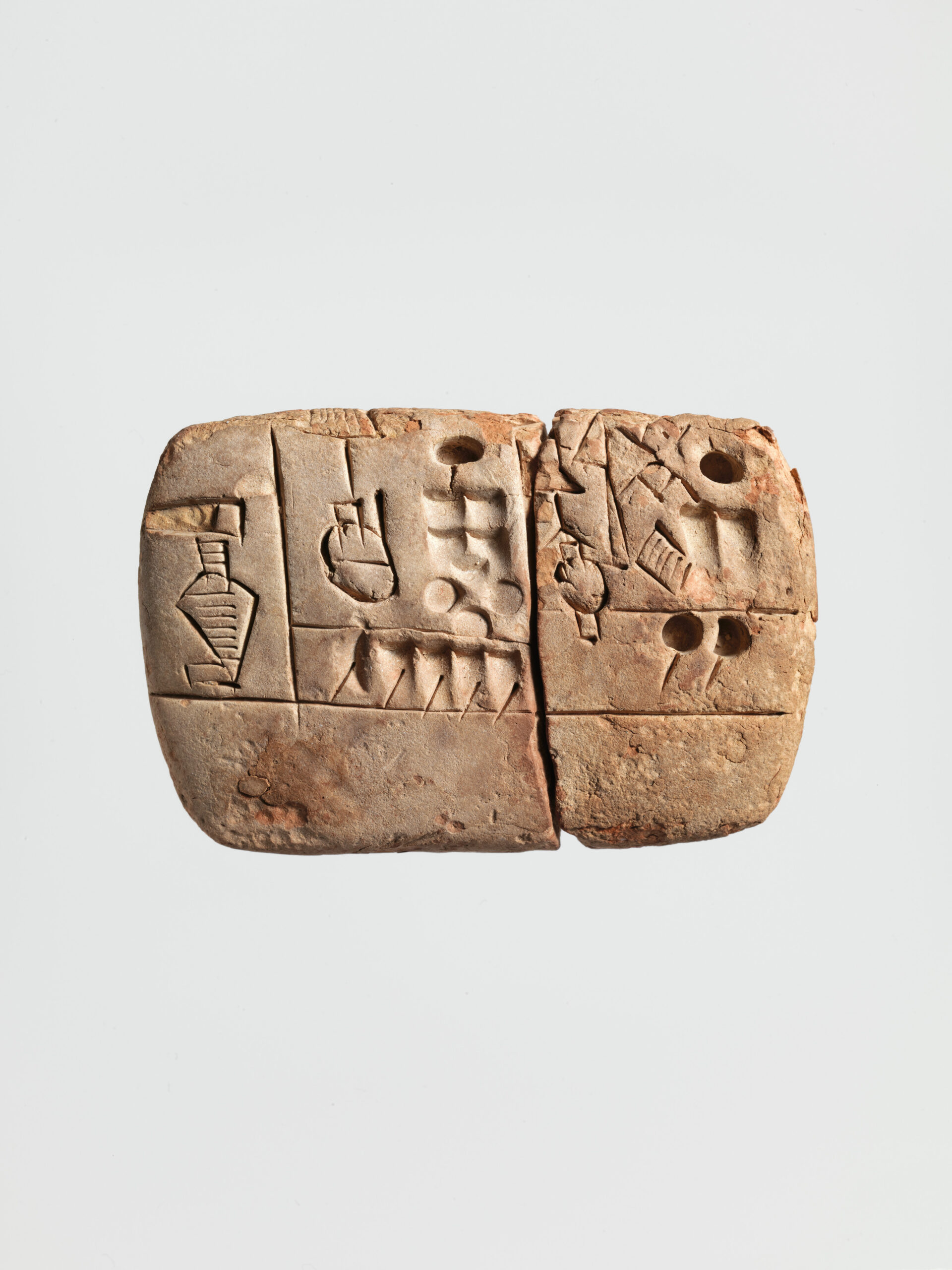
Ten sheep, ten jars and ten measures of barley are different things. A useful record must preserve both the quantity and what it refers to. In Uruk, that practical problem helped shape early writing.1
- Count it: record how much was produced, received or allocated.
- Identify it: connect the quantity with goods, people or institutions.
- Make it readable: arrange the information so another trained reader can use it.
Those were the foundations. Shared signs and an organised surface made accounts usable; later, sound values helped writing express much more than quantities and categories.5, 11
Why a growing city needed more than a tally
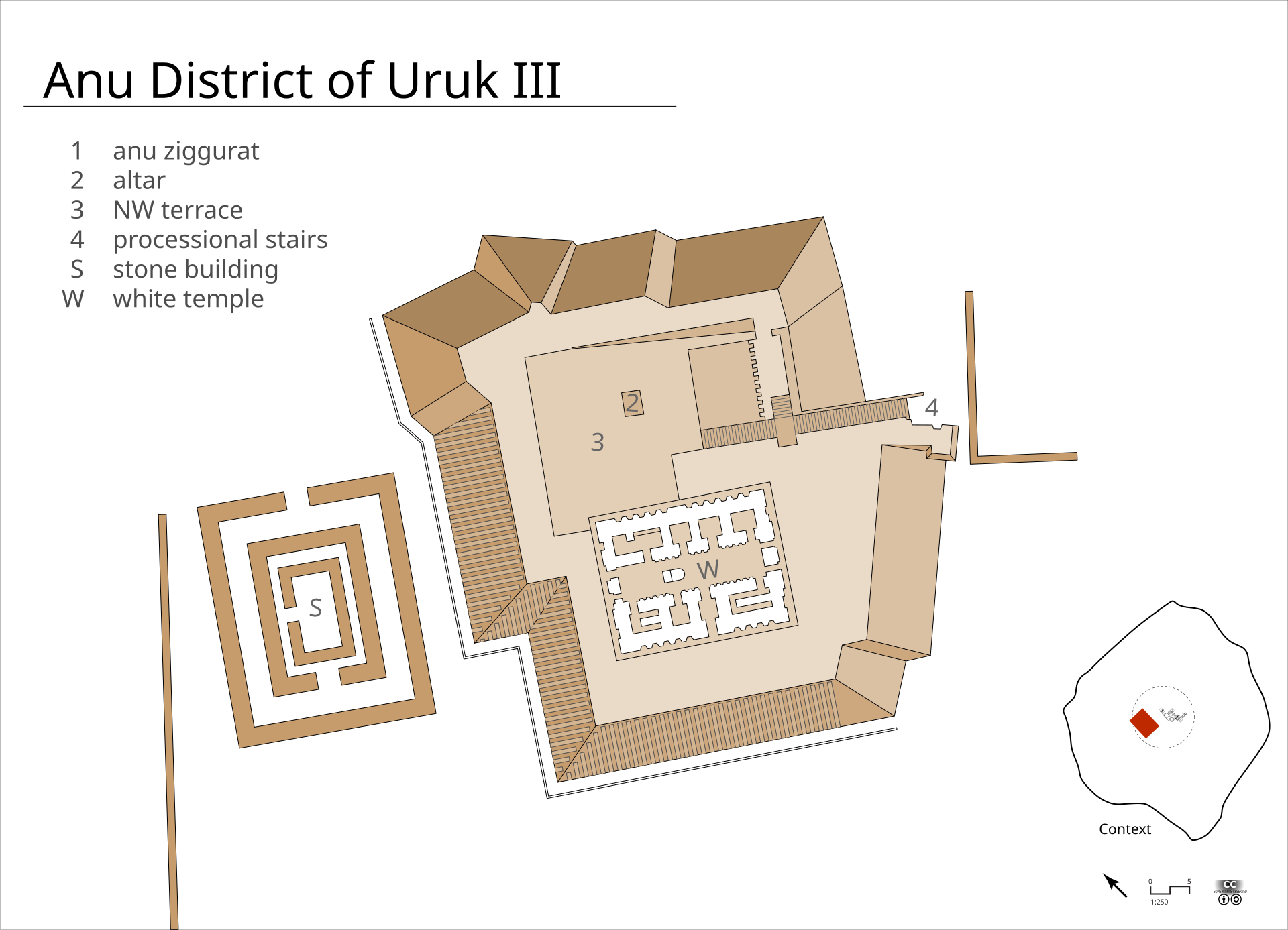
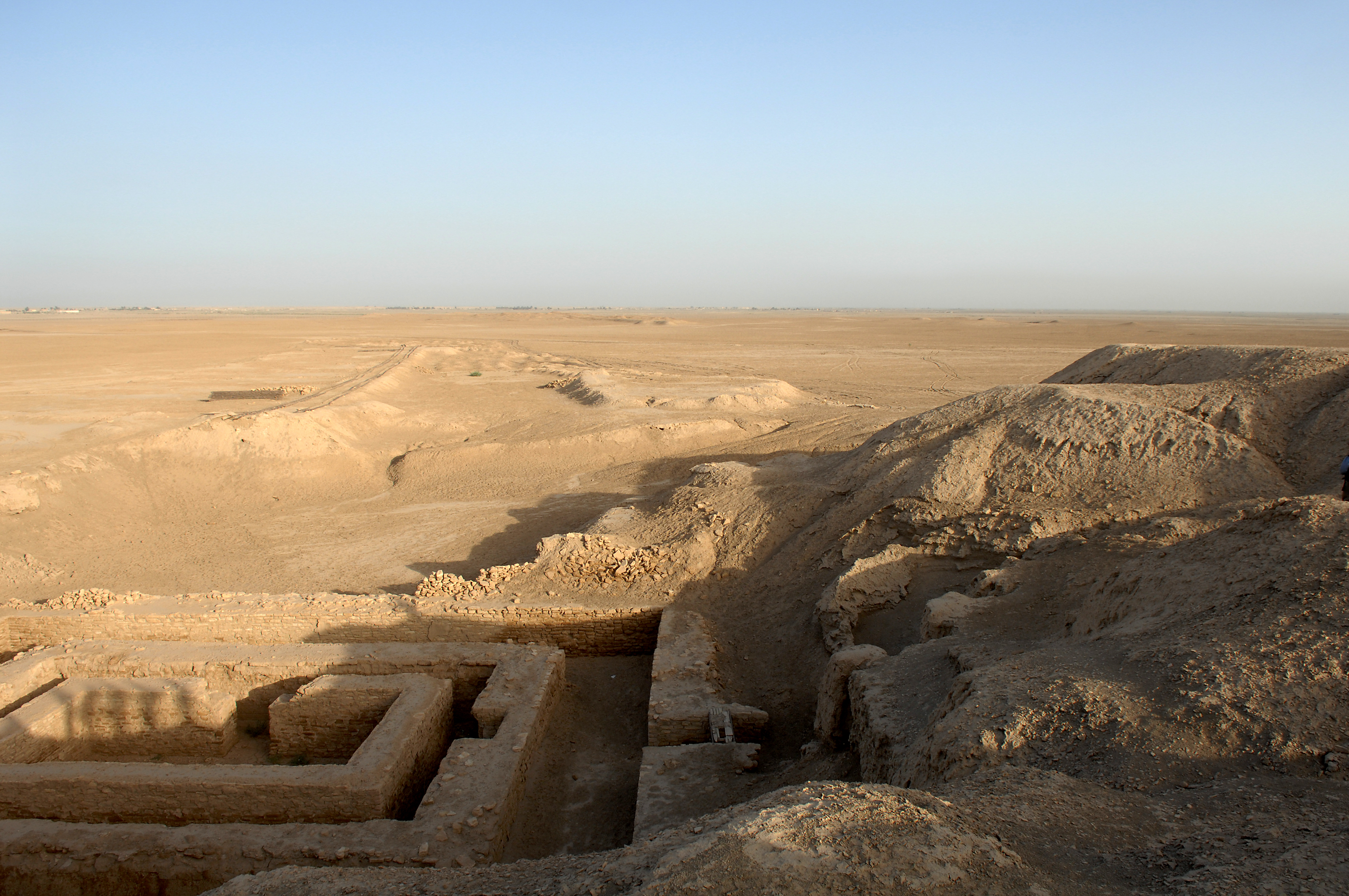
Uruk’s buildings made the scale of urban life visible. Its accounts reveal another part of that scale: the effort to coordinate supplies and work. Grain and animals could be recorded alongside the people or institutions connected with them. The relevant question was no longer just “How much?” It was also “How much of what, connected with whom?”1, 2
There is a practical difference between remembering one exchange and maintaining records that can be compared. A delivery may be finished while the information remains useful: another person may need to check an allocation, combine entries or relate supplies to work. A lasting record separates that task from the original conversation.
PLACE & TIME
The city behind the accounts
Uruk
Southern Mesopotamia · Present-day Iraq
c. 3500–2600 BCE
Period covered in this article
The tablets are unusually good evidence for this development, but they do not give us an inventor’s diary. Many early Uruk tablets were recovered from rubbish or reused building fill. Their archaeological position therefore cannot supply the precise day—or even an exact year—when writing began.2
How a tablet made information readable
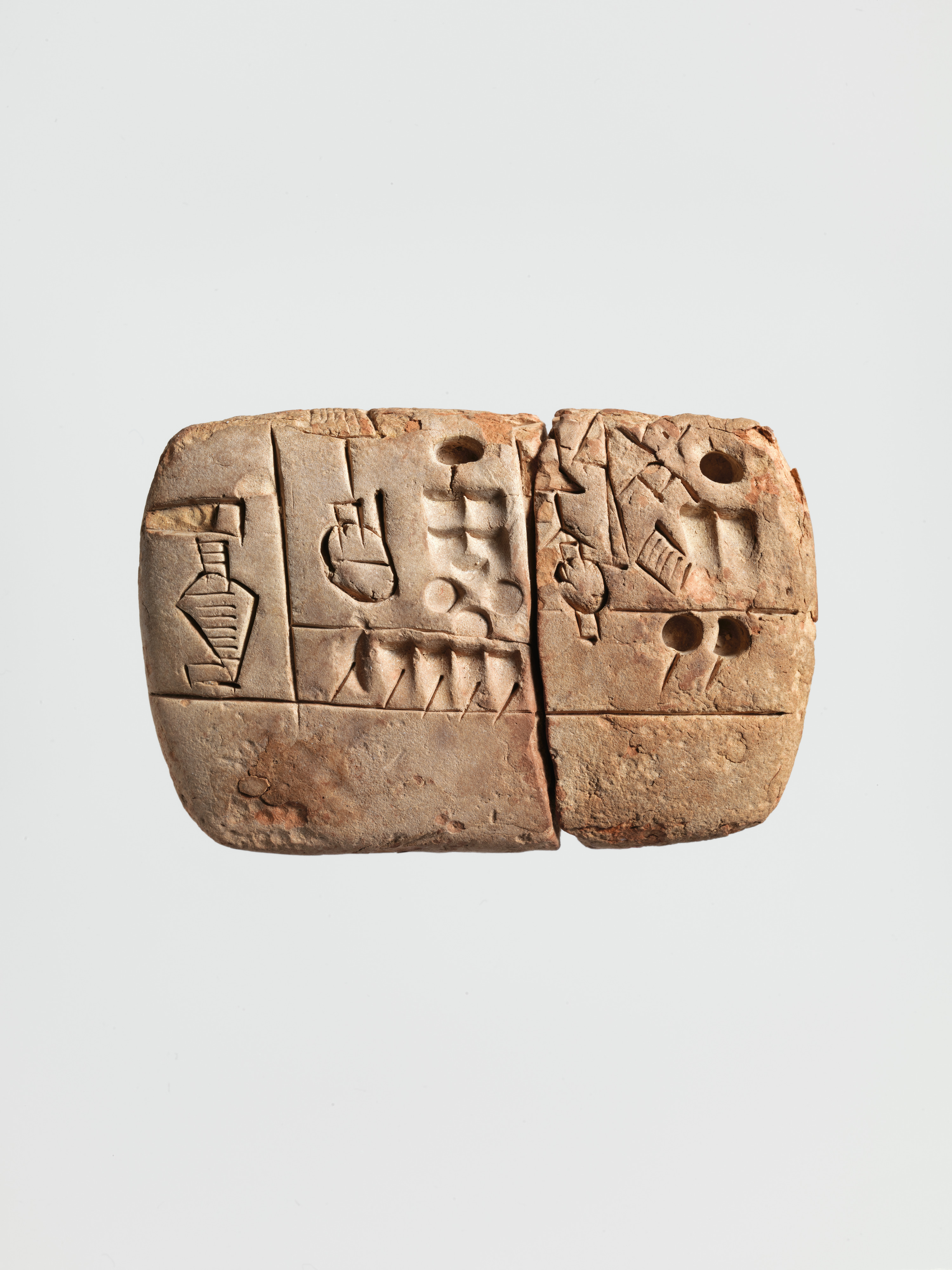
The account shown below concerns malt and barley groats. It dates to about 3100–2900 BCE and probably comes from Uruk. Even before trying to read its signs, notice the contrast between round impressions, more elaborate drawn marks and lines that divide the surface.3
Three jobs on one surface
| Part of the record | What it contributes | Why it matters |
|---|---|---|
| Numerical signs | A quantity, interpreted within a counting or measuring convention | They answer “how much?” rather than describing the whole transaction. |
| Other signs | A commodity, person, institution or administrative category | They narrow down what the quantity refers to. |
| Fields and divisions | The arrangement of entries and their relationships | The reader uses position as well as individual signs. |
Early accounting did not use one universal numerical system for everything. Different conventions applied to different kinds of goods and measurements. Knowing the commodity could therefore be necessary for interpreting the number. A circular impression was not a modern digit with one fixed value in every setting.2
The table above describes the roles of these features, not a sign-by-sign translation of the photograph. The distinction matters: recognising a number mark is easier than establishing everything an ancient account meant.
TERMS TO KEEP
Quantity, meaning and sound
Proto-cuneiform
The early Mesopotamian system of numerical and other signs on clay. It recorded structured information before writing regularly represented the detail of spoken language.
Logogram
A sign used for a word or a group of related words. It can be a recognisable picture, but it does not have to look like what it means.
Phonogram
A sign used for its sound value. In cuneiform, a sign could help spell a syllable rather than name the object it originally represented.
What counting stones and seals contributed
Writing grew among older ways of handling information. In the later fourth millennium, small clay counters were used in connection with goods or units of measurement. Some were enclosed in hollow clay balls, called bullae. Impressions on the outside could correspond to the counters inside, making a quantity visible without immediately breaking the container.5
Flat clay records offered different possibilities. A surface could carry numbers and additional signs, with lines separating one entry from another. Adding a drawn sign was a flexible way to introduce a category: a new kind of information did not always require a newly carved object.5
A seal left a repeatable image
A cylinder seal worked differently. Its design was carved around a small cylinder; rolling it across clay produced an impression. Such impressions could identify ownership or responsibility, and seals were used on closures for containers and doors as well as on tablets.6
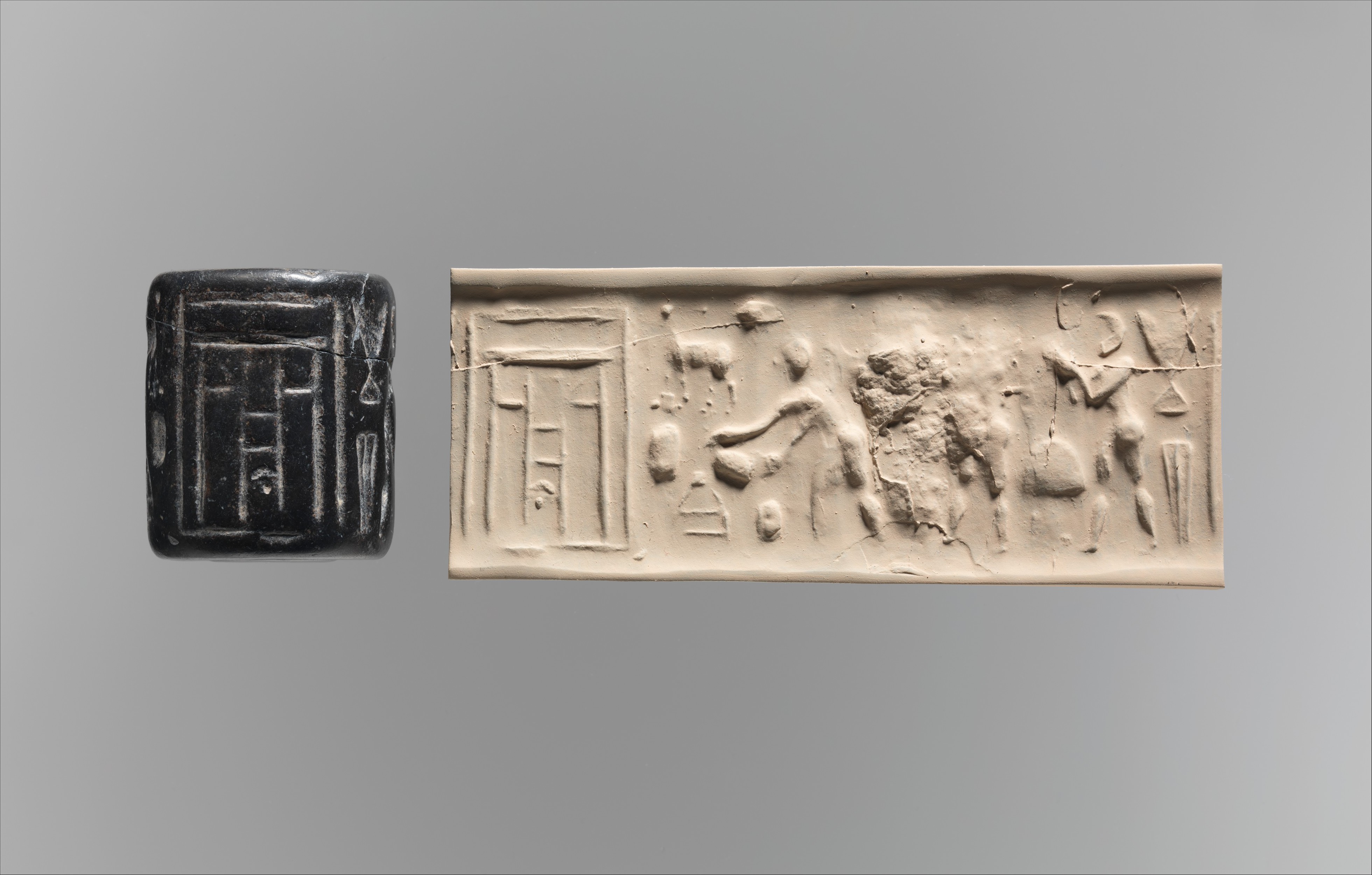
The modern roll-out reveals the seal’s connected scene: figures, vessels and a building. Rolling the cylinder reproduced that scene. Writing offered a different kind of flexibility.
| A cylinder seal | A written account |
|---|---|
| Repeats the design carved into the cylinder | Combines signs in entries that can change |
| Presents figures and objects as a connected scene | Uses categories, quantities and divisions to organise information |
A visual vocabulary before writing
Kathryn Kelley, Mattia Cartolano and Silvia Ferrara compare motifs of fringed textiles and netted vessels on early seals with related proto-cuneiform signs. Their argument suggests that some signs drew on images already associated with producing and moving goods.7
This is a connection between particular motifs, not a family tree for every sign. Counting devices, seals and drawn signs interacted; many proposed token-to-sign matches remain difficult to demonstrate.7
Why an early account did not read like a sentence
When we read a sentence, word order helps tell us who did what. Early accounts often organised information through the surface itself. A larger field might contain an entry; smaller fields could hold subdivisions. Related entries could be grouped together. The arrangement carried meaning that a string of spoken words would express differently.4
To understand the difference, consider this invented English record. It is an analogy, not a translation of an ancient tablet:
- Barley — 10 measures
- Malt — 4 measures
- Connected with store A
The categories and quantities are clear enough for a narrow task. Yet the record does not tell us whether the goods arrived, were issued or were still expected. A reader who knew the accounting procedure might supply that relationship. A reader outside it would need more information.
Proto-cuneiform similarly relied on shared administrative knowledge. Its categories were selective, and phonetic coding played a limited role. Calling it “early writing” is useful; treating it as ordinary speech written down would miss how the system worked.4
TEST THE EVIDENCE
An account is not a conversation
This tablet preserves a complete spoken sentence.
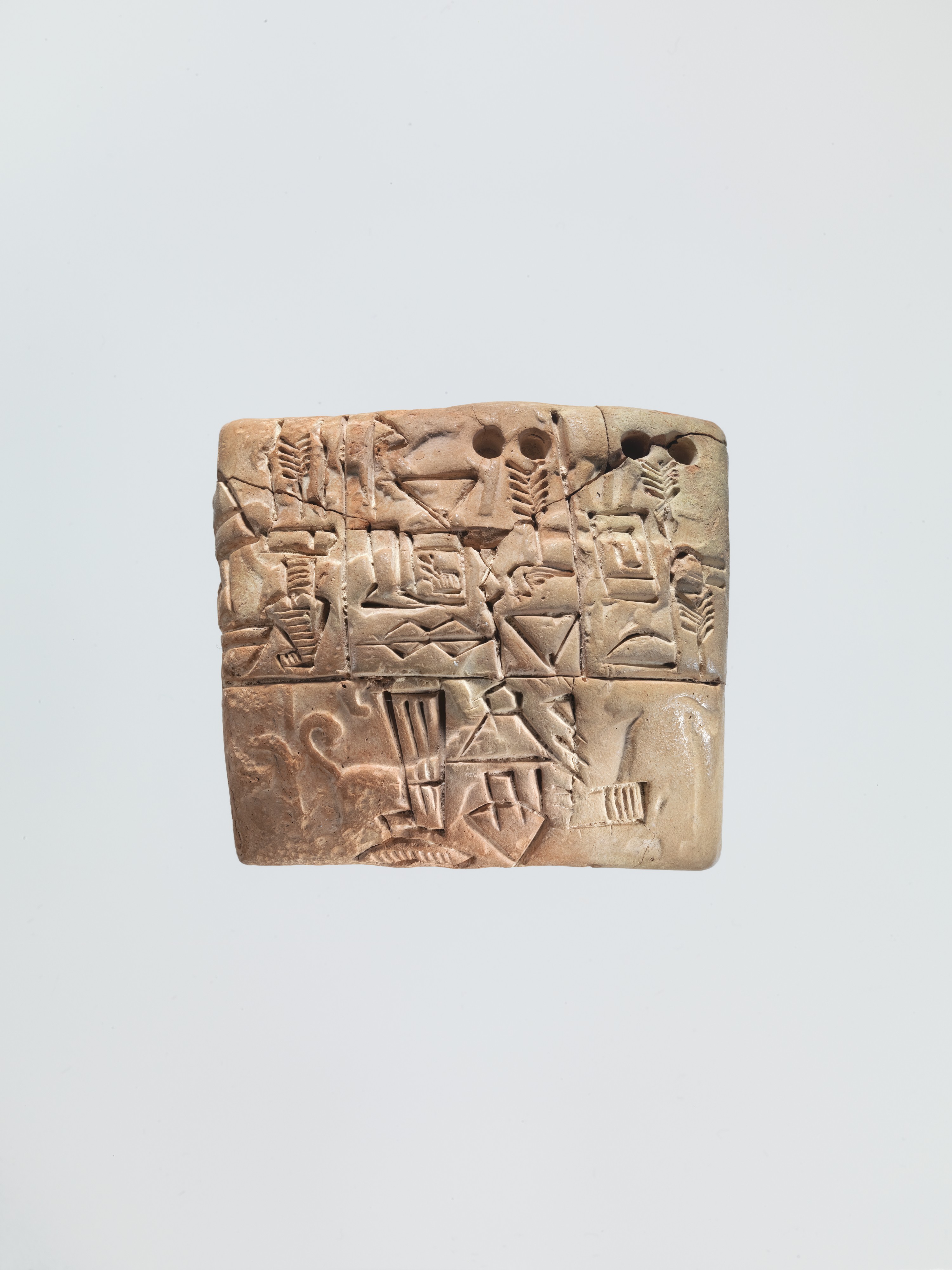
- SHOWS
- Circular impressions, drawn signs, dividing lines and traces of a rolled seal.
- SUGGESTS
- The museum interprets the record as probably documenting grain distributed by a large temple.
- CANNOT PROVE
- Early records omit verbs that would help fix the relationship between entries. We cannot recover an exact spoken sentence from this tablet.
A better-supported statement
The tablet probably records a grain allocation. Its signs and arrangement preserve selected information without giving us a complete spoken sentence.
Object and interpretation: The Met · 1988.433.1 · The Met · 1988.433.1 · Public Domain / CC0
That limitation should not make the achievement seem small. A record can be highly effective at a particular task without being able to express everything a language can say. Early accounting created precisely that kind of specialised tool.
How people learned to share the signs
A mark cannot serve a shared system if every writer gives it a private meaning. Sign forms, categories and ways of arranging entries had to be learned and passed on. Alongside administrative accounts, the early corpus contains another kind of document: lists of signs for words, grouped by subject.9, 4
These lexical lists covered subjects such as occupations, animals and vessels. They helped preserve the vocabulary and conventions of the writing system. The Standard Professions List is a striking example: versions were copied over a long period, including much later than the first Uruk examples.9
An account and a list answer different questions. The account concerns a particular set of entries. The list preserves a repertoire that can be used in many accounts. That is a crucial step from making a useful record to sustaining a writing tradition.
| An administrative account | A lexical list |
|---|---|
| Records a particular quantity or allocation | Collects signs and vocabulary by category |
| Relates entries to people, goods or institutions | Helps transmit conventions to other writers |
| Useful for a specific administrative task | Useful across many future records |
We should not fill the earliest period with a detailed classroom scene borrowed from later Mesopotamian schools. The surviving lists establish the work of organising and transmitting knowledge. They do not reveal every lesson, teacher or learner behind it.
The change that let signs write sounds
A system centred on things and quantities faces a different problem when it needs to spell a name or express a grammatical relationship. A picture of an object cannot, by itself, provide every word that a speaker might need. One solution is to use a sign for its sound, rather than only for the thing it denotes.11
From meaning to pronunciation
Here is a modern English analogy. A picture of a bee can stand for the insect. Used for its sound, it can instead suggest “be”—a word that does not name an insect. This illustrates the rebus principle: using a familiar sign for a different word with the same sound. It is an English explanation, not an ancient spelling.
The essential shift is from asking “What does this picture mean?” to asking “What sound can this sign supply?” In cuneiform, signs could have word values and sound values. A sign did not have to abandon its older use to take on a new one.11
- A word sign can identify a commodity or a familiar concept.
- A sound value can help spell something that is difficult to depict.
- Combining these possibilities expands what the system can express.
This was not an instant switch. Sound-based spellings were a minor feature of proto-cuneiform and became more important during the third millennium BCE. By around and after 2600 BCE, phonetic writing was used more consistently and the surviving written genres widened.2, 11
The shape of writing changed with its use
The change in what writing expressed was accompanied by changes in how it was made. Drawn forms became more conventional and less dependent on looking like objects. Impressed strokes contributed to the wedge-shaped appearance behind the name cuneiform.10
Karenleigh Overmann’s work approaches this as a gradual development involving repeated writing practice, the material surface and changing sign forms. The useful point for this history is that a script was something people worked with. Its development involved learned habits and continued adjustment, as well as the introduction of new signs.10
Keep the timescales separate
- Later fourth millennium BCE: counters, sealings and numerical records belong to a varied administrative toolkit.
- About 3300–3000 BCE: proto-cuneiform accounts and lexical lists are attested, especially at Uruk; exact early dates remain debated.
- During the third millennium BCE: sound-based uses increase, and writing gradually takes on a broader range of tasks.
These are overlapping developments, not three invention dates. A new technique could coexist with an older one, and the earliest surviving example need not mark the moment a practice began.7, 2
What writing made possible—and whose view it preserved
Writing began here as a practical way to organise information. Its early strength was a record that could be consulted beyond the original exchange: quantities linked to categories, arranged for a reader and supported by shared conventions.
What the accounts preserve
| What an account can show | What it leaves open |
|---|---|
| The goods and quantities an administration recorded | How the recipient experienced the allocation |
| The categories and relationships used to organise entries | Whether the procedure was fair |
| A repeatable way to preserve selected information | The full conversation behind a transaction |
An organised account is evidence of an administrative procedure. It does not, by itself, establish the fairness of that procedure.4
The system grew beyond accounts
Sound values widened the possibilities. Cuneiform came to serve religious, political, scholarly and literary texts alongside economic records.11
Counting helped create the problem; shared signs and, later, sound values expanded the answer. The result was a system people could teach, extend and adapt.
The grain accounts lead to another question: how did water reach the fields that supplied the city? The next part of the story follows irrigation, maintenance and the people doing the work. Return to The First Cities to follow the path.