A wall in ancient Uruk could be a mosaic. Builders pressed small cones into plaster, arranging their exposed ends into patterns. From a distance, you saw a decorated façade. Close up, you would have seen how many separate pieces—and how much careful work—made that surface possible. 1
That change of scale is a useful way into the city itself. Uruk’s monumental buildings are impressive, but they become more interesting when you ask what stood behind them: materials, skilled hands, food and the ability to keep a large undertaking going.
By around 3200 BCE, Uruk was an exceptionally large urban centre in southern Mesopotamia, in present-day Iraq. This chapter explores the city during roughly 3500–3000 BCE, with two clearly marked glimpses of its later history. What turned a settlement here into a place where so many kinds of work could come together? 2
Why Uruk grew beside water
A dry landscape with a wetter past
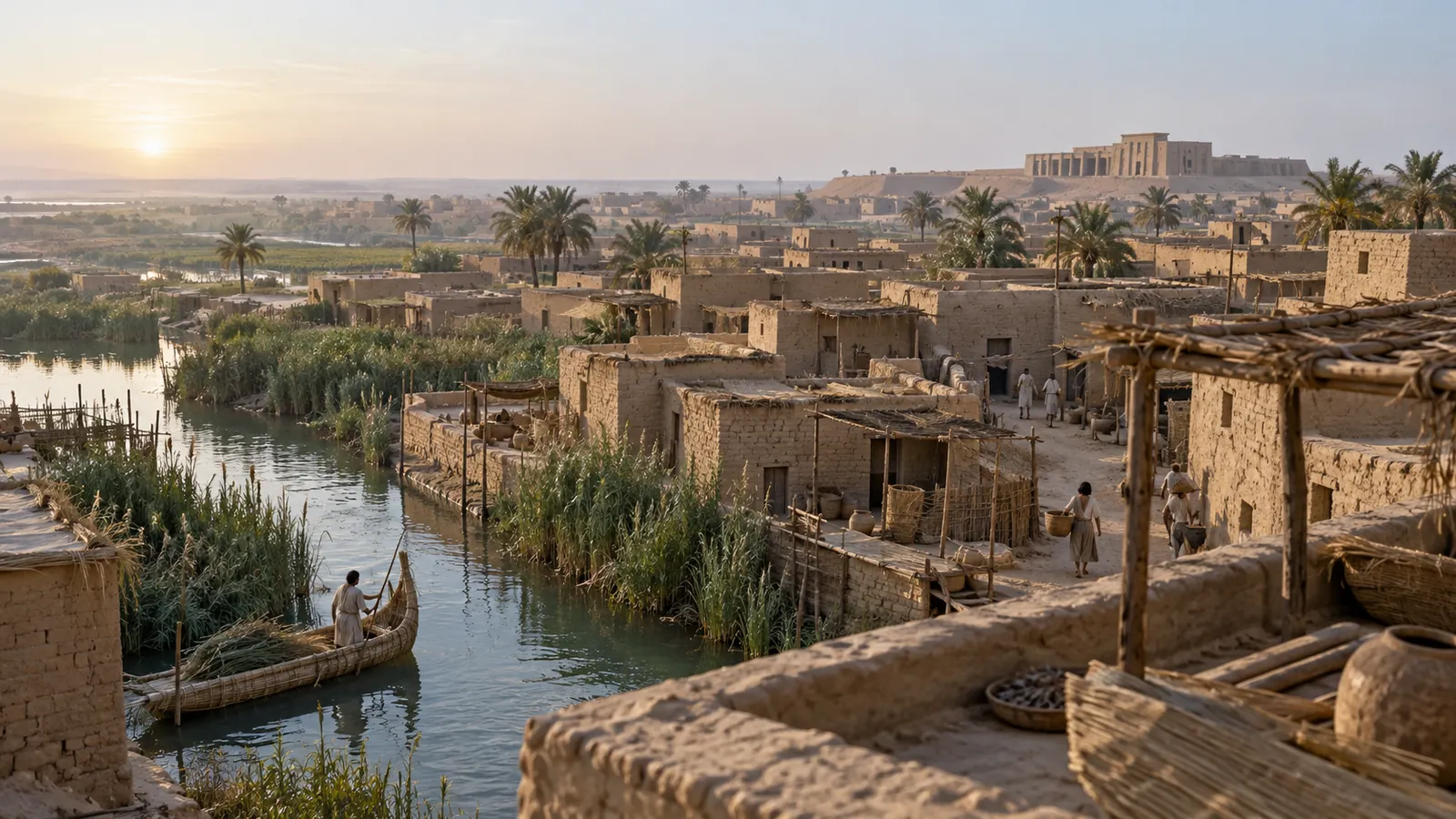
The archaeological site is called Warka today. Its dry surroundings can give the wrong impression of the early city. Uruk developed in a shifting river-and-marsh landscape; UNESCO identifies former waterways, canal beds and depressions left by wetlands as part of the evidence for that setting. 3
Water connected several parts of the economy. It supported cultivated land and wetland resources, while boats carried people and materials. A field outside the built-up settlement could matter as much to urban life as a room inside it.
What the surrounding land could provide
The southern lowlands offered a combination of useful resources: 4
- Fields and gardens: grain and other crops to feed a population concentrated in settlements.
- Rivers and marshes: fish, birds and reeds, as well as routes for water transport.
- Mud and clay: material for buildings, vessels and, eventually, written records.
Those resources were unevenly distributed. Local abundance did not include every kind of timber, metal or stone that craftspeople might want. Connections beyond the immediate landscape therefore mattered too. We will follow them more closely in the chapter on trade. 4
For now, keep the edge of the city open in your mind. Uruk’s buildings depended on activities spread across a much larger area.
PLACE & TIME
Find Uruk—and look beyond it
Uruk / Warka
Southern Mesopotamia · Present-day Iraq
c. 3500–3000 BCE
Main period explored
What made Uruk a city?
Size is one part of the answer. Archaeologist Jason Ur’s review places Uruk at approximately 250 hectares by 3100 BCE—about 2.5 square kilometres. That is an estimate of the settlement’s extent, not an ancient census or proof that every part was equally densely occupied. 5
The stronger case comes from several kinds of evidence together:
| Look for… | What it adds to the picture |
|---|---|
| A large settlement | Many people and activities concentrated in one place |
| Monumental building complexes | Work and materials assembled on a scale beyond an ordinary dwelling |
| Specialised production and administrative records | Different tasks, skills and ways of coordinating goods |
Uruk brings these features together unusually early. Its archaeological record includes large central buildings, changing pottery production and thousands of early tablets and sealings. 5
This also explains why a city cannot be understood simply by counting houses. You need to know what people did there, and how those activities connected.
THREE USEFUL TERMS
From the city centre to its surroundings
Hinterland
The area around a settlement that supplied it and exchanged goods with it. For Uruk, the story continues beyond the buildings.
Monumental
Built on an unusually large or imposing scale. It describes architecture; it does not, by itself, identify who commissioned a building.
Precinct
A distinct area within a larger site. Eanna is one of Uruk’s best-known precincts, with buildings repeatedly altered over time.
Building a skyline from earth
The White Temple: height took repeated work
In the western part of the centre, the building known as the White Temple stood on the raised terrace usually called the Anu Ziggurat. The terrace was enlarged and raised repeatedly, reaching about 12 metres in height. Its successive alterations produced an irregular outline and a complex approach by stairs. 6
The temple’s name comes from its white-plastered walls. A central hall, adjoining spaces and stairways survive in the archaeological record. Whether parts of the building rose to a second storey is a reconstruction question: the team that visualised it for the Uruk exhibition developed both one-storey and two-storey versions. 6
That distinction lets you picture the building without pretending that its entire appearance is settled. The substantial raised foundation is evidence; a completed roofline in a digital view is a reconstruction.
Eanna: building with more than mudbrick
The area called Eanna contained a changing sequence of large buildings. Earth was fundamental to construction, but the builders also worked with other materials. The so-called Limestone Temple had a base of carefully laid limestone slabs; its upper structure is thought to have been built in mudbrick. Its plan measured roughly 30 by 76 metres or more. 7
A project like that involved more than laying one wall after another. Even without a surviving work schedule, the structure lets us distinguish several necessary tasks:
- Obtain and move materials to the building site.
- Prepare the foundations and walls in the required positions.
- Coordinate different kinds of work, including masonry and surface finishes.
- Maintain or replace the building as the complex changed.
These tasks are inferred from construction itself. Moving large stone slabs and finishing a patterned façade called for different skills, brought together in one project.
A façade assembled one piece at a time
The cone mosaics from the opening belong to this architectural world. Their exposed ends produced geometric patterns across surfaces, including projecting elements and niches. Clay and stone both served in this form of decoration. The small unit—the cone—became part of a much larger composition. 1
The result demanded consistency: individual pieces had to work together as a pattern. Decoration is therefore evidence of making and arranging, as well as something to admire.
Were all these monumental buildings temples? The German Archaeological Institute notes that the balance between religious and representative or administrative functions in the early complexes remains debated. Their familiar archaeological names should not settle that question for us. 8
Follow the work beyond the monuments
A city needed vessels as well as impressive walls. Uruk-period pottery included wheel-made wares and coarse bowls formed in moulds—different approaches to making useful containers. They form part of the evidence for changes in craft production. 5
Written evidence adds another perspective. An early list from Uruk distinguished officials and specialist occupations, including potters and metalworkers. It is a glimpse of how activities were named and ordered, rather than a complete directory of the city’s inhabitants. 9
Choose a task below to see a different part of urban life. The point is to follow what each task needed from other people.
FOLLOW THE WORK
Which task would you follow?
A pot, a piece of cloth and a written entry reveal different connections between people. Choose one to trace the work behind it.
Choose a task. Then compare what it needs from others.
Make a vessel
- The work
- Uruk-period potters used different techniques, including the wheel and moulds for coarse bowls.
- Depends on
- Raw material, shaping skills and firing. Making a container and supplying its contents were different tasks.
- What it reveals
- A finished vessel connects skilled production with the people who stored, served or moved goods in it.
Different tasks, connected lives
No single craft explains a city. Together these activities connect materials, skills, supplies and information. The connections are the point.
An evidence-based comparison of activities, not a reconstructed day in a named worker’s life.
Read more: Holly Pittman, “Highlands and Lowlands” (see also sources 5 and 9)
When a job leaves a record
Early writing could keep selected information available after an activity had ended. Goods and quantities could be entered into a durable record, rather than depending entirely on the people who remembered them. 9
Consider the difference between these questions:
- What arrived? Identify the kind of goods.
- How much? Record an amount using a convention that another reader understands.
- What does this entry refer to? Keep the quantity connected to the right category.
Recording and reading were related skills: a mark had to mean something to someone besides its maker.
In his study of Uruk’s communication technologies, Hans Nissen places writing within a longer development of ways to store and process information. It was part of urban change, not an isolated invention that suddenly created a city. 10
One place, several very different cityscapes
Uruk continued to be rebuilt long after the period explored here. That creates a trap for anyone looking at a photograph or reconstruction: the most prominent surviving structure may belong to a much later city.
Keep these three moments separate:
| Period | Buildings and why the date matters |
|---|---|
| c. 3500–3000 BCE | Early monumental complexes and the White Temple: the main architectural world explored here. 6, 8 |
| Early 3rd millennium BCE | The earliest city-wall phase identified in the DAI’s 2019 investigations: later than a view around 3200 BCE. 11 |
| 21st century BCE | Ur-Namma’s Eanna ziggurat, whose mudbrick core survives: much later than the early city. 8 |
CHECK THE CITYSCAPE
Does this photograph show the earliest city?
This Eanna ziggurat belongs in a view of Uruk around 3200 BCE.
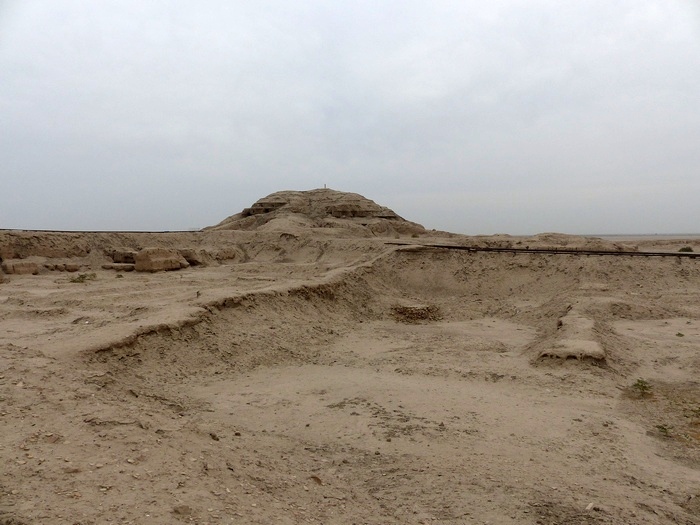
- Visible
- Surviving earth-built remains and excavated ground.
- Established by excavation
- The surviving ziggurat core is associated with Ur-Namma’s later building project.
- Not visible
- A photograph alone cannot date its brickwork or recover the fourth-millennium skyline.
Verdict: wrong period
Ur-Namma’s Eanna ziggurat belongs to the twenty-first century BCE—over a thousand years later.
Dating: German Archaeological Institute · Uruk results · Photograph: Marjon Verburg / CC0. Image source: reference 13.
Where are the people who lived here?
Monumental centres are easier to describe than a representative household. That imbalance partly reflects the history of research.
Nissen, who worked at Uruk, called the earlier excavation an “architect’s dig”. He describes meticulous attention to buildings alongside much weaker recording of some other finds. His account is a participant’s critical assessment, but it identifies a practical problem: a fine architectural plan does not automatically provide an equally detailed picture of daily life. 12
Research also reaches beyond the monumental centre. In 2019, the Warka Environs Survey used aerial and satellite imagery followed by field investigation to document features including waterways, irrigation, small settlements and installations around Uruk. Those traces belong to different periods and must be dated before they can enter a picture of the early city. 11
For a fuller view, three questions belong beside any impressive building:
- Where did its materials and supplies come from?
- What other activities made its construction and use possible?
- Which people and places remain poorly represented in the surviving evidence?
These questions bring the surroundings and less visible work back into the story. They also stop a single monumental precinct from standing in for everyone who lived in Uruk.
Was Uruk really the world’s first city?
Uruk is central to the history of urban life, but “first” needs a definition. Its size, architecture, production and administrative evidence make it one of the earliest major cities. Urban development was not confined to this one place: Jason Ur’s review also discusses a substantial fourth-millennium centre at Tell Brak in northern Mesopotamia. 5
For this Story Path, the useful question is what Uruk helps us understand. A city brought different kinds of work into sustained contact. Farmers, craftspeople, builders and record-keepers did not need to perform the same tasks; they needed arrangements through which the results of those tasks could reach other people.
Uruk’s great achievement was more than building on a larger scale. It was keeping many different activities working together.
The next chapter turns from the place to one of those activities: how early writing made information usable beyond a single encounter. The buildings bring us to the city. The records begin to show how parts of it were managed.