Mud, reeds and grain helped sustain the cities of southern Mesopotamia. They did not supply everything a metalworker, a jeweller or a ruler might want. Copper and deep-blue lapis lazuli had to come from beyond the lowland landscape. Woollen cloth offered something different: a product that people could make and send out.
Ancient Mesopotamian trade becomes easier to understand when we compare these goods. What was needed? What work changed the material? And what evidence survives? Those questions connect a metal tool, a blue bead and a piece of cloth without pretending they all travelled together or were exchanged in one transaction.
PLACE & TIME
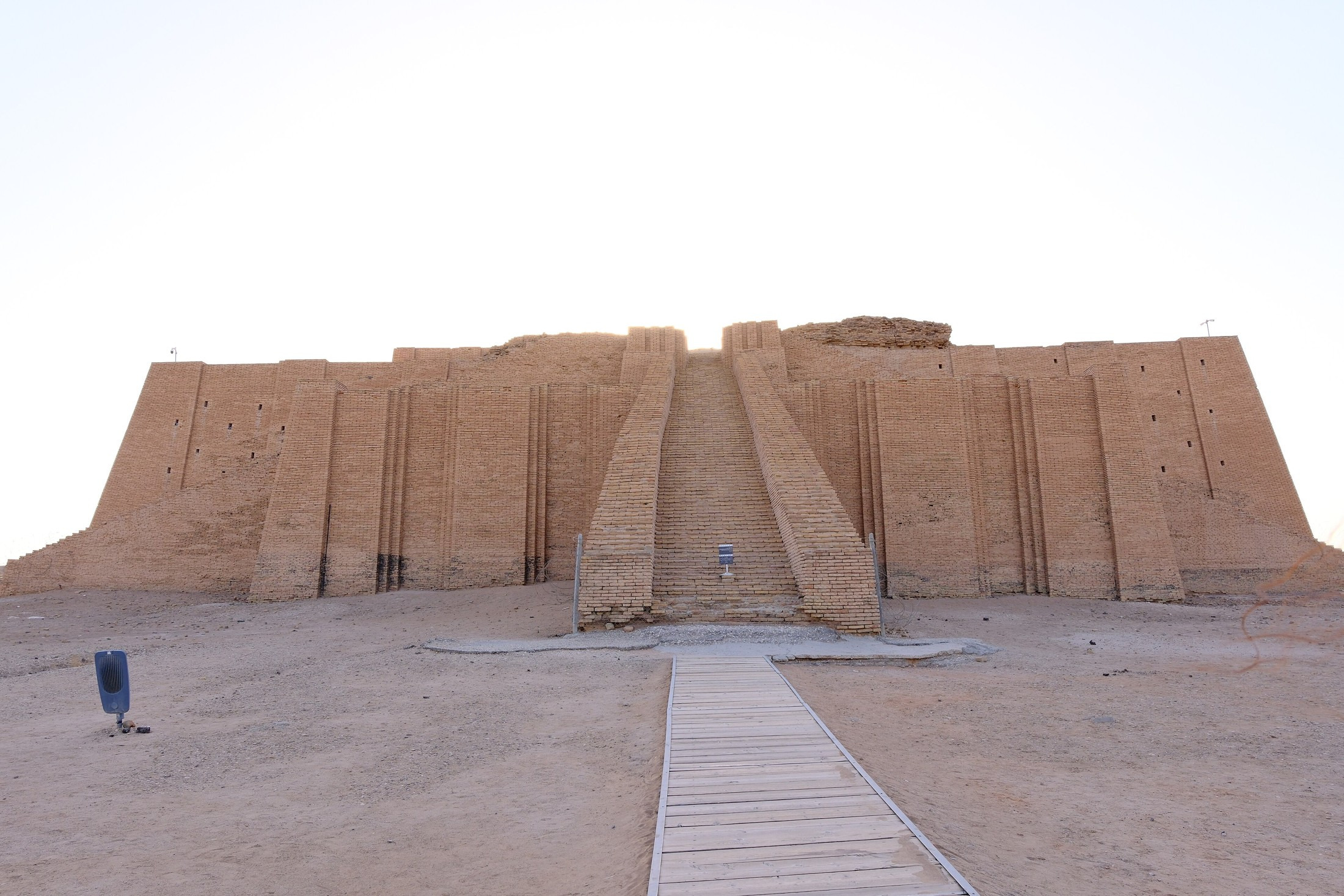
Start at Ur, then look beyond the lowlands
Ur / Tell al-Muqayyar
Southern Mesopotamia · Connections to the Gulf and Iran
c. 2600–2000 BCE
Approximate period covered
Three goods, three reasons to exchange
The lowlands were rich in useful resources. Crop-growing land, livestock, waterways and local building materials gave people ways to feed themselves, build and manufacture goods. The missing materials were specific: metal ores and hard, colourful stones were not products of the southern alluvium. Holly Pittman’s regional overview places these differences at the centre of exchange with the surrounding highlands.
| Compare the same question | Copper | Lapis lazuli | Woollen cloth |
|---|---|---|---|
| What was wanted? | Metal for tools and other objects | Blue stone for beads, seals and inlay | A manufactured textile of a particular quality |
| Where did the supply begin? | Ore-bearing regions, including Oman and Iran | Especially Badakhshan, in present-day Afghanistan | Sheep and textile production in Mesopotamia |
| What changed it? | Smelting and metalworking | Cutting, shaping, drilling and polishing | Preparing fibre, spinning and weaving |
| What best reveals the work? | Objects, production remains and scientific analysis | Finished objects, tools and workshop waste | Administrative records and textile research |
| What is easy to miss? | A metal object may have been recycled or reworked | The material source is not a complete itinerary | Much of the cloth itself has disappeared |
These are broad contrasts across the article’s period. They are not a price list, a record of one cargo or a claim that copper was always practical and lapis always ceremonial. The point is to distinguish imported material from a manufactured product—and then follow the different work each required.
Copper: the imported material that could become a tool
A metalworker needed more than a supply of food. Copper-bearing ore had to be extracted and processed before the metal could be shaped into useful objects. The sources lay outside the southern lowlands, including areas of Iran and the Oman Peninsula, connected to Mesopotamia through wider networks of movement and exchange.
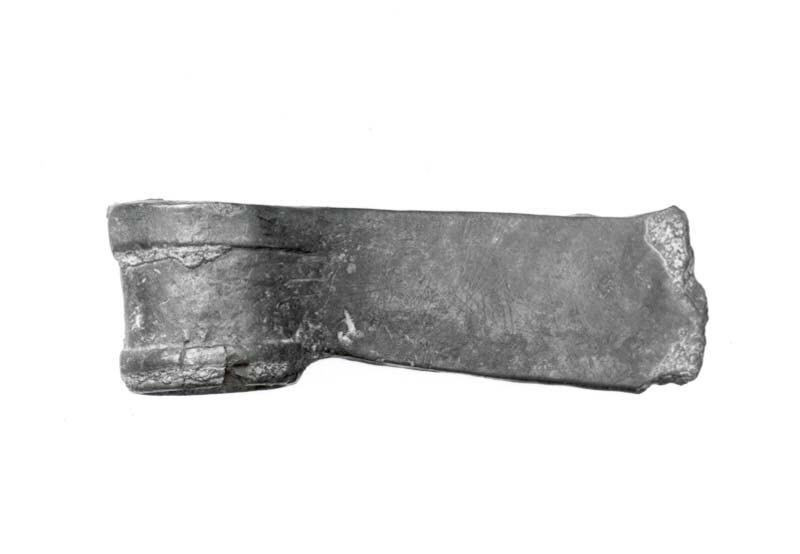
The axe head pictured here is catalogued by the Met as bronze, a copper alloy. It makes a useful distinction visible: a finished metal object is already several stages removed from ore. Its shape tells us about manufacture and use; its catalogue entry does not name the mine that supplied its metal.
A chemical signature can narrow the source
Begemann and colleagues compared lead-isotope data and chemical composition to define a signature for Omani copper. Their study found that signature among Mesopotamian objects from several periods, including Early Dynastic and Akkadian contexts. This supports a real connection with Omani sources, beyond merely placing two regions on a map.
The study’s abstract also identifies exceptions in the Gulf evidence pointing towards another possible source region. Copper supply therefore should not be reduced to a single line from one mine to one city. A likely geological origin and the people who transported or exchanged the metal are different questions.
TERMS TO KEEP
Material, manufacture and movement
Smelting
Extracting metal from ore using heat and the appropriate chemical conditions. It happens before the metal is made into a finished object.
Copper alloy
A material containing copper combined with other elements. A catalogue label such as bronze should not be silently changed to pure copper.
Intermediary
A person or community that helps goods pass between others. Material can travel a long way without one trader completing the whole journey.
Lapis: the stone’s journey also involved skilled work
Lapis lazuli offered something copper did not: a distinctive blue material suited to small, carefully worked objects. The Met’s beads from Ur, dated around 2600–2500 BCE, combine lapis with gold. Their catalogue links the lapis to Badakhshan in present-day Afghanistan. That identifies a distant source region, not every stage of these particular beads’ journey.
The space between quarry and finished bead matters. At Shahr-i Sokhta in eastern Iran, Tosi and Piperno reported lapis-working waste, broken or unfinished beads, and small stone tools associated with manufacture. Lapis powder still adhering to some tools helped connect them to the work. This is evidence for processing, rather than simply finding a finished imported object.
Their 1973 excavation account explored the possibility that some lapis travelled onwards as partly processed material. Removing unwanted material could reduce the weight being carried. That is a practical reason for work to occur along a network, instead of concentrating every stage at the quarry or final destination. It does not prove that the Met’s beads passed through this particular workshop.
What can the beads actually prove?
SOURCE CHECK
A distant material is not a complete travel record
These beads show that a merchant from Ur travelled all the way to an Afghan quarry.
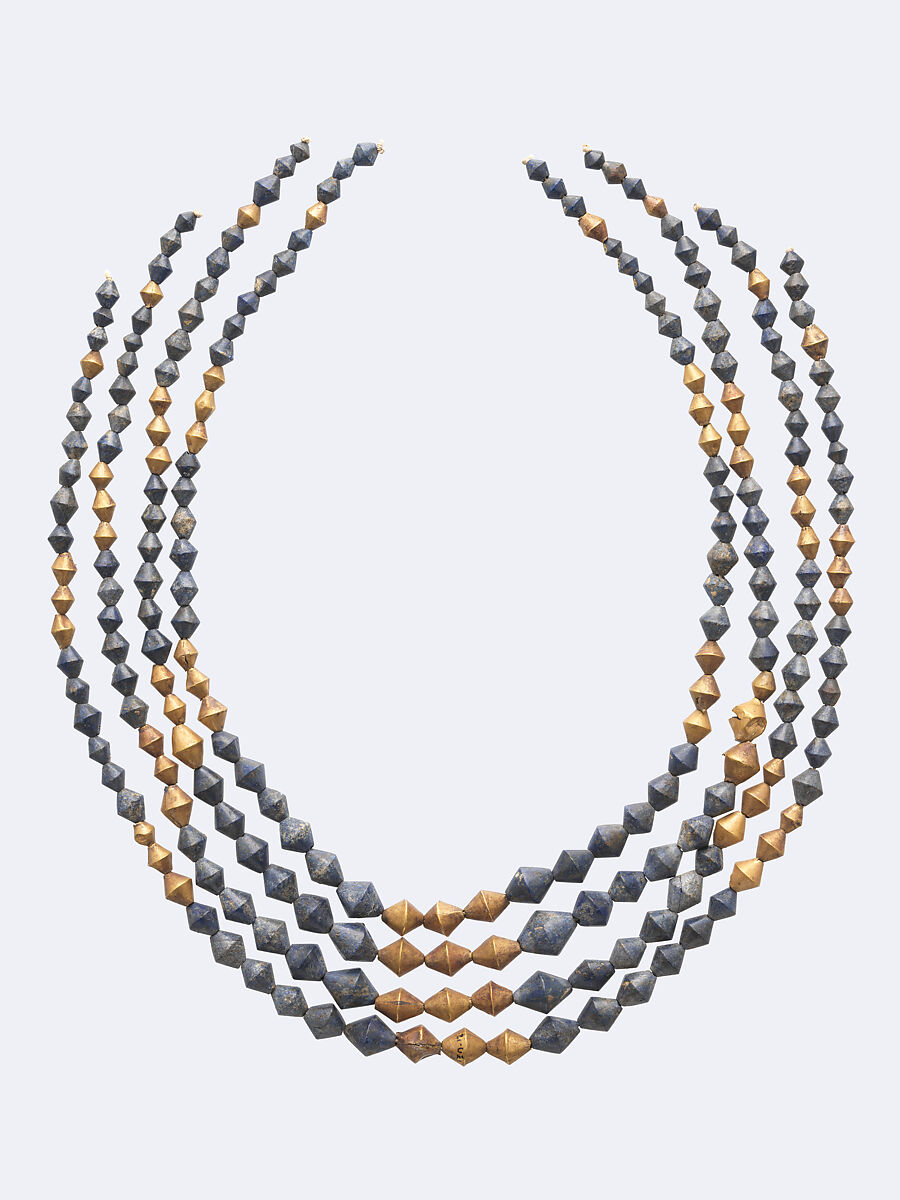
- What the object shows
- Worked gold and lapis beads from Ur, surviving as a museum assemblage. Their manufacture and materials are real evidence.
- What it supports
- People at Ur could obtain material from far beyond the southern lowlands. The catalogue identifies Badakhshan as the lapis source region.
- What remains unknown
- The individual carriers, intermediate exchanges, payment and exact route of these beads are not recorded by the object itself. It also does not show what an ordinary household owned.
Verdict
The beads support long-distance connections. They do not identify a merchant or establish a direct journey to the quarry.
Check the catalogue record The Met: Necklace beads, 33.35.48 · The Metropolitan Museum of Art, Dodge Fund, 1933. Public domain.
The Royal Cemetery provides extraordinary evidence of concentrated wealth. The Met’s cemetery overview distinguishes its elaborate tombs from the many simpler burials. Precious objects reveal what some people could acquire and display; they do not give us a representative basket of everyday possessions.
Cloth: the city could export work as well as material
Now reverse the direction. Imported metal and stone explain what Mesopotamian cities sought elsewhere. Cloth helps explain what they could offer. Wool from sheep became yarn, and yarn became textiles through preparation, spinning and weaving. Pittman describes cloth of different qualities entering exchange for both useful raw materials and prized goods.
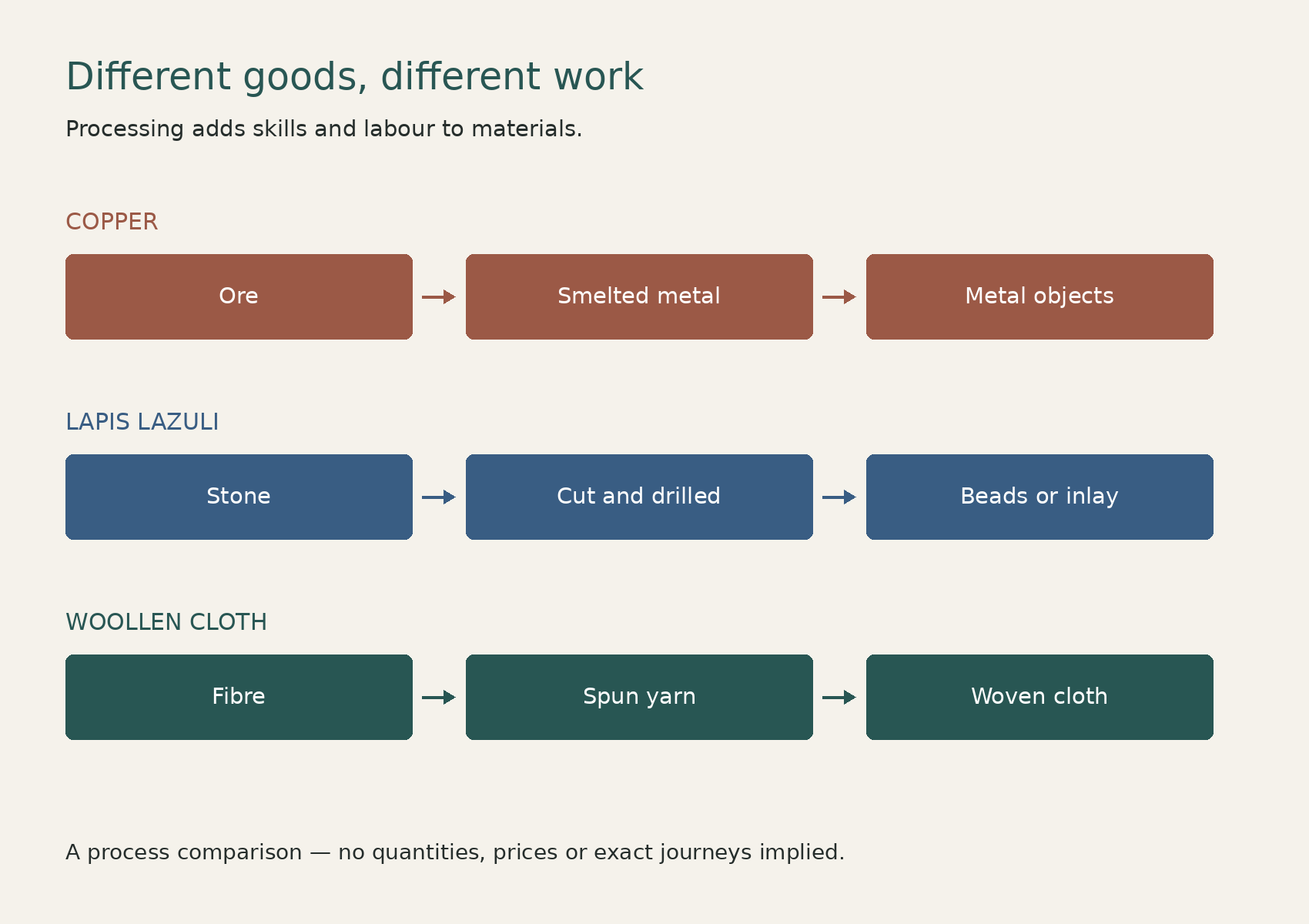
The transformation was not a single task. Firth and Nosch’s study of Ur III textile records distinguishes wool quality, yarn for the warp and weft, and the resulting fabrics. Warp threads form the lengthwise structure of a weave; weft threads cross them. Choosing and making those threads affected the finished product.
One cloth, different kinds of spinning
A Girsu text, ITT V 9996, describes work on a particular guz-za fabric. In Firth and Nosch’s interpretation, its strongly twisted warp yarn was assigned a spinning rate of about 8.3 grams per woman per day, compared with about 62.5 grams for its weft yarn. The quantities differ because the yarns and tasks differ. They are not a universal measure of an ancient spinner’s speed.
The researchers combine textual information with modern spinning experiments to investigate what the fabric could have been like. The experiments help interpret the records; they are not measurements taken in an ancient workshop. This late-third-millennium example makes the larger point concrete: “cloth” could embody several kinds of work and quality decisions before it was ready to be used or exchanged.
Textile production also required support for the people doing that work. Pittman describes workers sustained by institutional ration systems. Sending cloth out therefore connected exchange to the city’s livestock, labour and food supply. A textile was useful to a recipient, while its manufacture drew on arrangements much closer to home.
The surviving evidence is uneven
Put an account beside an object and the contrast becomes clearer. The tablet below records quantities of copper knives issued to individuals at Nippur. It tells us something a surviving knife alone cannot: the object was part of a documented allocation. Yet the tablet is not an overseas purchase contract. It does not identify the original ore source or name the people who carried it into Mesopotamia.
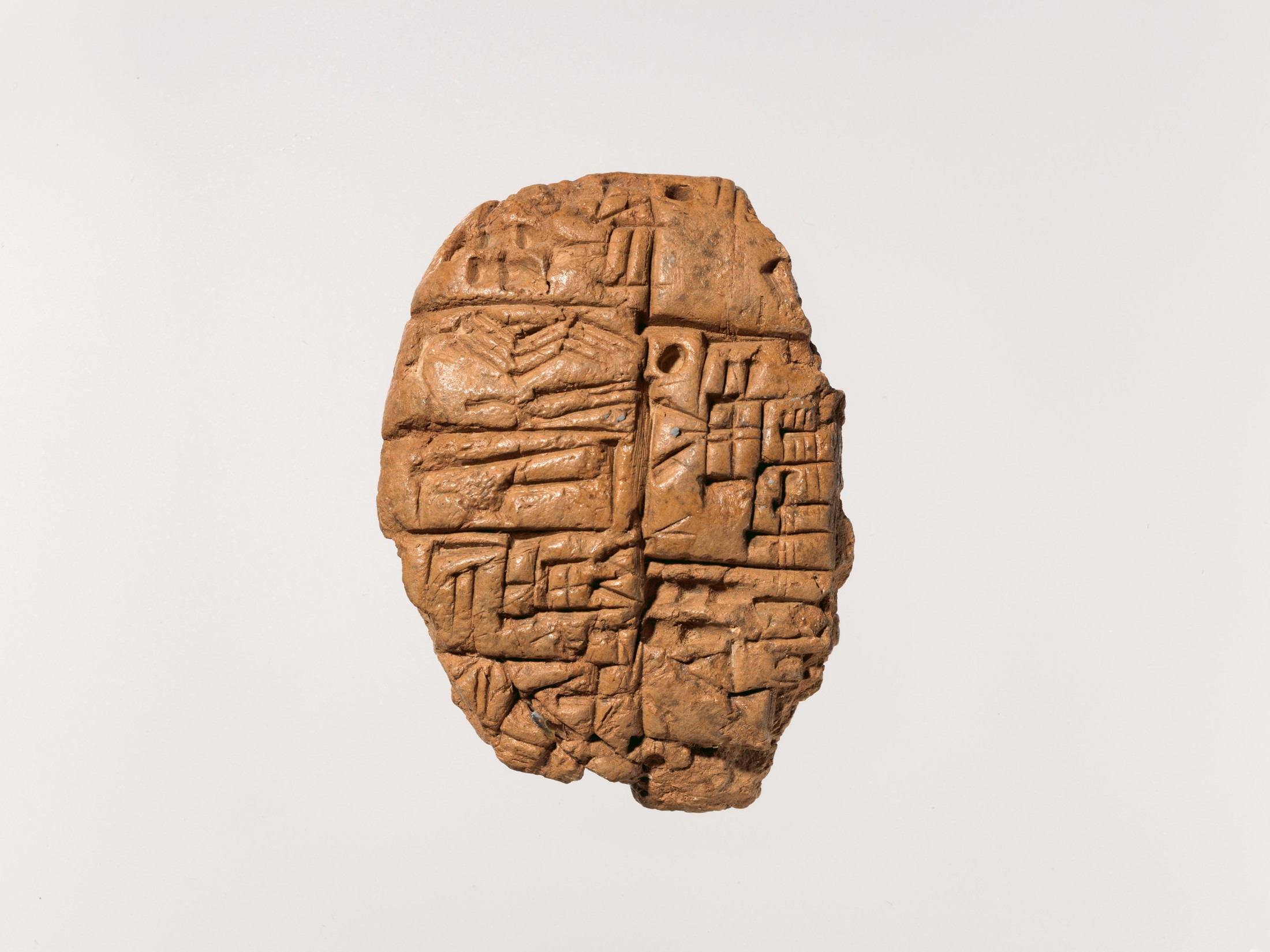
The evidence for cloth often starts at the other end: an administrative text describes fibre or work, while the fabric itself is missing. Metal can be reworked; stone-working can leave waste; organic yarn can disappear. A museum display rich in blue beads and metal objects can consequently make those goods look more representative than the surviving evidence justifies.
| Evidence you have | Question it can help answer | Another question still needs evidence |
|---|---|---|
| A finished object | What material and craft reached this place? | How did it change hands? |
| Workshop waste and tools | Where was a material processed? | Where did every finished item go? |
| A work or distribution record | What task or allocation was recorded? | Was this item subsequently exported? |
| A scientific material signature | Which source region fits the material? | Who transported it, and through which stops? |
Long-distance trade did not mean one uninterrupted journey
A distant source and a local findspot are endpoints. Between them could lie extraction, processing, storage, transport and several transfers. Overland connections and Gulf shipping both mattered in the wider regional picture. The title’s “copper in, cloth out” describes complementary roles, not a single paired shipment or a fixed exchange rate.
The comparison spans roughly 2600–2000 BCE. The beads belong near its earlier end; the Ur III textile records belong near its later end. Political arrangements and connections changed during those centuries. The goods help us compare recurring needs and work without freezing the whole period into one trading system.
A city could be productive and still depend on others
Copper, lapis and cloth reveal three different relationships. Copper connected access to ore with metalworking. Lapis connected prized colour with distant geology and specialised processing. Cloth connected local livestock and organised work with goods other communities could use.
That is why the lack of particular raw materials did not make the lowland cities helpless. Their own resources and skills supplied things worth exchanging. Trade joined different kinds of production, not simply rich suppliers and empty-handed buyers.
The next question is about access within the city. Who could organise this work, claim these resources or display the most costly objects? Comparing wealth with evidence for authority will take us into the next chapter of the First Cities story.